




Search
Related News
- 00
0000-00
Animal Nutrition Premix: How to Choose a Formula for Livestock - 00
0000-00
USDA Cuts US Corn Output and Stocks, Raises Soybean Yield in November WASDE - 00
0000-00
Choosing Dairy Farm Systems: Milking, Feeding, and Herd Management - 00
0000-00
Rabobank: Climate Change and Heat Stress Threaten European Dairy Competitiveness - 00
0000-00
Planning Feeder and Drinker Layouts in a 1,000-Broiler House
Choosing Greenhouse Side Vents: Ventilation Area and Controls




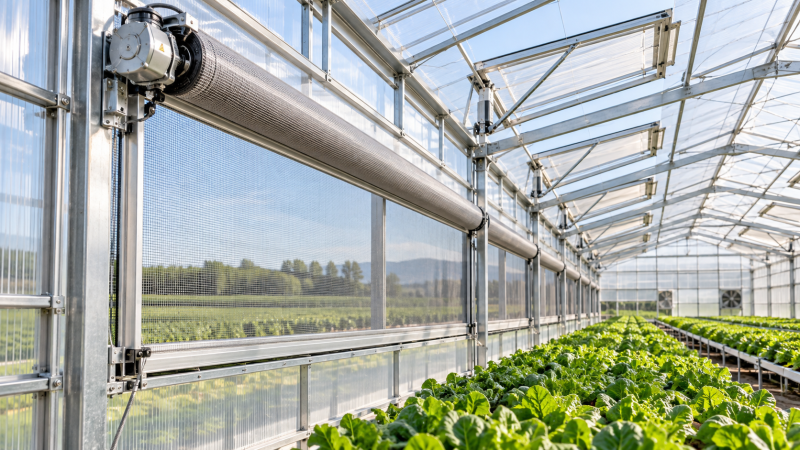
When a greenhouse overheats even with its side vents open, the problem is not necessarily the motor or the thermostat. The openings may be too small after screening is fitted, the airflow may be blocked by a dense crop, or there may be no effective outlet higher in the structure. Select a side vent by assessing its usable opening area and airflow path first, then choose controls that can operate that opening reliably under local weather conditions.
A practical comparison starts with the crop’s acceptable temperature and humidity range, the greenhouse geometry, and the cooling load. From there, assess the free area of each proposed vent, its interaction with roof openings or mechanical cooling, and its response to wind, rain, and equipment faults. A large nominal opening is of limited value if screens, hardware, or control settings prevent it from delivering useful airflow.
Start with the airflow path, not the advertised opening
Side vents admit or exhaust air depending on wind direction and pressure. Warm air can also rise and leave through higher openings, drawing replacement air through lower vents. Neither mechanism is constant: wind shifts, external air temperature changes, and adjacent structures can alter pressure around the greenhouse.
For a naturally ventilated structure, identify where air is expected to enter and where it can leave. Side openings paired with roof vents can support a low-to-high flow path, but the balance depends on opening sizes, roof geometry, and weather. Side-only ventilation may be workable in some layouts; in a wide or densely planted house, however, air may not reach the center effectively. An evaluator should ask for a ventilation assessment specific to the building rather than assume that two open sidewalls guarantee uniform conditions.
Natural ventilation also has a cooling limit. It exchanges indoor air with outdoor air; it cannot reliably maintain a greenhouse below outdoor air temperature without an additional cooling mechanism. High humidity outside can likewise restrict the drying effect of ventilation. If the crop’s required climate cannot be met during critical weather periods, compare the side vent design with options such as forced ventilation or evaporative cooling, considering their local operating constraints.
Calculate the area that air can actually use
Suppliers may describe vent capacity using opening length, curtain height, structural aperture, or another nominal dimension. These figures are not interchangeable. Establish a common basis before comparing offers:
- Measure the structural opening. Use the clear dimensions available between framing members, excluding portions that cannot open.
- Determine the open position. A roll-up curtain may expose a different area from a hinged panel at its maximum permitted angle. Check the actual clear opening, not simply the panel’s surface area.
- Account for obstructions. Mullions, drive components, braces, and overlapping materials can reduce the unobstructed passage.
- Assess the screen separately. Record the screen’s open-area characteristics and pressure-loss information, where available. A geometric free-area percentage alone does not fully describe airflow resistance.
- Compare inlet and outlet capacity. Identify whether another opening or a restricted internal passage limits the complete airflow route.
For a simple rectangular opening, the gross area is its clear length multiplied by its clear height. If a house has two side openings, calculate each side separately and add them only when the design comparison calls for total opening area. Do not automatically treat the sum as the effective inlet area: under a given wind direction, one side may act mainly as an inlet and the other as an outlet.
Expressing opening area as a proportion of floor area can help compare designs of different sizes, but the ratio is a screening metric, not proof of cooling performance. The same ratio can produce different conditions in a narrow house and a wide multispan structure. Ask whether the calculation includes roof vents, whether it refers to gross or clear area, and whether screens are included. Without those definitions, two percentages may describe very different installations.
Screening changes the ventilation decision
Insect screens can reduce pest entry, but they also add resistance to airflow. Finer mesh may be appropriate for the pests being excluded while making passive ventilation less effective. Compare screen specifications against the target pest, expected fouling, cleaning access, and the available opening area. Where possible, request pressure-drop data at relevant air velocities and test the proposed combination of screen and vent, rather than assessing either component in isolation.
Dust, algae, and debris can increase resistance during operation. Allow access for inspection and cleaning without damaging the mesh or compromising the seal around its perimeter. A larger screened opening may offset some resistance, but its performance still depends on the pressure driving airflow; a simple area correction cannot predict conditions across every wind speed.
Match the vent mechanism to the structure
The appropriate greenhouse ventilation equipment side vent depends on the wall construction, exposure, crop layout, and maintenance access. The following comparison highlights the trade-offs that should appear in a technical specification.
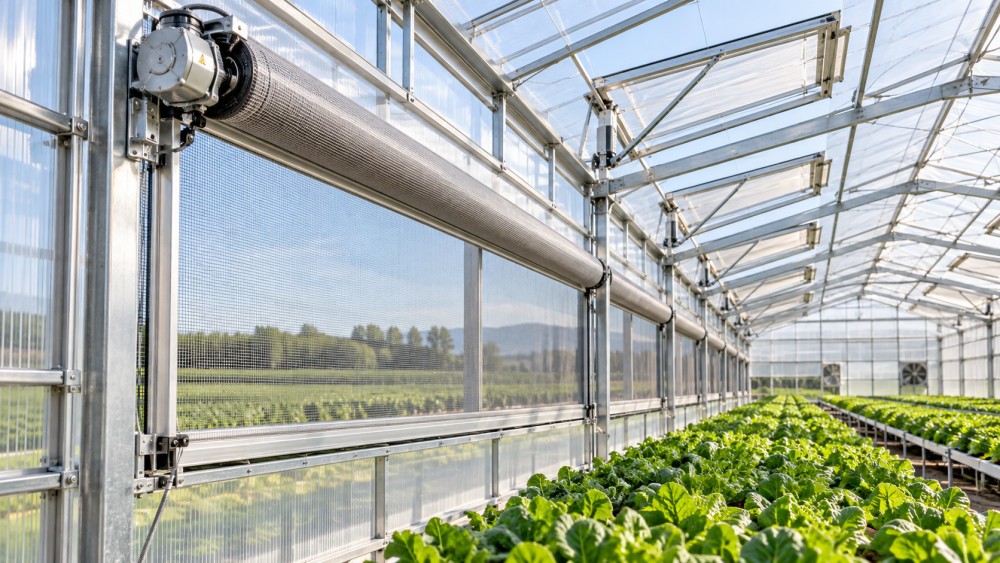
A continuous curtain can offer a broad opening, but long runs need suitable support and a drive sized for the load. Uneven rolling can leave gaps when closed or strain the mechanism. Hinged panels provide a more defined opening geometry, although their effective area depends on the opening angle and surrounding frame. In either arrangement, ask for dimensions and operating limits with the screen installed, not just the bare mechanism.
Wind exposure deserves particular attention. A vent that opens fully in sheltered conditions may need a lower maximum position during strong winds. Check the manufacturer’s permitted operating envelope, anchoring requirements, and wind response strategy for the actual site. The closed assembly must also resist weather while allowing the drive to stop correctly at both travel limits.
Choose controls around operating risk
Manual operation can be reasonable for a small or intermittently used structure when an operator can respond promptly and the crop tolerates short fluctuations. Its weakness is not necessarily poor equipment; it is the time between a weather change and a person adjusting the opening. Consider weekends, rapid solar gain, rain, and wind shifts when judging whether manual control is realistic.
Motorized vents reduce that dependence, but automation is only as useful as its sensors, settings, and failure behavior. A basic temperature controller may open and close a vent at defined thresholds. A staged or proportional controller can adjust opening position more gradually, which may reduce abrupt temperature swings when properly configured. More complex coordination can include humidity, outdoor temperature, wind, rain, heating, roof vents, and fans.
Specify the control sequence before selecting the actuator. At minimum, establish the following:
- The temperature measurement location and the opening and closing thresholds, including a deadband to prevent repeated cycling.
- Whether the actuator supports intermediate positions, how position is determined, and what happens if the controller loses that information.
- Wind and rain overrides, their priority over crop-temperature commands, and the conditions for returning to normal operation.
- Coordination with heating and mechanical ventilation so systems do not work against each other unnecessarily.
- Alarm, manual override, and power-loss behavior, including whether a safe position can actually be reached without backup power.
Sensor placement can determine whether an otherwise capable system responds appropriately. A temperature sensor exposed to direct radiation, located against a warm wall, or placed outside the crop zone may not represent the air affecting plants. Use a suitable shield and location, then compare readings with conditions at other relevant points in the house. A single sensor may be inadequate where exposure or crop density varies substantially across zones.
Humidity control requires care as well. Opening vents can help remove moisture when the incoming air has lower absolute moisture content, but relative humidity alone does not establish that. Cold incoming air may also create crop stress or increase heating demand. The control sequence should therefore consider both temperature and moisture conditions, not simply open whenever indoor relative humidity exceeds a setpoint.
Evaluate the complete installation before approval
Request drawings showing clear openings, screens, drive locations, limit switches, wiring routes, and service access. Confirm compatibility with the greenhouse frame and covering, including how the vent interface will be sealed. For a retrofit, check whether gutters, posts, benches, irrigation lines, or crop supports obstruct the proposed travel or airflow path.
Compare actuator torque and duty requirements with the actual vent size and loading, including friction, screen arrangement, and exposure. Obtain the allowable travel range and cycle limitations, together with the method for setting and checking limit positions. If several vents share one drive, establish whether a jam in one section can affect the others and how the fault will be detected.
Commissioning should verify the sequence rather than merely demonstrate that the motor runs. Exercise the vent through its permitted range, confirm limit stops and manual override, and simulate sensor or power faults where safe to do so. Check that wind and rain commands take priority as intended, and record the as-installed settings. After the crop is established, compare temperatures and humidity across the growing area; differences may reveal an obstructed airflow path or a control zone that needs adjustment.
For final comparison, favor the proposal that documents usable opening area, screen resistance, operating limits, and control behavior under both normal and adverse conditions. Where a design relies heavily on natural ventilation to protect a temperature-sensitive crop, request a site-specific engineering assessment of the expected airflow and cooling capacity before treating the opening-area ratio as sufficient.