




Search
Related News
- 00
0000-00
How to Select Agricultural Irrigation Solutions for Water-Limited Farms - 00
0000-00
How to Select Food Plant Sanitation Equipment for High-Risk Processing Areas - 00
0000-00
Selecting Meat Packaging Technology to Extend Shelf Life and Control Leakage - 00
0000-00
Selecting Secondary Dairy Packaging Systems for Hygienic, High-Speed Distribution - 00
0000-00
How to Design Greenhouse Irrigation Zones for Uniform Watering and Lower Waste
Integrated Pest Management vs Routine Spraying: Which Works Better?




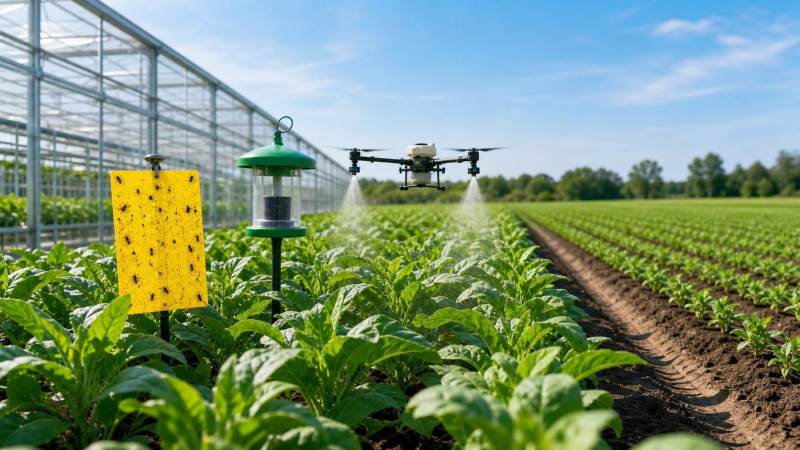
Choosing between integrated pest management and routine spraying is no longer a simple debate about whether to spray more or less. In modern crop systems, the better approach is the one that protects yield, limits resistance, supports compliance, and fits real operating conditions. That is why integrated pest management is drawing stronger attention across greenhouses, open-field production, protected cultivation, and broader agri-food supply chains.
Routine spraying can still appear efficient on paper. It is familiar, easy to schedule, and often built into standard farm practice. Yet technical evaluation increasingly looks beyond short-term knockdown. Questions now center on pest pressure trends, residue exposure, biological balance, labor efficiency, and how control decisions affect downstream food safety and market access.
What the comparison really involves
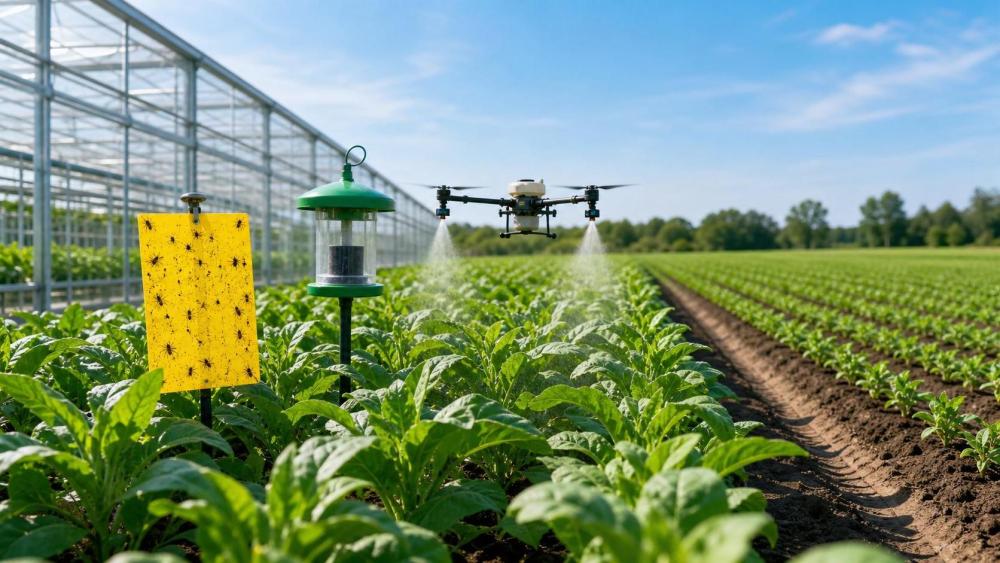
The comparison is not chemical control versus no control. It is a comparison between two management logics.
Routine spraying relies on repeated, calendar-based applications. Treatments are often applied before monitoring confirms an economic or operational threshold.
Integrated pest management uses monitoring, thresholds, prevention, environmental control, biological tools, and selective intervention. Spraying may still be used, but it is one tool inside a broader control system.
In practice, integrated pest management asks a more useful question: what combination of actions keeps pest pressure below damaging levels with the lowest long-term disruption?
Why this matters more across the agri-food chain
The issue matters because pest control is no longer isolated at the farm gate. Crop protection decisions now influence procurement risk, residue management, processing consistency, certification readiness, and supply reliability.
In greenhouse vegetables, berries, herbs, and high-value ornamentals, a routine spraying program may suppress visible outbreaks while quietly increasing resistance pressure. Once efficacy drops, recovery costs rise quickly.
In food-oriented production systems, frequent broad-spectrum spraying can also complicate residue compliance, harvest timing, and buyer specifications. That becomes a business issue, not only an agronomic one.
This is especially relevant to AFBN’s operating context, where agriculture, bioscience, food processing, cold-chain planning, and supplier benchmarking are closely connected. Pest strategy affects more than crop health. It affects system performance.
Where routine spraying still performs well
Routine spraying is not automatically the wrong choice. Under some conditions, it can deliver fast and predictable results.
- High pest pressure with immediate crop loss risk
- Limited scouting capacity or poor field visibility
- Short crop cycles with narrow intervention windows
- Emergency suppression during a severe outbreak
The strength of routine spraying is operational simplicity. Teams know the schedule, products are standardized, and response speed can be high.
The weakness is that simplicity often masks hidden cost. Unnecessary applications, natural enemy disruption, resistance development, and repeating the same chemistry can gradually reduce control quality.
Why integrated pest management often works better over time
Integrated pest management generally performs better when the goal is stable control over multiple production cycles. It is designed to reduce dependence on any single intervention.
Its first advantage is earlier detection. Monitoring tools, scouting routines, traps, and environmental records reveal pressure before damage becomes visible at scale.
Its second advantage is targeted action. Instead of treating every area the same way, integrated pest management supports location-specific and pest-specific decisions.
Its third advantage is resistance management. Rotating modes of action, reducing unnecessary exposure, and preserving biological control agents extends the useful life of available products.
This matters in controlled-environment farming, where whiteflies, thrips, mites, aphids, and fungal vectors can adapt quickly. Once resistance builds, even premium inputs may underperform.
A practical performance view
Typical settings where the answer changes
The better option depends on crop type, facility design, pest biology, and market requirements. There is no universal answer without context.
Greenhouses and vertical farms
These systems are often the strongest fit for integrated pest management. Climate control, exclusion measures, scouting access, and biological release programs create conditions for precision control.
Because crops are intensive and continuous, routine spraying can quickly create resistance and disrupt beneficial organisms. The operational penalty becomes visible fast.
Open-field and broad-acre crops
Routine spraying may seem easier where large acreage limits close monitoring. Even so, integrated pest management remains relevant through threshold-based scouting, resistant varieties, trap crops, and smarter spray timing.
The goal is not to eliminate spraying. It is to improve when, where, and why applications happen.
High-spec food supply programs
Where produce enters demanding retail, export, or processing chains, integrated pest management often offers better alignment with traceability, residue expectations, and audit documentation.
That makes it valuable not only agronomically, but commercially.
How to evaluate which approach works better
A useful assessment should compare systems, not just spray bills. The most informative review usually includes the points below.
- Outbreak frequency over multiple crop cycles
- Pest identification accuracy and scouting reliability
- Mode-of-action rotation discipline
- Compatibility with beneficial insects or biological inputs
- Residue, re-entry, and pre-harvest interval constraints
- Labor demand for monitoring versus repeated blanket application
- Crop loss variability and quality consistency
This broader view aligns with how AFBN frames technology comparison. A control method should be judged by operational effect across production, compliance, and downstream handling, not by one season’s chemical cost alone.
Common misconceptions that distort decisions
One common misconception is that integrated pest management is slower and softer. In reality, it can include decisive chemical intervention when thresholds require it.
Another misconception is that routine spraying is more predictable. It may feel predictable because the schedule is fixed, but fixed schedules often ignore changing pest dynamics.
A third misconception is that integrated pest management is suitable only for premium crops. As digital monitoring, sensors, and decision support tools improve, its logic becomes practical across larger and more diverse systems.
What to do next in a real evaluation process
For most operations, the best next step is not an immediate switch to zero spraying. It is a structured review of where routine applications are essential, where they are habitual, and where integrated pest management can improve control quality.
Start with one crop, one facility, or one recurring pest problem. Compare threshold records, spray frequency, efficacy decline, residue pressure, and crop quality outcomes.
Then examine whether better scouting, biological tools, exclusion practices, climate adjustment, or selective chemistry could reduce total intervention without increasing risk.
In most modern production environments, integrated pest management works better when the objective is durable performance rather than repeated reaction. The most reliable decision comes from benchmarking pest control as part of the full production system, from crop health to final market requirements.