




Search
Related News
- 00
0000-00
How to Select Agricultural Irrigation Solutions for Water-Limited Farms - 00
0000-00
How to Select Food Plant Sanitation Equipment for High-Risk Processing Areas - 00
0000-00
Selecting Meat Packaging Technology to Extend Shelf Life and Control Leakage - 00
0000-00
Selecting Secondary Dairy Packaging Systems for Hygienic, High-Speed Distribution - 00
0000-00
How to Design Greenhouse Irrigation Zones for Uniform Watering and Lower Waste
Is Vertical Farming Viable in Hot Climate Regions?




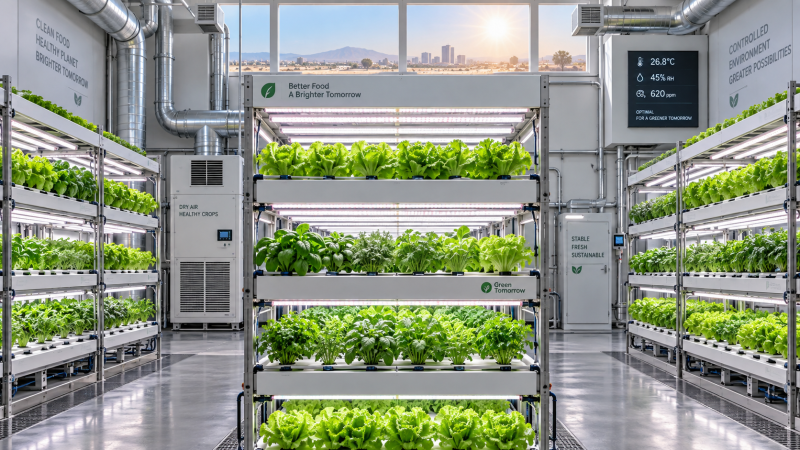
Vertical farming can be commercially viable in hot climate regions, but only when the facility is designed around heat management, power use, crop value, and distribution conditions from the start. A productive crop room alone does not prove viability. In locations where outdoor temperatures remain high for long periods, every watt of lighting, pump energy, and equipment heat becomes part of the cooling burden. The business case therefore rests on whether stable, high-quality output can justify the combined cost of electricity, cooling, labor, packaging, and local delivery.
Hot climates create a difficult but understandable operating environment. They often bring strong solar radiation, high daytime temperatures, warm nights, dust, humidity swings, and seasonal pressure on electrical grids. These conditions affect a fully enclosed farm differently from an open field or greenhouse. The growing area is insulated from direct sunlight, yet the building envelope, loading areas, water rooms, and mechanical spaces still absorb heat. Cooling equipment must remove both outdoor heat gain and the heat generated inside by LED fixtures, dehumidification equipment, fans, pumps, and people.
Heat changes the economics before it changes the crop
Leafy greens, herbs, microgreens, and young plant production are often the first crop categories considered for vertical systems because they have relatively short growing cycles, compact forms, and a need for consistent quality. In a hot region, however, a crop with good biological performance can still be unprofitable if the climate system must work continuously at high load.
The useful question is not whether a room can be cooled to a target air temperature. Modern equipment can achieve that under many conditions. The more meaningful question is whether the facility can maintain temperature, humidity, airflow, nutrient solution temperature, and carbon dioxide levels without pushing energy consumption beyond the value generated by each kilogram of saleable crop.
Cooling demand rises when the building has poor insulation, frequent door opening, unconditioned service corridors, undersized condensers, or poorly separated wet and dry zones. It also rises when lighting schedules are selected only for crop growth rather than for the local power profile. Running lights during cooler night hours may reduce refrigeration load, but the result depends on electricity tariffs, grid reliability, labor patterns, and the ability of harvest and packing operations to work around the revised cycle.
Warm nights deserve particular attention. A site with intense daytime heat but cooler evenings can operate differently from one where external temperatures remain elevated around the clock. Night cooling is often assumed to provide recovery time for the mechanical system. When night temperatures stay high, compressors, condensers, and air-handling equipment have less opportunity to operate under favorable conditions. This affects annual operating cost, maintenance intervals, and the required capacity reserve.
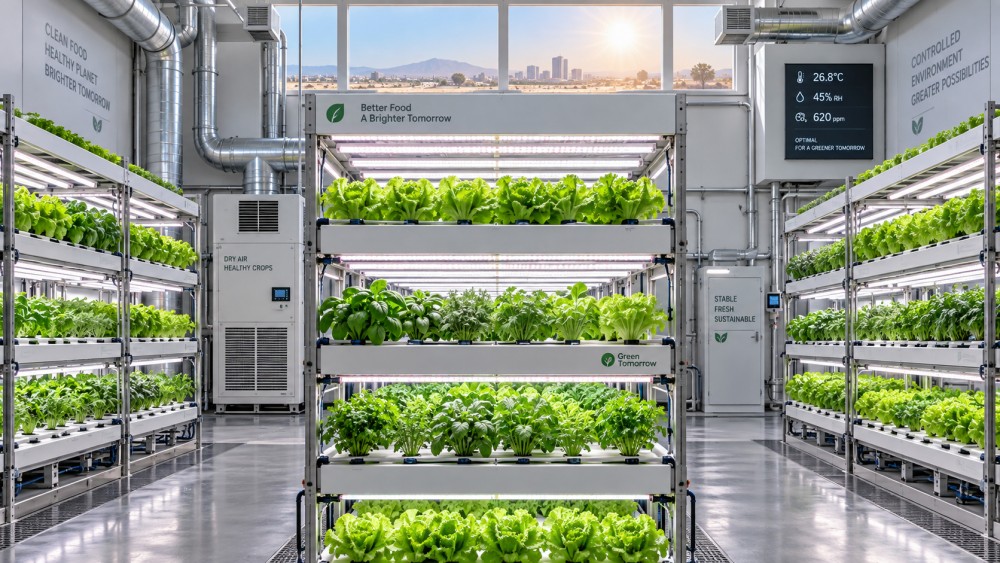
Cooling, humidity, and lighting must be assessed together
A common planning error is to treat cooling as a separate utility line. In vertical farming, thermal and moisture balances are closely linked. Plants transpire moisture into the room, while cooling coils remove sensible heat and can also condense water. If dehumidification is insufficient, humidity rises, transpiration becomes less predictable, and disease pressure can increase. If drying is too aggressive, plants may experience water stress even when the nutrient solution is correctly prepared.
Lighting further complicates the balance. LEDs are more efficient than older lighting technologies, but the energy not converted into plant-usable light becomes heat within the growing environment. Increasing light intensity may shorten a crop cycle or improve biomass, yet it can also demand more cooling and dehumidification. The highest possible light level is rarely the most commercial setting. A lower fixture output, better light uniformity, carefully chosen photoperiod, and crop-specific spacing can produce more reliable economics than simply maximizing photons at canopy level.
Crop recipes should be tested against the actual facility rather than copied from a temperate-climate installation. Air temperature near the return grille is not the same as leaf temperature at the edge of a rack. Dense multi-layer systems can develop warm zones, low-airflow pockets, or humidity gradients between shelves. These conditions often appear first as uneven growth, tip burn, weak roots, condensation near channels, or inconsistent harvest weights. They should not automatically be blamed on seed quality or nutrient formulation.
Water efficiency is valuable, but it does not remove the energy problem
Recirculating hydroponic systems can use water efficiently because runoff and evaporation are controlled within the facility. This is meaningful in water-constrained regions, especially where outdoor cultivation requires substantial irrigation and quality water is limited. Yet water savings should not be treated as a substitute for a complete economic model. Water still requires filtration, disinfection where appropriate, dosing, circulation, temperature control, testing, and periodic system cleaning.
The source water profile has a direct effect on system design. High salinity, variable hardness, suspended solids, or microbial contamination can change filtration needs and influence nutrient management. Reverse osmosis can produce a more controlled starting water source, but it creates energy use, membrane maintenance, reject-water handling, and a requirement for careful remineralization. A facility that assumes all available water can enter a recirculating system without treatment may later face unstable electrical conductivity, emitter blockage, mineral precipitation, or uneven crop response.
Nutrient solution temperature is particularly easy to overlook in hot regions. A reservoir located near a warm mechanical room, roof exposure, or exterior wall can gain heat even when the crop room seems well controlled. Warm solution carries less dissolved oxygen and can place pressure on root health. Insulated tanks, shaded pipe runs, separated utility rooms, appropriate circulation design, and continuous monitoring reduce the risk of discovering the issue only after crop uniformity declines.
Building design has more influence than many equipment comparisons
The enclosure is part of the production system. Wall assemblies, roof construction, vapor control layers, insulated doors, floor detailing, penetrations, and loading interfaces all affect operating stability. In a hot, dusty environment, a high-performance cooling system can be undermined by frequent infiltration through receiving doors or poorly sealed cable and pipe penetrations. In a humid coastal climate, condensation control and corrosion resistance become equally important.
Materials should be selected for washdown, moisture exposure, cleaning chemicals, and the local atmosphere. Corrosion around coils, fasteners, electrical enclosures, rack joints, and drainage points can become a recurring maintenance cost when salt-laden air or high humidity is present. Drainage must remove condensate and wash water without creating stagnant zones beneath racks or near utility walls. A surface that is easy to clean on a drawing may be difficult to access once plumbing, electrical trays, and crop channels are installed.
Mechanical equipment needs physical space for service. Condensers placed where they recirculate hot exhaust air, filters installed without access clearance, and pumps located beneath fixed racks create avoidable downtime. During procurement, capacity figures should be reviewed alongside maintenance access, spare-parts availability, controls compatibility, and actual site conditions. Nominal cooling capacity at a favorable test condition is not the same as available performance during the hottest operating period.
Crop choice determines whether the controlled environment is being used well
High-volume commodity crops are difficult to justify in a fully enclosed vertical farm when electricity and cooling are expensive. The production system adds the most value where consistent quality, short shelf life, local freshness, clean handling, predictable supply, or specific crop characteristics support a premium relative to field-grown alternatives. This does not require exotic crops, but it does require a realistic match between crop value and operating intensity.
Leafy greens and herbs are often suitable because quality can deteriorate quickly after harvest and uniformity matters to foodservice, retail, and processing applications. Seedling production can also be relevant where protected propagation reduces weather-related variability before plants move to another cultivation system. Fruiting crops usually impose more challenging economics in vertical arrangements because they need greater light input, longer occupancy of the growing area, trellising, pollination management, and more complex labor. Their feasibility should be calculated from room occupancy and usable harvest output, rather than from yield per plant alone.
Packaging and distribution are part of crop value. If a farm is built close to demand but has no reliable cold holding, clean packing workflow, or rapid delivery route, the advantage of local production can be lost after harvest. Conversely, a short route and stable demand can reduce the need for long storage periods and help preserve the quality created in the controlled environment.
Power reliability and operating discipline are not secondary details
In hot climates, an interruption in power can become a crop-loss event quickly because the room accumulates heat while fans, irrigation, monitoring, and cooling stop. Backup generation, battery-supported controls, alarms, emergency ventilation strategy, and restart procedures must reflect the likely duration and frequency of interruptions. Backup power sized only for office loads or selected pumps will not protect a densely planted room during a prolonged outage.
Controls should record conditions by room and, where needed, by rack zone. A single sensor near the wall may indicate that the room is within setpoint while plants in the center layers experience weaker airflow or higher humidity. Trend records are useful when they connect environmental events to crop observations: harvest variation, root color, disease incidence, irrigation timing, and packout quality. Without that connection, teams can collect extensive data without identifying the condition that is actually driving inconsistency.
Maintenance also needs to be planned around the climate load. Dirty condenser surfaces, clogged filters, failing fans, drifting sensors, and blocked drains tend to have a larger production effect when there is little thermal margin. Cleaning schedules should account for dust levels and seasonal conditions rather than relying on a generic calendar. Sensor calibration requires similar discipline; inaccurate humidity or nutrient readings can lead to corrective actions that make the underlying problem worse.
Commercial viability comes from a site-specific operating model
A credible feasibility assessment combines local weather patterns, electricity structure, water treatment needs, building heat gain, crop recipes, labor flow, packaging requirements, expected saleable yield, and distribution distance. Treating these as separate calculations produces false confidence. The interaction matters: a more insulated building may reduce cooling demand, a different lighting schedule may change both power cost and staffing needs, and a crop with a faster cycle may increase packing workload and cold-storage turnover.
Phased commissioning is often more reliable than immediately filling every rack. Early production should confirm air distribution, drainage behavior, reservoir temperature, lighting uniformity, sanitation access, and the time required for seeding, transplanting, harvesting, and cleaning. Full capacity is meaningful only when those routines remain stable across the hottest period, not merely during initial operation.
Vertical farming in hot regions is therefore viable under defined conditions rather than as a universal substitute for conventional agriculture. Projects with robust building envelopes, efficient heat rejection, disciplined humidity control, dependable power, suitable water treatment, crops matched to local value, and short routes to market have a stronger basis for stable operation. Where cooling energy is costly, infrastructure is unreliable, and the crop has little value beyond bulk volume, the same technology can produce attractive plants while failing to produce attractive economics.