




Search
Related News
- 00
0000-00
Animal Nutrition Premix: How to Choose a Formula for Livestock - 00
0000-00
USDA Cuts US Corn Output and Stocks, Raises Soybean Yield in November WASDE - 00
0000-00
Choosing Dairy Farm Systems: Milking, Feeding, and Herd Management - 00
0000-00
Rabobank: Climate Change and Heat Stress Threaten European Dairy Competitiveness - 00
0000-00
Planning Feeder and Drinker Layouts in a 1,000-Broiler House
Crispy Powder vs. Batter Mix: What Changes Fried Chicken Texture?




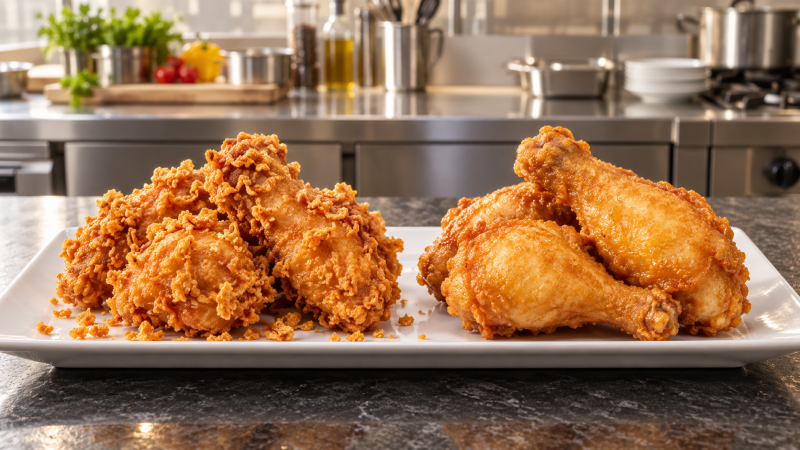
Texture Starts Before the Fryer
Fried chicken texture is often described with broad terms such as “crispy,” “crunchy,” “light,” or “craggy,” but those results come from a series of physical changes that begin well before the product enters hot oil. The choice between a dry crispy powder and a wet batter mix affects how much moisture reaches the surface, how the coating adheres, how quickly the crust sets, and whether the finished piece shatters cleanly or eats more like a continuous shell.
For food developers, restaurant operators, contract manufacturers, and ingredient buyers, the question is not simply which coating is crispier. A dry coating system and a batter-based system solve different production problems. One may suit a hand-breaded, irregular crust with visible flakes; the other may be better for a more uniform exterior, a smoother surface, or a process where coating pickup needs tighter control.
The most useful comparison is therefore based on the desired eating experience, the chicken cut, frying equipment, hold time, labor model, and moisture-management capability of the operation.
What “Crispy Powder” Usually Means in Practice
A crispy powder is generally a dry seasoning-and-coating blend applied directly to a moist chicken surface or after a light pre-dust and wetting step. Depending on the formulation, it may contain wheat flour, starches, leavening agents, salt, spices, sugar, protein ingredients, and coarse particles that create an uneven fried surface. Some processes also use a dry-wet-dry sequence: flour or predust, a liquid dip, then a final dry coating.
The dry outer layer absorbs some surface moisture from the chicken and forms a hydrated interface. Once fried, starch granules gelatinize, proteins set, water migrates outward as steam, and the coating dries into a porous crust. The degree of porosity strongly affects bite. A more open structure often produces a lighter crunch, while a denser coating can become hard, thick, or greasy if the frying profile is not matched to the formulation.
A dry coating is especially useful where the desired result includes visible ridges, flakes, or uneven clusters. Those irregularities increase surface area and create thin edges that fry rapidly. They can deliver an audible crackle at the point of service, but they also create more variation from piece to piece if moisture level, coating pressure, or dwell time is poorly controlled.
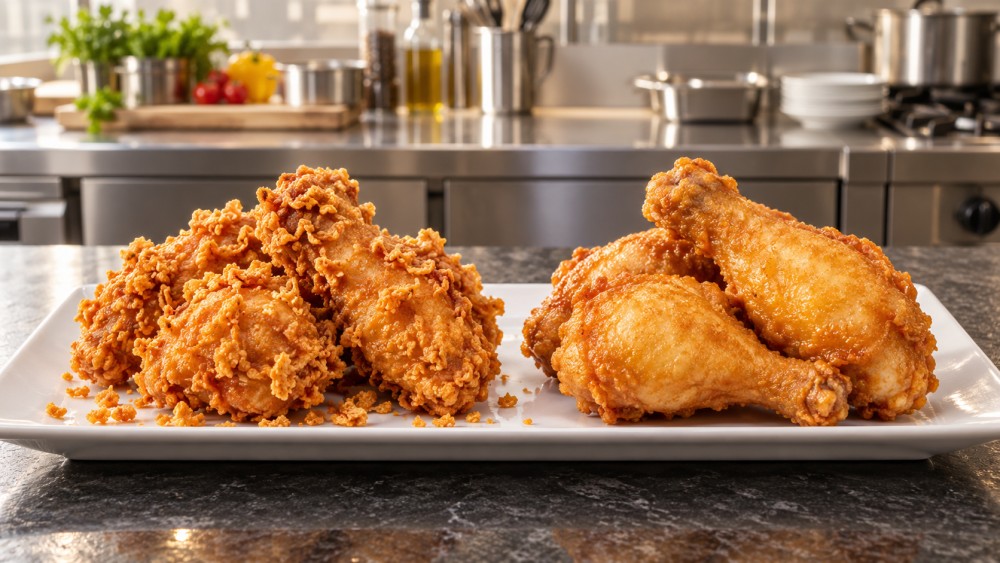
How Batter Mix Changes the Surface
Batter is a liquid suspension of flour, starch, seasonings, and sometimes functional ingredients dispersed in water or another liquid. It is normally applied by dipping, enrobing, or passing product through controlled coating equipment. Unlike a dry coating, batter creates a continuous wet film around the chicken before frying.
That film can provide reliable adhesion and coverage, particularly on smooth pieces, formed products, boneless portions, or products that will receive a secondary breading. As the battered chicken enters the fryer, the outer portion begins to set while steam expands beneath it. The resulting texture depends heavily on batter viscosity, solids content, starch selection, leavening, temperature, and the amount of time the coating has to dehydrate.
A thin batter may produce a delicate, relatively smooth crust. A thicker batter can create a more substantial shell, but excessive thickness may trap moisture, delay crust setting, or leave a pasty layer near the meat if the frying process is too short. Batter can also act as a useful intermediate adhesive layer for crumb or flour coatings, helping the next layer attach more evenly.
Why the Two Systems Feel Different When Eaten
The most important difference is not whether either coating contains flour or starch. It is how the ingredients are arranged around the chicken. A dry blend creates layers that hydrate from the product outward. Batter starts as a liquid layer and dries from the oil-contact surface inward. That difference changes steam movement, bubble formation, crust density, and the amount of oil that can remain in surface voids after frying.
In many commercial applications, the answer is a hybrid rather than a strict choice. A light batter may be used to improve adhesion, followed by a dry coating that supplies the desired rugged texture. The sequence can be adjusted for a thinner, more delicate finish or a heavier, craggier crust.
Ingredients That Influence Crunch More Than the Label
“Crispy” on a product description does not guarantee a particular result. Ingredient functionality and processing conditions matter more than the category name. Wheat flour, for example, can provide structure through gluten development, while starches can influence brittleness, expansion, and moisture control. Rice flour, corn starch, potato starch, tapioca starch, and modified starches may behave differently in the fryer because they gelatinize, swell, and set under different conditions.
Leavening agents can create gas cells that lighten the crust. Used carefully, they contribute to a more open bite. Used excessively, they may create an uneven, fragile coating or an alkaline flavor. Protein ingredients may support adhesion and browning, but they can also make a crust firmer. Sugar and reducing sugars affect color development, yet high sugar levels raise the risk of overly rapid darkening when oil temperature or fry time is not adjusted.
Particle size is another overlooked variable. Fine flour tends to make a closer, more even surface. Larger crumbs, flakes, or agglomerated particles create a more pronounced crunch but can detach during handling or break down in packaging. Seasoning distribution is also easier to judge on a dry coating line than in a liquid batter system, where suspended particles can settle if the batter is not mixed and circulated properly.
Applying a Crispy Powder Without Creating a Heavy or Patchy Crust
The application stage determines whether a dry coating becomes light and crisp or thick and uneven. Chicken that is excessively wet can turn the first layer into paste, creating dense spots and weak adhesion. Chicken that is too dry may not retain enough powder, leaving exposed areas that cook and brown differently from coated areas.
For a basic dry-coating process, operators commonly evaluate the following sequence:
- Surface preparation: Remove excess purge or marinade from the chicken without drying the product to the point that coating cannot adhere.
- Predust, if needed: Apply a fine dry layer to help manage surface moisture and provide an anchor for a later wet dip.
- Controlled wetting: Use water, a seasoned liquid, or batter only when the process requires stronger adhesion or a thicker final coating.
- Final dry application: Apply the powder with enough contact to form flakes, while avoiding aggressive compression that produces a compact, doughy layer.
- Short set period: Allow the coating to hydrate briefly before frying when the formulation and process call for it. Too little time can cause blow-off; too much can make the surface gummy.
When evaluating a fried chicken coating powder, buyers should look beyond flavor descriptions and ask how it is intended to be applied: direct dusting, dry-wet-dry breading, slurry-assisted coating, or industrial enrobing. A coating designed for one sequence may behave poorly in another. For example, a blend formulated to develop flakes after a liquid dip may not produce the same texture when applied straight onto marinated chicken.
Frying Conditions Can Override a Good Coating Formula
Even a well-designed coating cannot compensate for inconsistent oil management. If oil temperature falls sharply after loading, the coating may absorb more oil before the crust sets. If the oil is too hot, the exterior can brown before the thickest part of the chicken is safely cooked. Product load, piece size, fryer recovery rate, oil turnover, filtration practice, and moisture released from the chicken all affect the final crust.
Steam is central to fried texture. During frying, internal water moves toward the surface and escapes through the coating. A crisp crust is easiest to maintain when the surface has lost sufficient moisture and the product is served promptly. Once fried chicken is placed in tightly covered packaging or held in a humid cabinet, trapped steam can rehydrate the coating. Thin flakes soften especially fast, while thick coatings may shift from crisp to chewy.
Holding requirements should be defined before selecting a system. A chicken piece eaten immediately after frying can support a different coating design from a delivery product expected to remain packaged for an extended period. Ventilation, package geometry, portion size, and stacking all influence post-fry moisture retention. A coating that performs well at the fryer exit may not be the best match for transport or display holding.
Quality Checks for Product Development and Procurement
A practical trial should compare more than color and first-bite crunch. Teams can build a simple evaluation sheet covering coating pickup, adhesion after frying, visual coverage, breakage, oiliness, seasoning uniformity, crispness after a defined hold period, and texture after reheating where relevant. The test should use the same chicken cut, marinade level, fry load, oil condition, and packaging format for each coating being compared.
For dry ingredients, procurement review should also include lot consistency, declared allergens, shelf-life requirements, storage conditions, particle-size consistency, mixing instructions, and the supplier’s documentation for food safety and ingredient specifications. If a coating contains wheat, milk, egg, soy, or other regulated allergens, segregation and label-control procedures need to match the market where the final food is sold.
Ingredient specifications should state whether the blend is intended for raw poultry, pre-cooked products, frying, oven finishing, or air-fryer applications. These are not interchangeable processes. Oven and air-fryer systems provide less direct heat transfer than immersion frying, so a coating built for a deep fryer may not dry or brown in the same way without added oil or a reformulated binder system.
Food Safety Cannot Be Judged by Crust Color
Golden-brown coating is a visual quality cue, not a reliable indicator that poultry is cooked safely. The U.S. Department of Agriculture Food Safety and Inspection Service states that poultry should reach an internal temperature of 165°F (74°C), measured with a food thermometer in the thickest part of the product. The temperature check should avoid bone and should be built into production verification, especially when piece sizes vary or when a dark coating can mask underbrowning or overbrowning.
Cooling and holding controls matter as much as the frying step for operations preparing chicken ahead of service. The U.S. Food and Drug Administration Food Code identifies 41°F (5°C) or below as the cold-holding benchmark for time/temperature control for safety foods, subject to applicable local rules and operational procedures. Local regulations, customer specifications, and validated process plans may impose additional requirements.
Sources: U.S. Department of Agriculture, Food Safety and Inspection Service, “Safe Minimum Internal Temperature Chart”; U.S. Food and Drug Administration, Food Code, cold-holding provisions for time/temperature control for safety foods.
Choosing the Coating System Around the Finished Product
A dry crispy powder is usually the stronger starting point when the product brief calls for irregular flakes, a hand-breaded appearance, pronounced surface crunch, or visible seasoning distribution. It requires close control of chicken surface moisture and handling, but it can create a distinctive crust with relatively simple application equipment.
Batter mix is often more suitable where a smooth, continuous layer, predictable coverage, or strong adhesion is needed. It can also serve as a bridge between the chicken and a secondary dry layer. Its performance depends on viscosity management, proper agitation, drainage, and fry conditions that allow the batter to set without becoming heavy.
The preferred system should be selected against the real operating conditions: fresh or frozen chicken, marinated or unseasoned pieces, bone-in or boneless cuts, immediate service or packaged delivery, manual breading or automated lines. Texture is not created by a single ingredient. It is the combined result of coating architecture, moisture movement, frying control, and the time between fryer exit and the first bite.