




Search
Related News
- 00
0000-00
Animal Nutrition Premix: How to Choose a Formula for Livestock - 00
0000-00
USDA Cuts US Corn Output and Stocks, Raises Soybean Yield in November WASDE - 00
0000-00
Choosing Dairy Farm Systems: Milking, Feeding, and Herd Management - 00
0000-00
Rabobank: Climate Change and Heat Stress Threaten European Dairy Competitiveness - 00
0000-00
Planning Feeder and Drinker Layouts in a 1,000-Broiler House
Food Biotechnology Applications: From Fermentation to Food Ingredients




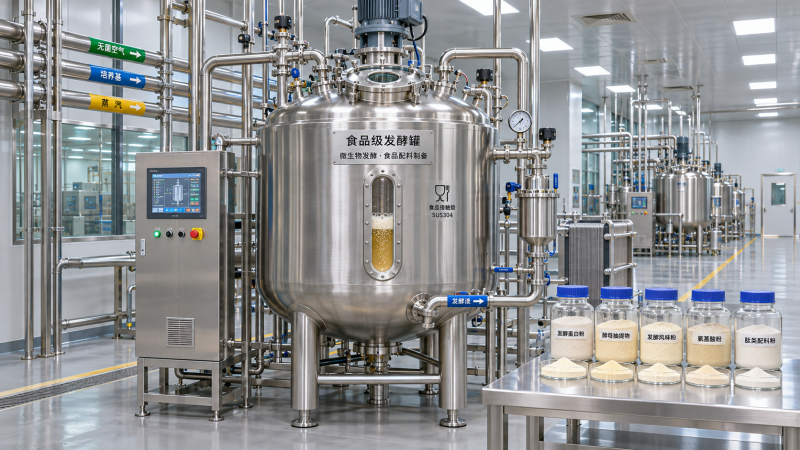
Food biotechnology applications are transforming how foods and ingredients are produced, processed, and evaluated. From traditional fermentation to microbial enzymes, probiotics, and alternative proteins, these technologies give food manufacturers different ways to manage consistency, develop ingredients, and respond to changing demand. Their commercial value, however, depends on more than the biology. The choice of raw material, processing conditions, safety controls, and intended market all shape whether an application works beyond the laboratory.
Where biotechnology fits in the food chain
Food biotechnology uses living organisms, cells, or biological components such as enzymes to make, modify, or assess food. Some applications are familiar: yeast helps bread rise, while lactic acid bacteria contribute to yogurt and many fermented vegetables. Others involve growing microorganisms in controlled vessels to produce proteins or other ingredients for use in food formulations.
These approaches do not all do the same job. A culture may transform milk into yogurt and remain in the finished product. An enzyme may be added during processing to change a carbohydrate or protein, with little or no intended activity in the final food. In precision fermentation, the microorganism is often a production system: the desired ingredient is recovered from the fermentation process and the production organism may not be present in the finished ingredient.
That distinction matters when assessing safety, labeling, processing requirements, and cost. It also prevents a common misunderstanding: a fermented food, a probiotic product, and an ingredient made by precision fermentation are not interchangeable categories.
Fermentation: an established process with new uses
Traditional fermentation relies on microorganisms to transform raw materials. In cheese, for example, cultures acidify milk and influence flavor and texture as the product develops. In bread, yeast generates gas that helps form the crumb. Depending on the food, microorganisms may be naturally present or added as selected starter cultures.
For an industrial producer, the attraction of a defined starter culture is greater control. A culture supplier can specify the organisms and their intended performance, allowing the manufacturer to build a process around predictable acidification or flavor development. But the culture is only one part of the system. Raw-material composition, temperature, hygiene, processing time, and competing microorganisms can all affect the outcome.
Consider a plant-based yogurt alternative. A culture selected for dairy may not perform the same way in an oat or soy base because the available nutrients and buffering properties differ. The manufacturer may need to adjust the substrate, select a different culture, or change the heat treatment. Even if acidification is satisfactory, the product still has to deliver an acceptable texture and flavor through its shelf life.
Fermentation can also influence preservation, including through acid formation or the production of other antimicrobial compounds. It is not a substitute for a validated food safety plan. The protection achieved depends on the organisms, the food matrix, processing, packaging, and storage conditions.
From fermentation vessel to food ingredient
Modern microbial fermentation can be used to make ingredients rather than a finished fermented food. In biomass fermentation, the microorganisms themselves are grown as a source of material, such as protein-rich fungal biomass. In precision fermentation, microorganisms are directed to produce a specific substance, which may then be separated and purified for use as an ingredient.
The distinction affects the factory design. If the cells are the product, the manufacturer must control their composition, texture, and suitability for consumption. If the target is a secreted protein or enzyme, downstream separation and purification may be central to the economics. In either case, the path from feedstock to packaged ingredient involves more than the fermentation vessel.
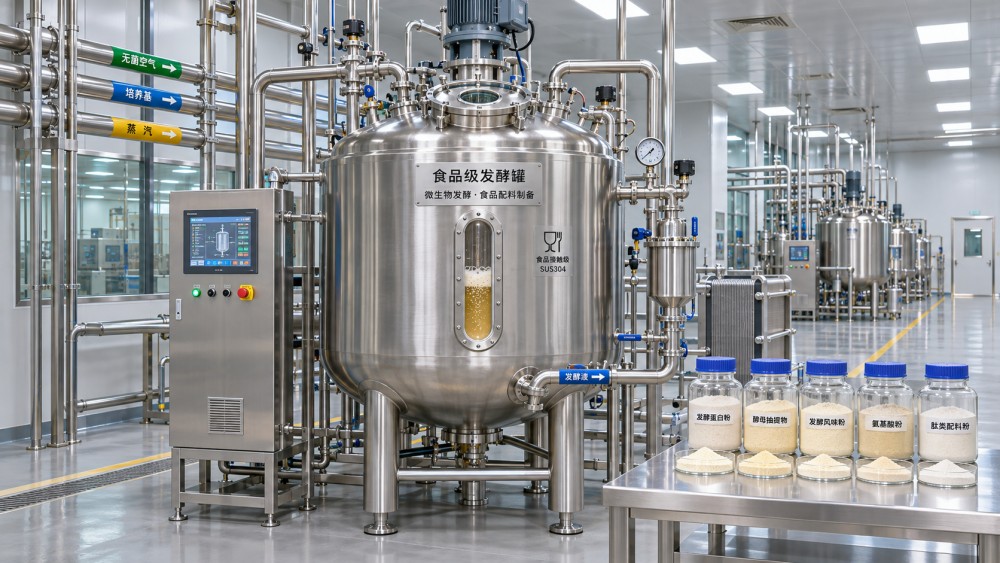
A typical production pathway includes preparation of the nutrient feedstock, cultivation under controlled conditions, recovery of the desired material, further processing, and quality testing. The exact steps depend on the organism and ingredient. A promising yield in a small vessel does not automatically translate to a viable large-scale process: oxygen transfer, heat removal, contamination control, and recovery can become harder as equipment size changes.
There is also a practical question about the ingredient’s job. A new protein may have an appealing nutritional profile, but a beverage producer may care equally about solubility, stability during heat treatment, and whether sediment forms during storage. For a bakery, water binding or browning behavior may matter more. A technical specification is useful only when it reflects the intended application.
Enzymes do work that may never be visible on the label
Enzymes are proteins that catalyze specific reactions. Food processors use them to modify raw materials, manage processing, or create desired product characteristics. Lactase, for example, breaks down lactose into simpler sugars and is used in the production of lactose-reduced dairy foods. Pectinases can help break down pectin during fruit processing, supporting juice extraction or clarification.
The value of an enzyme depends on the conditions under which it operates. Temperature, acidity, processing time, and the composition of the food all influence activity. More enzyme is not necessarily the answer if the process conditions are unsuitable or if excessive reaction changes flavor or texture. A manufacturer also needs to know whether the enzyme remains active after the intended processing step and whether that matters for product stability.
Food enzymes may be sourced from plants, animals, or microorganisms. Their regulatory treatment and declaration can depend on the jurisdiction, production method, and role in the finished product. A processing aid in one market should not automatically be assumed to receive identical treatment elsewhere.
Probiotics require more than a culture name
Not every microorganism used in fermentation is a probiotic. Probiotics are live microorganisms that, when administered in adequate amounts, confer a health benefit on the host. That definition makes the distinction clear: a food may contain live cultures without having evidence to support a specific probiotic claim.
For product development, identification at the strain level matters because evidence associated with one strain should not automatically be applied to another. The amount consumed, the population studied, and the claimed effect also matter. A supplier’s general description of a bacterial species is not the same as evidence for a particular finished product.
Survival is another constraint. A culture added before heat treatment may not remain viable afterward; a refrigerated product may lose viable organisms during distribution; and moisture or oxygen exposure can affect dry formulations. Developers therefore need to consider the whole route from manufacturing to the end of shelf life, including packaging and storage. Any health or nutrition claim must also be assessed against the rules of the intended market.
Alternative proteins: production method is only part of the story
Biotechnology contributes to alternative proteins in several ways. Microbial biomass can serve as a protein ingredient; fermentation can produce specific proteins; and cell cultivation can be used to grow animal cells for food. These are distinct production routes, with different inputs, processing needs, and regulatory questions.
A common development mistake is to treat protein content as the sole measure of success. The ingredient also has to fit a formulation and a manufacturing line. Does it disperse in a drink? Can it form a cohesive texture in a prepared food? Does it introduce an unwanted flavor? Will it tolerate freezing, cooking, or the intended shelf-life treatment? The answers can determine how much additional formulation work is required.
Environmental performance should be examined with the same care. Feedstock production, energy source, water use, recovery, and waste handling all affect the result. A comparison based only on the fermentation step, or on an assumed future production scale, may not represent the full supply chain.
Safety, testing, and regulatory review
Food biotechnology does not remove the need for conventional food safety controls. Manufacturers still need suitable raw materials, hygienic equipment, contamination prevention, traceability, and testing appropriate to the process. Fermentation adds its own questions: whether the production organism is properly identified, whether unwanted organisms can grow, and whether the process consistently delivers the intended outcome.
For an ingredient produced by a microorganism, a safety assessment may need to address the production organism, the manufacturing process, ingredient composition, potential impurities, and relevant allergenicity considerations. The details depend on the ingredient and jurisdiction. A protein with the same intended function as a familiar ingredient should not be presumed to have identical properties without appropriate evidence.
Rules vary by market and can depend on factors such as whether a food is considered novel, how an organism was developed, and how the ingredient is used. Some products may require a premarket assessment or authorization; others may follow a different pathway. Before committing to a launch, companies should check the current requirements with the relevant authority and qualified regulatory advisers, including rules for ingredient names and claims.
Testing plans should reflect the product rather than follow a generic checklist. A live-culture product may need viable-count testing through shelf life, while a purified ingredient may require close control of identity, composition, and process-related impurities. Laboratory results are most useful when sampling, methods, and acceptance criteria are agreed in advance.
What to examine before scaling an application
For researchers and project teams comparing food biotechnology applications, the most useful starting point is a clearly defined product function. “Made by fermentation” says little about whether an ingredient can replace an existing material, support a claim, or fit a particular production line. The questions below help turn an attractive concept into something that can be assessed.
- What is being sold or used: a live culture, microbial biomass, an enzyme, or a purified ingredient?
- Which properties must remain consistent in the finished food, and how will they be measured?
- Are the feedstock, utilities, fermentation capacity, and downstream equipment available at the intended scale?
- What happens to the ingredient during heat treatment, packaging, transport, and storage?
- Which safety evidence, specifications, and regulatory checks are needed for each intended market?
- How will by-products, cleaning streams, and batch-to-batch variation be managed?
These questions connect biotechnology to the wider food system: agricultural feedstocks, processing equipment, laboratory capacity, packaging, and cold-chain performance can all affect the final outcome. That value-chain perspective is also central to the work of the Global AgriFood & Bioscience Intelligence Alliance (AFBN), which organizes information across food production, processing, and bioscience applications.
The best next step is often a realistic application trial, supported by supplier documentation and an early regulatory review. A technology that performs well in isolation still has to survive contact with the actual recipe, factory, and distribution conditions.