




Search
Related News
- 00
0000-00
Animal Nutrition Premix: How to Choose a Formula for Livestock - 00
0000-00
USDA Cuts US Corn Output and Stocks, Raises Soybean Yield in November WASDE - 00
0000-00
Choosing Dairy Farm Systems: Milking, Feeding, and Herd Management - 00
0000-00
Rabobank: Climate Change and Heat Stress Threaten European Dairy Competitiveness - 00
0000-00
Planning Feeder and Drinker Layouts in a 1,000-Broiler House
Tags
Why Fried Chicken Coating Loses Crispness: Moisture Control Factors




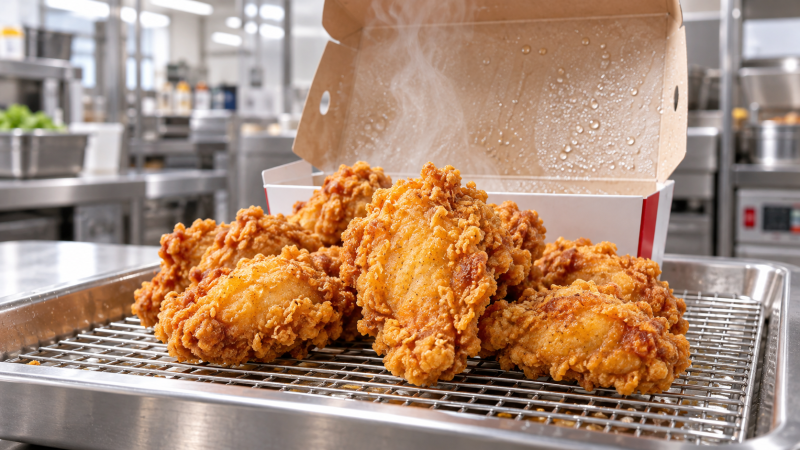
Crisp fried chicken does not usually fail because the coating “went soft” on its own. It fails because water moves: from the meat, from steam trapped under the crust, from humid air, from packaging condensation, or from sauces and holding equipment. Once enough moisture reaches the porous fried layer, the brittle structure that creates the audible crack and dry bite begins to plasticize. The coating may still look golden, yet feel leathery, oily, or damp.
For quality-control and food-safety teams, crispness is more than a sensory preference. It affects complaint rates, product consistency, rework decisions, packaging suitability, delivery performance, and the ability to maintain safe time-temperature controls without sacrificing eating quality. A coating process that performs well at the fryer may still fail after ten minutes in a closed takeaway box or during a delayed handoff at a hot-holding station.
Crispness depends on a dry, fragile surface structure
During frying, heat rapidly evaporates water near the product surface. Starch gelatinizes, proteins set, and the coating develops pores and a rigid structure. This structure is crisp when its moisture level remains low enough for the coating matrix to stay glassy and brittle rather than soft and flexible.
The difficulty is that fried chicken contains a large internal moisture reservoir. After the product leaves the fryer, residual heat continues to drive water vapor outward. Steam may escape through the crust, but it can also condense beneath a lid or migrate back into the coating. In practical terms, a coating has to manage two opposing demands: it must allow steam to leave quickly enough to limit sogginess, while retaining enough adhesion and structural integrity to stay attached during handling.
Research on fried foods describes this relationship as a combination of heat transfer, water loss, crust formation, oil uptake, and post-frying moisture migration. Coating composition and pore structure influence all of these mechanisms. A visibly thick coating is not automatically more durable; if it traps too much moisture or is poorly set before frying, it may soften quickly after cooking. (Source: Varela, P. and Fiszman, S.M., “Hydrocolloids in Fried Foods,” Food Hydrocolloids, 2011.)
Where moisture enters the coating system
Loss of crispness is often treated as a single frying problem, but the source may sit upstream or downstream. A useful investigation begins by identifying when the coating first departs from the expected texture: immediately after frying, after hot holding, after packing, or only after delivery.
Moisture released from the chicken
Chicken portions vary in thickness, skin condition, surface moisture, and marinade pickup. A wet surface can dilute predust, reduce coating adhesion, and create local weak spots. During frying, moisture from the meat turns to steam and moves toward the surface. If the crust develops too early or becomes overly dense, steam pressure may create separation between the meat and coating. This can produce a hollow, blistered crust that initially appears crisp but softens rapidly once removed from the fryer.
Excessive tumbling, long marination, inconsistent draining, or insufficient time between marination and coating can intensify this problem. Quality teams should distinguish between a formulation issue and an incoming-product issue. A coating cannot fully compensate for uncontrolled surface water on chicken pieces.
Water carried in batter or slurry
Where a batter step is used, its viscosity, solids content, temperature, and dwell time affect how much water enters the system. Batter that is too thin may create a weak, uneven layer and encourage bare spots. Batter that is too thick can retain water, form an excessively heavy shell, or prevent the outer layer from frying evenly. The target is not simply “more pickup.” It is consistent pickup that produces a stable crust at the intended fry time.
The choice between a dry coating and a batter-based system should reflect the serving format. Operators comparing dry applications with wet adhesion layers may find it useful to review how fried chicken coating powder differs from batter mixes in terms of texture formation, moisture exposure, and process handling. The decision should be validated on the actual product, fryer, packaging, and holding conditions rather than judged only from a bench-top fry test.
Steam accumulation after frying
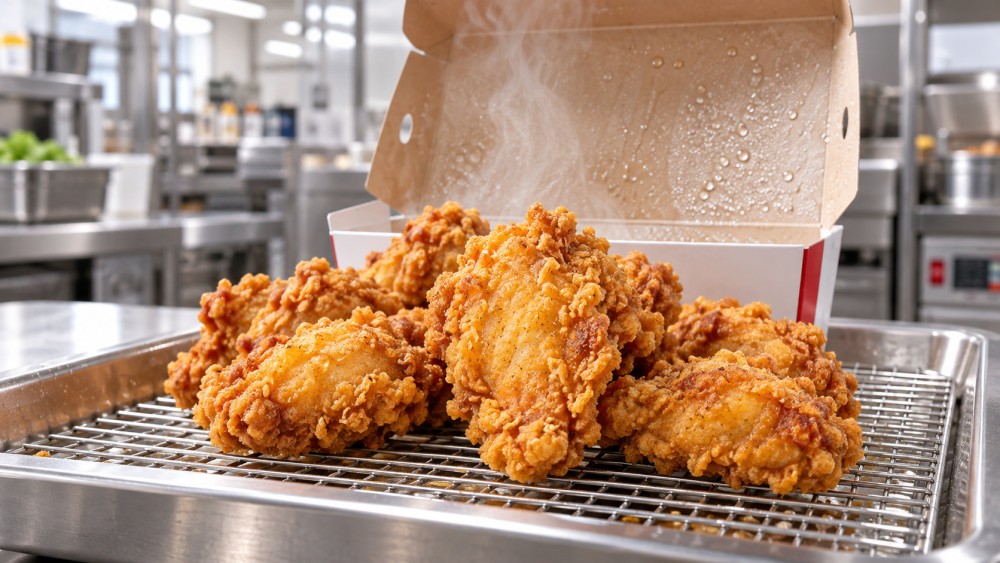
Closed packaging is one of the most common reasons a product that leaves the fryer crisp reaches the customer soft. Freshly fried chicken continues to release vapor. If that vapor is confined inside a tight container, it condenses on the lid and returns to the product as liquid water. The effect may be especially severe when hot chicken is packed immediately, stacked in insulated bags, or held in a humid delivery environment.
Packaging design should be tested as part of the product specification. Venting can help release steam, but too much ventilation may accelerate heat loss. The practical balance depends on portion size, product temperature at packing, journey time, ambient conditions, and whether sides, sauces, or cold items share the same pack. A package trial should assess crust texture after realistic holding intervals, not only immediately after closing the lid.
Humidity in hot-holding equipment
Holding cabinets can preserve temperature while damaging texture. Heated equipment with high humidity, limited airflow, or prolonged holding may cause the coating to absorb moisture from the surrounding environment. Units used for mixed menus require particular attention: settings suitable for moist cooked foods may not suit fried products.
Food safety and sensory quality must be managed together. In the United States, the FDA Food Code identifies 135°F (57°C) or above as the hot-holding temperature for time/temperature control for safety foods, unless another provision applies. Maintaining this minimum does not establish that a fried product will remain crisp at that temperature or at a particular humidity level. Facilities still need product-specific holding limits based on validated operational conditions. (Source: U.S. Food and Drug Administration, Food Code 2022, Section 3-501.16.)
Frying conditions that create a weak crust
When crispness is poor immediately after frying, the investigation should focus on coating pickup, fry load, oil condition, temperature recovery, and final internal temperature. A fryer display can show the setpoint while the food experiences a substantially different oil temperature after a heavy load is introduced.
Oil condition also deserves routine attention. As frying oil degrades, changes in viscosity, foaming behavior, heat transfer, and surface deposits can make process outcomes less predictable. Excess crumbs can burn, darken the oil, and attach to the product, while inadequate filtration can increase variation between production periods. A sound control plan records oil filtration, make-up oil practices, visual condition, fryer loading, and product appearance alongside routine quality checks.
Food safety verification cannot be replaced by appearance. Golden color and a firm crust do not confirm that the thickest part of the chicken reached a safe internal temperature. The USDA Food Safety and Inspection Service advises cooking poultry to 165°F (74°C), measured with a food thermometer. (Source: USDA FSIS, “Safe Minimum Internal Temperature Chart,” accessed 2024.) If a process change is made to improve crispness by shortening fry time or reducing product size, the cooking validation and monitoring plan should be reviewed at the same time.
Coating formulation choices that affect moisture tolerance
A dry coating is a system rather than a single ingredient. Flour type, starch source, particle size, leavening, salt, seasonings, protein ingredients, hydrocolloids, and processing history can each change adhesion, porosity, color development, and the rate at which the crust takes up moisture.
Coarser crumb systems may create a more open, rugged surface that appears highly crunchy, but they can be vulnerable to breakage and may need an effective binder layer. Fine powders can provide more uniform coverage and a cleaner bite, yet may form a dense shell if pickup is excessive. Starches can support crispness, but their performance depends on the full recipe and the water available during cooking. There is no universal “crispiest” blend because the desired result changes with chicken cut, coating method, fryer design, hold time, and packaging.
When qualifying a fried chicken coating powder, procurement and QA specifications should go beyond flavor and color. Useful supplier documentation and incoming checks may include lot identification, allergen declaration, microbiological requirements, moisture specification where relevant, storage conditions, shelf-life controls, packaging integrity, particle-size consistency where specified, and reconstitution instructions for any companion batter. Requirements should be risk-based and aligned with the facility’s hazard analysis rather than copied from an unrelated product category.
A practical troubleshooting sequence for quality teams
Changing the coating formulation before understanding the failure point can create unnecessary cost and make root-cause analysis harder. A controlled sequence is more reliable.
- Define the defect clearly. Record whether the product is soft, leathery, oily, detached, unevenly colored, or soggy after a defined period. “Not crispy” is too broad for corrective action.
- Map the time line. Evaluate samples at fryer discharge, after the normal holding period, after packaging, and after a realistic transport simulation. This identifies where moisture becomes critical.
- Check raw-product variability. Review thawing, marination, drain time, piece size, skin condition, and surface moisture. Compare affected batches with conforming batches when records allow.
- Verify process conditions under load. Measure actual oil temperature recovery, product load, fry time, filtration status, and coating pickup. Observe operator practices around shaking, resting, and basket loading.
- Assess post-fry exposure. Inspect cabinet settings, airflow, pack closure, venting, stacking, and sauce placement. A sauce cup touching hot chicken can create a local condensation zone.
- Validate one change at a time. Trials should retain samples through the full intended service window. A change that improves immediate crunch but causes coating loss after twenty minutes is not a complete correction.
Keeping texture controls aligned with safety controls
The best crispness strategy is not to reduce cooking or holding safeguards. It is to separate the controls that prevent unsafe temperature exposure from the controls that limit moisture damage. Product temperature, time, cooling, cross-contamination prevention, allergen management, and sanitation remain governed by the facility’s food-safety program. Texture controls should sit alongside them as defined quality parameters.
For fried chicken, this often means establishing an operational sensory window: the product is safe within the approved time-temperature conditions, but it is released for service only within a shorter period in which the coating still meets the agreed texture standard. Staff can then make informed disposition decisions instead of attempting to restore crispness by re-frying products without a documented process.
What a robust moisture-control plan looks like
Crispness is preserved when moisture is managed from raw preparation through final handoff. The most reliable programs control surface water before coating, monitor coating pickup and fryer recovery, prevent excessive steam exposure after frying, and test packaging under real service conditions. They also treat texture complaints as process signals rather than assuming the coating itself is always at fault.
For quality and safety managers, the practical objective is a repeatable crust that remains acceptable for the defined serving period while chicken reaches the required internal temperature and stays within approved holding controls. That objective is achieved through coordinated formulation, process, packaging, and verification decisions—not through a single adjustment at the fryer.
Sources
- U.S. Food and Drug Administration. Food Code 2022, Section 3-501.16, Time/Temperature Control for Safety Food, Hot and Cold Holding.
- USDA Food Safety and Inspection Service. Safe Minimum Internal Temperature Chart.
- Varela, P., and Fiszman, S.M. “Hydrocolloids in Fried Foods: A Review.” Food Hydrocolloids, 25(8), 2011, pp. 1801–1812.