




Search
Related News
- 00
0000-00
Animal Nutrition Premix: How to Choose a Formula for Livestock - 00
0000-00
USDA Cuts US Corn Output and Stocks, Raises Soybean Yield in November WASDE - 00
0000-00
Choosing Dairy Farm Systems: Milking, Feeding, and Herd Management - 00
0000-00
Rabobank: Climate Change and Heat Stress Threaten European Dairy Competitiveness - 00
0000-00
Planning Feeder and Drinker Layouts in a 1,000-Broiler House
Choosing Grain Processing Systems for Different Grains and Capacities




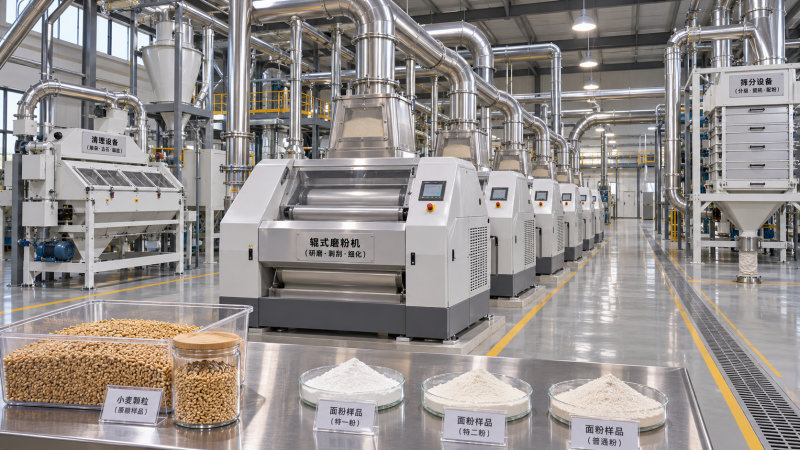
The best grain processing systems are selected around the finished product and the condition of the incoming grain, not capacity alone. A line designed to produce wheat flour will not automatically deliver the separation, surface treatment, or handling needed for polished rice. Even when two facilities process the same grain, differences in moisture, contamination, operating hours, and product specifications can lead to different equipment choices.
Start by defining what must leave the plant: whole kernels, flour, grits, feed, or an ingredient for further processing. Then work backward through the required cleaning, conditioning, milling, separation, and packing stages. Only after that flow is clear does a capacity figure become useful for comparing systems.
Match the process to the grain and finished product
Grain type determines much of the basic process, but the intended product determines how far processing should go. Removing a husk, separating bran, reducing particle size, and preserving whole kernels are different tasks. A flexible line may handle several grains, but flexibility often comes with changeover, cleaning, and performance trade-offs.
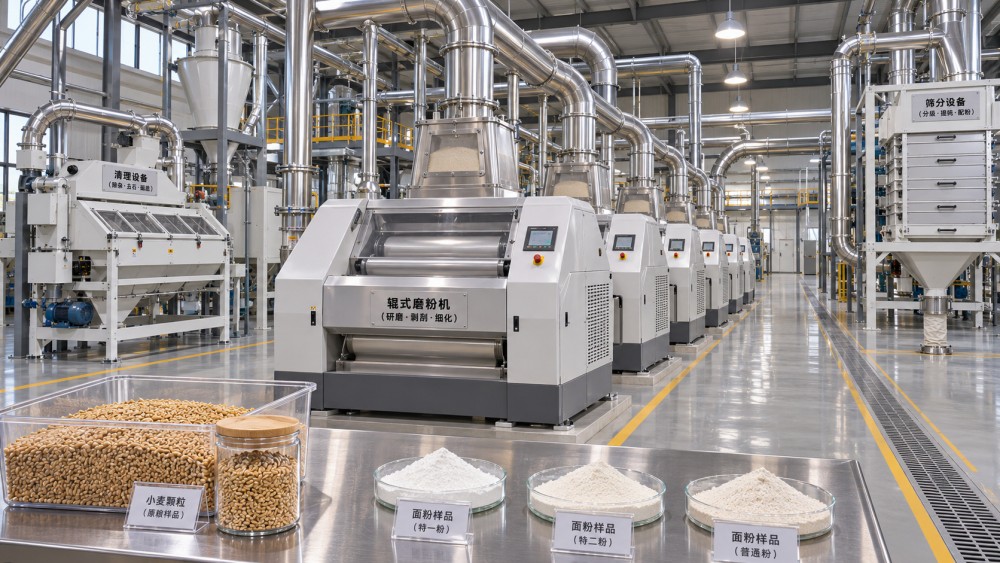
For wheat flour, a staged roller-milling and sifting arrangement allows the operator to separate material progressively. A simpler mill may be suitable for whole-grain meal, but it will not necessarily provide the same control over bran separation or flour grades.
Rice selection depends heavily on whether the plant will sell brown rice, white rice, broken rice, or several grades. Dehusking and separation are central to the process; whitening and polishing are added according to the product. Equipment settings and material handling matter because an increase in breakage can change the value and destination of the output even when total throughput remains acceptable.
Maize lines also vary substantially. A feed mill producing ground maize has a different objective from a dry mill producing food-grade grits with controlled germ and bran content. For oats or barley, grain variety and the ease of hull removal influence equipment choice. A quotation based only on the grain name leaves too much undefined.
Define capacity at each point in the line
A supplier’s stated capacity may refer to raw grain entering a machine, cleaned grain reaching the mill, or finished product leaving the line. These are not interchangeable. Cleaning removes foreign material; milling creates several product and by-product streams; and some material may be recirculated for further processing. Ask suppliers to identify the measurement point and the feed conditions behind each capacity claim.
Begin with the required finished-product volume and the planned operating schedule. Work backward using an agreed mass balance that accounts for cleaning losses, by-products, and the expected product split. Then consider availability: a plant that must stop for cleaning, maintenance, or product changes cannot be sized as though it runs continuously at its nominal rate.
For example, a facility producing a single flour grade over long runs may prioritize stable throughput and integrated controls. A smaller operation making several specialty flours may get more value from accessible machines, manageable batch sizes, and faster cleaning. A larger nominal machine is not automatically better if frequent changeovers leave it underused or complicate traceability.
Check the capacities of the entire route, including intake, cleaners, conveyors, bins, sifters, and packing equipment. A mill can only sustain its intended output if the surrounding equipment supplies and removes material at compatible rates. Buffer storage can absorb short interruptions, but it does not correct a persistent mismatch between stages.
Assess incoming grain before comparing quotations
Ask prospective suppliers to design around a defined range of raw material, not an ideal sample. The relevant conditions include grain variety, kernel size, moisture, foreign material, damaged kernels, and the range of grain sources expected over the year. Changes in these properties affect how machines are set and can alter both output and product quality.
Cleaning should be matched to the contaminants that are likely to arrive. Screening separates material by size; aspiration removes lighter material; magnets capture suitable ferrous contaminants; and destoners use differences in physical behavior to separate stones from grain. Optical sorting can be useful when color or visible defects matter, but it is not a substitute for upstream cleaning or a complete food safety program.
Moisture is equally important. Wheat may be tempered before milling to condition the kernel for separation, while other processes have their own moisture requirements. If incoming grain varies, the design may need suitable storage, moisture measurement, conditioning, or drying capacity. Drying is a separate process decision: too much heat or unsuitable handling can damage grain quality, while inadequate drying can make storage and downstream processing less reliable.
Consider storage time as well as machine selection. A plant receiving seasonal harvests needs an intake and storage strategy that protects grain condition until processing. More milling capacity alone will not solve poor segregation, inadequate aeration, or inconsistent raw material supply.
Choose the right level of integration and automation
A compact, modular configuration can suit a phased investment, a facility with limited space, or a business developing several products. Its practical advantage depends on whether modules are accessible for cleaning and maintenance and whether later additions can connect without disrupting material flow. Before reserving space for expansion, check the capacity of shared services, dust extraction, electrical distribution, and conveying routes.
A more integrated line can make sense when the product range is stable and the plant needs coordinated control across several stages. It may reduce manual transfers and support consistent operation, but it also requires careful attention to interfaces. If one section stops, the control system must manage upstream feed and downstream material safely. Clarify which supplier is responsible for integrating equipment from different manufacturers.
Automation should address specific operating needs. Useful functions may include monitoring motor loads, controlling feed rates, recording batches, detecting blockages, and alarming when process conditions move outside agreed limits. For a small, frequently changing operation, accessible manual adjustment may be more useful than complex controls that local staff cannot maintain. For a continuous line, limited visibility into bottlenecks can make troubleshooting costly.
Compare suppliers on product quality, not just throughput
Ask each supplier to quote against the same feed specification, operating schedule, and finished-product requirements. Otherwise, a lower-cost proposal may simply assume cleaner grain, a broader product specification, fewer operating hours, or equipment outside its scope.
A useful comparison package should include:
- A process flow diagram and mass balance: show the main product, by-product, recirculation, and waste streams, with capacity defined at each relevant point.
- Product acceptance criteria: specify the required grades, particle-size distribution, whole-kernel condition, or other measurable attributes appropriate to the product.
- Utility and site requirements: identify electrical supply, compressed air, water where needed, ventilation, dust collection, building loads, and equipment access.
- Operating assumptions: state the grain condition, expected run time, staffing assumptions, and changeover requirements used to develop the proposal.
- Scope and interfaces: distinguish equipment supplied from items such as installation, civil works, storage, controls integration, commissioning, and operator training.
- Support provisions: establish spare-parts availability, maintenance access, documentation, and the type of remote or local technical support offered.
Product recovery deserves particular attention. Higher finished-product yield can be attractive, but the comparison must use the same quality specification. A flour stream with different bran content, or a rice stream with a different proportion of broken kernels, is not necessarily equivalent even if both suppliers describe it as finished product. By-products also need a destination; their handling and storage belong in the process design.
Plan trials around the grain the plant will actually receive
Where product quality or processing behavior is uncertain, a representative trial can expose issues that a catalog cannot. Provide samples that reflect the intended grain range and agree in advance on the process settings, output streams, and measurements to be recorded. For a multi-grain plant, a trial on one easy-to-process material says little about changeover time or performance on the others.
Review more than the preferred output sample. Examine rejects and by-products, the amount and condition of recirculated material, and the effect of changing settings on both throughput and quality. A short trial is useful for comparing process behavior, but it does not by itself demonstrate sustained plant availability, maintenance intervals, or performance across a full season of variable grain.
Before purchase, turn the agreed operating conditions and product criteria into a commissioning and acceptance plan. Define how material will be supplied, where samples will be taken, which measurements will be used, and who is responsible for correcting problems across equipment interfaces. That gives the project a practical basis for judging the complete line, rather than accepting individual machines that have not yet demonstrated their performance together.