




Search
Related News
- 00
0000-00
How to Select Agricultural Irrigation Solutions for Water-Limited Farms - 00
0000-00
How to Select Food Plant Sanitation Equipment for High-Risk Processing Areas - 00
0000-00
Selecting Meat Packaging Technology to Extend Shelf Life and Control Leakage - 00
0000-00
Selecting Secondary Dairy Packaging Systems for Hygienic, High-Speed Distribution - 00
0000-00
How to Design Greenhouse Irrigation Zones for Uniform Watering and Lower Waste
Slaughterhouse Processing Cost: Key Drivers and Cost-Control Levers




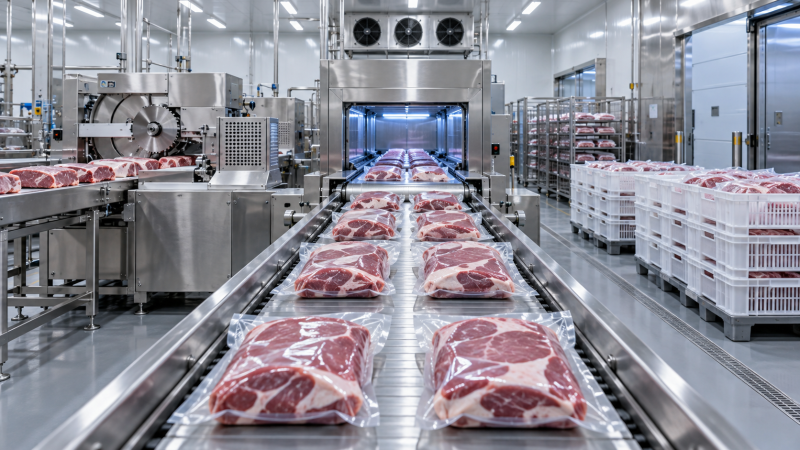
The most useful way to assess slaughterhouse processing cost is not to ask whether a plant’s total operating expense is high or low. The approval question is whether the cost per saleable kilogram is structurally justified by the plant’s species mix, product specification, throughput profile, hygiene requirements, and asset condition—and whether a proposed investment changes that unit economics without creating new operational exposure.
A low reported processing cost can be misleading if it is achieved through deferred maintenance, inadequate sanitation time, weak traceability, excessive trim loss, or underfunded cold-chain capacity. Conversely, a plant with higher labor or utility expenditure may generate better margins when it recovers more saleable product, maintains stable specifications, reduces claims, and runs at a more consistent utilization rate. Cost control in slaughter operations is therefore a yield-and-reliability discipline, not simply an expense-cutting exercise.
Processing cost must be measured against saleable output
For financial control, the core denominator should be saleable output rather than head count, liveweight intake, or nominal line capacity. Those measures remain operationally relevant, but they do not reveal the full economics of deboning, trimming, chilling, packaging, and by-product handling.
A practical baseline separates cost into at least three views:
- Cost per head processed: useful for slaughter-floor productivity, livestock receiving, veterinary inspection, and fixed handling activities.
- Cost per kilogram of carcass weight: useful for comparing slaughter and primary chilling performance across shifts or facilities.
- Cost per kilogram of saleable product: the most decision-relevant measure where cutting, deboning, value-added preparation, packaging, and yield recovery materially affect revenue.
The third measure is often the more meaningful one for an approval decision. A change that adds cost per head but improves recovery of high-value cuts, lowers condemned-product exposure, or supports a more profitable packaging format can still improve contribution margin. The opposite is also true: a labor-saving project can appear attractive until lower trim accuracy, reduced grade consistency, or higher rework erodes product value.
Cost reporting should also distinguish between controllable operating cost and the economic cost of capacity. Depreciation, lease obligations, interest, building upkeep, insurance, compliance overhead, and management labor do not disappear when production volume falls. Plants running well below a stable throughput level may show an unfavorable cost per kilogram even when floor-level labor and utility practices are reasonable.
Throughput stability is often the largest hidden cost lever
Slaughter and further-processing lines are highly interdependent. A stoppage at one point can idle labor, disrupt chilling schedules, increase sanitation complexity, delay dispatch, and reduce the amount of product that can be completed within a shift. The financial effect is not limited to lost line minutes. It is the conversion of fixed and semi-fixed cost into fewer saleable units.
For this reason, nominal equipment speed should not be used as the primary investment benchmark. The relevant question is sustained, specification-compliant throughput after accounting for product mix, inspection holds, changeovers, sanitation windows, rework, breakdowns, and downstream packing constraints.
A project designed to increase kill-floor speed may have limited value if the cutting room, blast chilling area, carton handling system, or dispatch docks remain the actual bottleneck. Increasing upstream speed in that situation can raise work-in-process inventory, refrigeration load, labor pressure, and product-handling risk without increasing shipments.
Approval models should therefore use a constrained-capacity map. It should identify the slowest effective point in the process under normal operating conditions, not only the rated capacity shown in equipment documentation. For mixed-product facilities, this map should be tested against the actual production schedule, because a line can perform differently when handling different carcass sizes, cut programs, packaging formats, or export specifications.
Higher utilization is not always financially preferable. Running too close to physical capacity can leave insufficient time for preventive maintenance, cleaning, verification, and recovery from a disruption. The most economic operating point is normally one that balances labor absorption with the capacity needed to protect hygiene, equipment reliability, and order fulfillment.
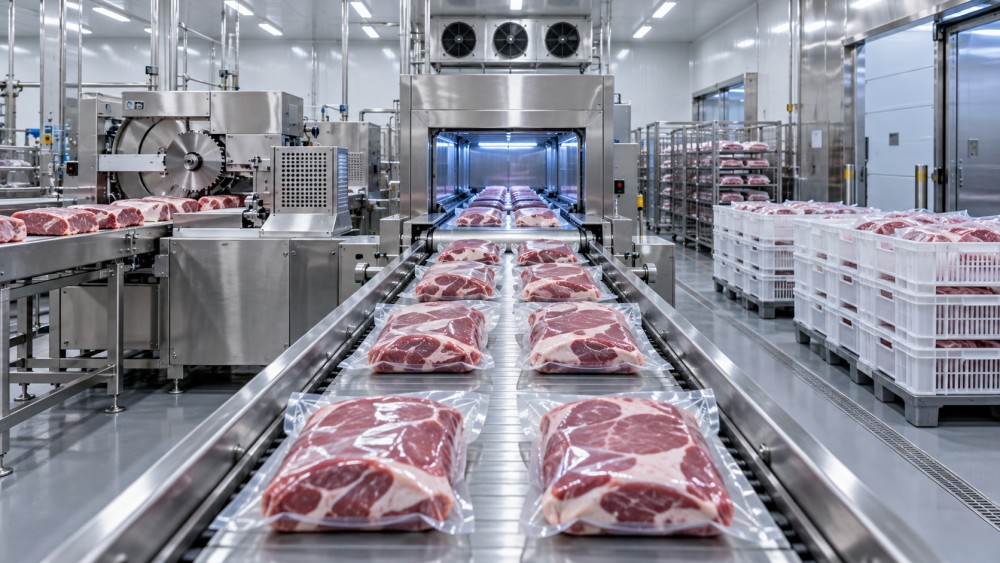
Labor cost is driven by work content, not payroll alone
Labor is frequently the most visible component of slaughterhouse processing cost, yet headcount reduction is an incomplete control strategy. Work content changes with species, carcass variability, product specifications, trimming standards, inspection requirements, packaging complexity, and the degree of manual handling between process stages.
In deboning and portioning, for example, a labor-saving proposal should be tested against four financial effects: direct wage reduction, achievable yield, product specification compliance, and maintenance or technical-support cost. Automation that reduces repetitive handling can improve consistency and reduce dependence on difficult-to-staff positions. But it may also require a steadier product presentation, more disciplined upstream grading, stronger maintenance capability, and different staffing patterns for setup, monitoring, and intervention.
Overtime should not be treated as a simple premium-cost issue. Persistent overtime can signal unreliable scheduling, poor line balance, inadequate maintenance planning, slow changeovers, or a mismatch between order patterns and available capacity. Reducing it may require operational redesign rather than more labor procurement.
A useful approval case separates labor into fixed shift coverage, variable labor linked to output, and avoidable overtime or agency labor. Only the latter categories may be quickly removable. If automation leaves mandatory staffing levels unchanged, the expected payroll saving may be much smaller than the equipment supplier’s theoretical labor displacement estimate.
Yield loss is a cost issue and a revenue issue
Yield is commonly discussed as a production metric, but it has direct financial consequences because loss affects both the volume and the value of output. The same physical loss can have very different consequences depending on whether it occurs in a low-value stream, a premium primal cut, edible offal, recoverable trim, or material that must be downgraded.
Relevant yield losses include avoidable trimming, poor cut accuracy, damage during handling, drip loss during chilling, temperature-related quality deterioration, contamination events, product misclassification, excess rework, and disposal of material that could otherwise enter an approved co-product stream. Some losses are visible in daily production records; others are buried in inventory variance, downgrade reports, customer claims, or weak reconciliation between livestock intake and packed-product output.
Financial review should avoid assuming that every additional percentage point of yield is equivalent. The value of recovery depends on the product mix and sales route. Recovering material into a lower-value channel may improve utilization but not justify a capital-intensive solution. By contrast, preventing loss or downgrade in a high-value export or retail specification can support a stronger investment case even when the recovered volume is modest.
The most reliable yield-improvement proposals specify where the loss occurs, how it will be measured before and after implementation, which product category benefits, and whether downstream demand exists for the recovered output. Without this discipline, “yield improvement” can become an unverified assumption embedded in a capital request.
Utilities are linked to process design and operating discipline
Water, electricity, thermal energy, compressed air, and refrigeration are essential to safe processing. Their cost cannot be responsibly reduced through blanket consumption targets. A slaughterhouse must maintain cleaning performance, process temperatures, handwashing availability, equipment function, and cold storage conditions required by its operating controls and applicable regulations.
The financial opportunity lies in identifying consumption that does not contribute to hygiene, food safety, or production. Water use can rise through poorly controlled hose practices, leaks, excessive pressure, unsuitable nozzle selection, inefficient cleaning sequences, and repeated washdowns caused by process disruption. Energy use can rise when refrigeration doors remain open, product flow is poorly coordinated, defrost cycles are mismanaged, insulation or seals deteriorate, motors run unnecessarily, or cold rooms hold inventory longer than planned.
Utility projects should be evaluated using load profiles rather than annual consumption alone. Refrigeration demand, for example, depends on product temperature at entry, dwell time, room loading, door activity, ambient conditions, equipment condition, and the timing of production peaks. A more efficient refrigeration asset may offer lower consumption, but its economic value also depends on installation downtime, refrigerant management, spare-parts availability, controls integration, and the remaining life of associated equipment.
Metering at meaningful process boundaries is often more valuable than a broad utility-reduction target. It allows management to distinguish a change in production volume from a change in consumption intensity, and to identify whether a problem is located in slaughter, chilling, cutting, sanitation, freezing, or cold storage.
Sanitation and compliance spending should be protected, then made more efficient
Food safety, animal welfare controls, worker safety, traceability, veterinary inspection, wastewater management, and export-market requirements create costs that cannot be assessed solely through an operating-expense lens. Failure in these areas can result in product holds, rework, disposal, delayed shipments, customer disputes, enforcement action, or loss of market access. The resulting exposure can exceed the apparent savings from a reduced sanitation crew, shorter cleaning window, or deferred facility repair.
The correct financial question is whether the process achieves the required control outcome with avoidable labor, chemical, water, energy, and downtime removed. This requires examining sanitation design as well as sanitation effort. Equipment with inaccessible surfaces, difficult drainage, damaged seals, poor hygienic zoning, or excessive manual disassembly can create recurring cleaning cost that remains hidden in labor and utilities budgets.
Capital proposals for hygienic redesign should include the cost of validation, commissioning, staff training, cleaning-procedure revision, and production interruption. They should also identify whether the change simplifies verification or merely transfers work from one department to another.
Maintenance deferral creates a misleading cost baseline
Maintenance spending is sometimes treated as a discretionary cost center when profitability is under pressure. In a slaughterhouse, deferred maintenance can shift cost into breakdown labor, emergency parts, production losses, sanitation delays, refrigeration risk, quality deviations, and safety exposure.
The most damaging failures are not necessarily those with the highest repair invoice. A relatively small component failure can stop a conveyor, disrupt a packaging line, compromise a temperature-controlled process, or force product to wait beyond its planned processing window. The financial impact depends on where the failure sits in the line and how quickly operations can recover.
A sound maintenance investment case ranks assets by consequence of failure rather than by age alone. Criticality should reflect effects on food safety, legal compliance, worker safety, throughput, cold-chain integrity, product quality, and dispatch commitments. This is more informative than using maintenance expenditure as a flat percentage of asset value.
Condition monitoring, spare-parts planning, and preventive maintenance can reduce avoidable disruption, but their benefits should be modeled conservatively. The projected return should not assume that every prevented breakdown becomes additional revenue; in some plants, the benefit will mainly be lower overtime, lower waste, fewer emergency purchases, and more predictable production scheduling.
Capital approval should test total cost of ownership, not purchase price
Equipment quotations often present a clear acquisition price while leaving integration costs scattered across separate budgets. In slaughter and meat-processing projects, these can include civil works, drainage modifications, electrical upgrades, refrigeration connections, compressed-air capacity, guarding, wastewater implications, software interfaces, line controls, commissioning support, training, spare parts, and temporary production arrangements during installation.
The table below highlights the distinction between an attractive quotation and an economically robust project.
Payback remains useful, but it should not be the only approval measure. Short payback can favor projects that reduce visible labor while overlooking initiatives that protect compliance, prevent major operational disruption, improve product recovery, or extend the useful life of critical infrastructure. Net present value, sensitivity testing, and a downside operating scenario provide a more durable basis for comparing different project types.
Cost control becomes credible when it is connected to operating evidence
The strongest cost-control programs do not begin with an arbitrary percentage reduction. They start with a reconciled operating baseline: livestock or carcass input, saleable output by category, labor hours, overtime, utility intensity, downtime, waste, rework, maintenance events, and cold-storage dwell time. The aim is to identify cost movements that have a physical explanation.
When a proposed change is evaluated against that baseline, management can distinguish between genuine structural improvement and a temporary reduction caused by lower sanitation activity, reduced maintenance, inventory drawdown, or a favorable production mix. This also makes post-investment review more credible. The same metrics used to approve a project should be used to assess whether its expected benefit was achieved.
Slaughterhouse processing cost is ultimately governed by the interaction of throughput, yield, hygiene, asset reliability, and product value. The most defensible investments are those that improve one or more of these drivers while preserving control over the others. Cutting a visible expense line may improve a monthly report; improving the cost of safe, specification-compliant saleable output is what protects the economics of the plant.