




Search
Related News
- 00
0000-00
How to Select Agricultural Irrigation Solutions for Water-Limited Farms - 00
0000-00
How to Select Food Plant Sanitation Equipment for High-Risk Processing Areas - 00
0000-00
Selecting Meat Packaging Technology to Extend Shelf Life and Control Leakage - 00
0000-00
Selecting Secondary Dairy Packaging Systems for Hygienic, High-Speed Distribution - 00
0000-00
How to Design Greenhouse Irrigation Zones for Uniform Watering and Lower Waste
How Does Agricultural Engineering Improve Water Use in Arid Farms?




Engineering Water Productivity Rather Than Simply Cutting Irrigation
Agricultural engineering improves water use in arid farms by making each unit of water more measurable, controllable, and productive. The strongest systems do not rely on one device or one irrigation method. They combine field layout, water delivery, soil measurement, crop scheduling, nutrient management, drainage, and, where appropriate, protected growing environments.
For a farm facing limited groundwater, irregular surface-water deliveries, or rising pumping costs, the practical objective is rarely to use the lowest possible volume of water. It is to maintain an economically viable crop with the smallest avoidable loss. Water that evaporates before reaching the root zone, runs below active roots, leaks from distribution lines, or is applied when the crop cannot use it adds cost without improving output. Engineering addresses those losses at several points in the production system.
This distinction matters when evaluating investments. A farm may install drip irrigation and still waste water if emitter flow is uneven, irrigation timing follows a fixed calendar, filtration is poorly maintained, or crop zones with different soils receive the same schedule. Conversely, a relatively simple system can deliver substantial improvement when its design matches the water source, field topography, soil profile, crop value, and available management capacity.
Delivering Water to the Root Zone With Greater Control
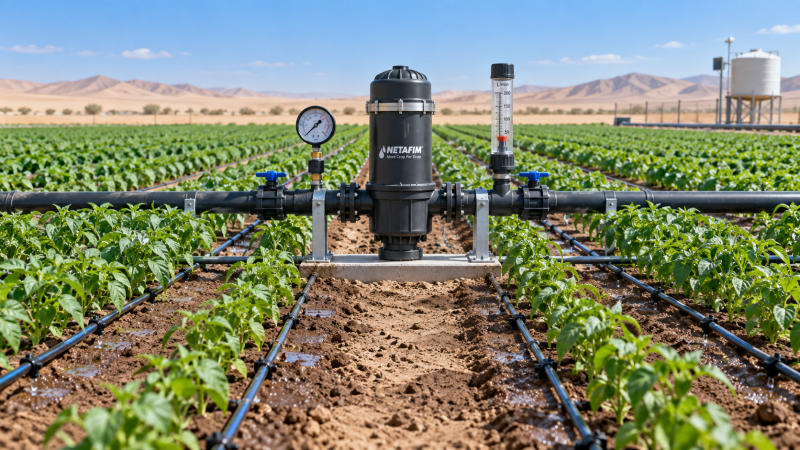
Pressurized irrigation is often the first engineering intervention considered in dry regions. Drip and subsurface drip systems deliver water near plant roots in small, controlled amounts. Micro-sprinklers may be more suitable for certain orchards, while center pivots fitted with low-pressure drop nozzles can improve uniformity across larger field crops. The correct choice depends on much more than the label of the irrigation technology.
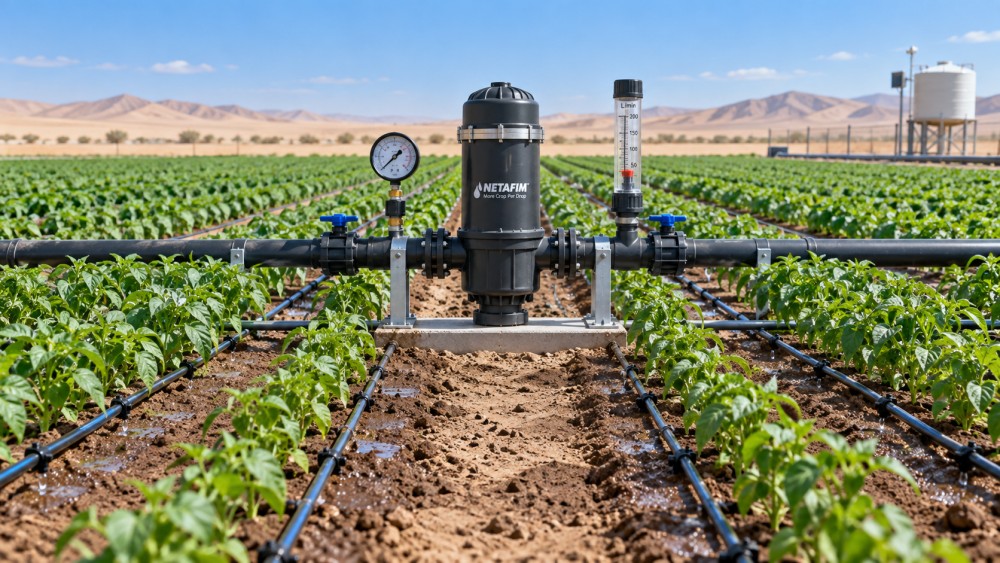
A well-designed system begins with hydraulic conditions. Pump capacity, pressure variation across the field, pipe diameter, elevation changes, filtration requirements, water quality, and emitter specifications all affect whether plants receive the intended application. If pressure is too low at the far end of a block, plants may be under-irrigated while other areas receive excess water. If pressure is too high, flow can rise beyond the design range and increase deep percolation or runoff. Flow meters and pressure gauges are therefore operational tools, not optional accessories for a technically sophisticated farm.
Field zoning also has a direct effect on water productivity. A single irrigation block may contain sandy areas that drain rapidly, heavier soils that hold water longer, slopes with different pressure behavior, and crop sections at different growth stages. Treating these areas as one unit forces a compromise schedule. Dividing the farm into manageable hydraulic zones allows irrigation duration and frequency to follow local conditions.
In orchards and high-value row crops, the wetting pattern deserves as much attention as total water volume. The aim is to create an adequately sized wetted root zone, rather than a narrow strip that limits root development or a broad wetted surface that increases evaporation and weed pressure. Emitter spacing, emitter discharge rate, lateral placement, soil texture, and root depth need to be assessed together. A layout that performs well in a loam soil may be poorly suited to coarse sand or a layered soil profile.
Surface irrigation should not automatically be dismissed in arid agriculture. In some farms, it remains the realistic starting point because of field size, crop type, existing infrastructure, or capital constraints. Engineering can improve it through land leveling, graded borders, gated pipes, controlled inflow, shorter run lengths, and better cutoff timing. These measures do not produce the same degree of point-level control as drip systems, but they can reduce uneven distribution and tail-end losses where a full conversion is not yet viable.
Using Measurement to Replace Calendar-Based Irrigation
Water use improves sharply when irrigation decisions reflect actual crop demand and soil water status. Many farms still irrigate on fixed intervals because the method is familiar and simple to administer. In arid conditions, however, a calendar rarely captures changing temperatures, wind, crop canopy development, rainfall, soil depth, or variability in water delivery.
Soil-moisture sensors can show whether water is reaching the active root zone and whether it is moving below it. Their value comes from placement and interpretation. A sensor installed too shallow may show dry soil even though deeper roots still have available moisture. A sensor placed near a leaking emitter, an atypical soil patch, or the edge of a wetting zone can give misleading readings. Farms should use sensor locations that represent real management zones and pair them with field observations, irrigation records, and knowledge of crop development.
Weather-based scheduling provides another layer of control. Temperature, solar radiation, humidity, and wind influence crop water demand. By combining local weather information with crop stage and soil conditions, managers can estimate when demand is rising and adjust irrigation before sustained plant stress appears. The estimate should guide decisions, not replace agronomic judgment. A high-demand weather pattern may call for more frequent irrigation, but irrigation duration should still account for the soil's capacity to hold and transmit water.
Remote sensing and aerial imagery can help identify zones that merit closer inspection, especially on large farms. Differences in canopy temperature, vigor, or crop uniformity may reveal pressure problems, clogged lines, poor drainage, salinity, disease, or uneven soil conditions. Such tools are most useful when they trigger a physical check in the field. A stressed zone does not automatically prove that the farm needs more water; it may indicate that water is applied unevenly or that roots cannot use the water already present.
The management workflow matters as much as the sensor package. Someone needs to review readings, compare them with irrigation events, inspect exceptions, and authorize schedule changes. A system that produces detailed dashboards but cannot be acted on during a critical irrigation window has limited practical value. For this reason, smaller operations may benefit more from a limited number of well-sited sensors and dependable flow monitoring than from a complex monitoring platform with no clear decision process.
Managing Fertilizer, Salts, and Drainage Alongside Water
In arid farms, water management cannot be separated from nutrient and salinity management. Fertigation, the application of soluble nutrients through irrigation water, can place nutrients closer to active roots and allow applications to be divided across the season. When it is properly managed, this reduces the need to apply large nutrient doses before planting and can support more consistent crop development.
Yet fertigation does not automatically improve efficiency. Stock solutions must be compatible with the water source and the irrigation equipment. Poor filtration, unsuitable mixing, inadequate flushing, or weak injection control can cause line blockage, uneven nutrient delivery, and corrosion. Nutrients applied through irrigation also remain vulnerable to leaching when the irrigation event exceeds root-zone storage. A nutrient program should therefore be tied to water application volumes, irrigation frequency, crop demand, and periodic checks of water and soil conditions.
Salinity presents a separate constraint. Irrigation water contains dissolved salts to varying degrees, and evaporation concentrates those salts near the soil surface and in the root zone. Drip irrigation can reduce surface evaporation and improve control, but it does not eliminate salt accumulation. In some conditions, farms need planned leaching events to move salts below the active root zone. That requires adequate drainage and a realistic assessment of where the leached water will go.
This is one area where an overly narrow focus on water-saving targets can create damage. Reducing irrigation volume without accounting for salt balance may protect the annual water budget while weakening crop performance over several seasons. Drainage design, soil permeability, groundwater depth, irrigation-water quality, and crop salt tolerance should be considered before setting aggressive deficit-irrigation targets.
Recovering and Reusing Water Where the System Can Support It
Water recovery can improve farm resilience, but only when water quality and treatment needs are understood. In protected horticulture, drainage from hydroponic or substrate-based systems may be collected, treated, and recirculated. This can reduce freshwater demand and retain nutrients that would otherwise be discharged. The approach requires monitoring of electrical conductivity, pH, nutrient balance, and biological risk. Recirculating a solution without adequate treatment can spread root pathogens or allow salts and unwanted ions to accumulate.
Runoff capture, storage ponds, and reuse systems can also help farms make better use of intermittent supplies. Their usefulness depends on the timing of water availability, evaporation from storage, water quality, permitting conditions, and the energy required to move water back into the irrigation network. In a very hot, exposed setting, an uncovered storage reservoir may lose a meaningful share of collected water to evaporation. The engineering case should include conveyance losses and storage losses, not only the theoretical volume that can be captured.
Packhouse wash water, cooling water, and other non-irrigation streams sometimes offer reuse opportunities, but they must be evaluated separately from field runoff or greenhouse drainage. Organic load, disinfectant residues, pathogens, suspended solids, and food-safety requirements can restrict how and where water may be reused. A reuse project should begin with a clear water-quality map: source, contaminants of concern, treatment process, storage conditions, intended use, and monitoring responsibility.
Reducing Crop Demand Through Field and Climate Design
Engineering also improves water use by reducing unnecessary crop stress and limiting evaporative demand. Mulches, conservation tillage, windbreaks, shade structures, and protected cultivation can alter how much water reaches the soil surface and how quickly it is lost. Their suitability varies by crop and location.
For open-field production, mulches may suppress evaporation and weeds, but they bring material, installation, and disposal considerations. Windbreaks can reduce drying winds, though they may shade crops or compete for water if poorly planned. Raised beds and carefully designed drainage can improve root-zone conditions where short irrigation events are needed, while poorly formed beds can shed water away from plants or concentrate runoff.
Greenhouses and shade houses offer tighter control over irrigation, fertigation, and climate. They can be compelling for high-value crops where yield consistency, quality, and water productivity justify the capital and operational burden. They are not a universal answer to arid farming. Cooling systems may consume water or energy, structures require maintenance, and operators need the capability to manage climate, irrigation, crop health, and nutrient solution as one connected system. A protected-cropping investment should be assessed against market access and crop margin, not judged solely by the promise of lower water use per kilogram.
How to Judge an Irrigation Engineering Project Before Buying Equipment
The most useful starting point is a farm water balance. Decision-makers should identify the source and reliability of water, pumping energy, distribution losses, storage capacity, crop water demand, soil variability, drainage condition, and current yield variability. Without this baseline, it is difficult to tell whether the main constraint is inefficient application, insufficient supply, poor scheduling, salinity, weak system maintenance, or an unsuitable crop plan.
- Water source: Test for sediment, hardness, salinity, biological contamination, and seasonal variation. Water quality determines filtration, treatment, flushing, and emitter choices.
- Soil and topography: Map texture, effective rooting depth, compaction, infiltration behavior, slopes, and low-lying areas. A uniform design may perform unevenly on a variable field.
- Crop economics: Match automation and control investment to crop value, production risk, labor availability, and the cost of a yield or quality loss.
- Operating capacity: Confirm who will inspect filters, repair leaks, flush lines, calibrate meters, interpret readings, and respond to alarms during the season.
- System flexibility: Consider whether zones, valves, filters, and controls can accommodate changes in cropping patterns, water allocation, or field expansion.
Suppliers should be asked to explain the design assumptions behind proposed flow rates, pressure requirements, filtration stages, zone sizes, and expected operating routines. A quotation that lists pumps, pipes, controllers, and emitters without showing how they fit the farm's water source and field conditions leaves too much risk with the buyer.
Maintenance deserves the same scrutiny as installation. Clogged emitters, damaged laterals, inaccurate pressure regulators, neglected filters, and uncalibrated fertigation equipment gradually undermine water performance. Farms should define routine checks and retain simple records of flow, pressure, irrigation hours, filter cleaning, fertilizer injection, and repairs. Those records make it easier to identify whether declining crop uniformity stems from irrigation performance or another production issue.
Water Efficiency Is a System Outcome
Agricultural engineering gives arid farms the ability to apply water more precisely, observe where it goes, and adjust production around the limits of the land and water source. The highest-value improvements usually come from linking infrastructure with decisions: hydraulic design with field zoning, moisture data with irrigation schedules, fertigation with root-zone conditions, and water-saving targets with salinity and drainage management.
For growers and project teams, the right question is not whether a particular technology is water-efficient in isolation. It is whether the complete system can deliver uniform water to the crop, preserve soil function, remain maintainable under local conditions, and support the yield and quality required by the business. That is the standard by which water engineering becomes a durable advantage in arid agriculture.