




Search
Related News
- 00
0000-00
Animal Nutrition Premix: How to Choose a Formula for Livestock - 00
0000-00
USDA Cuts US Corn Output and Stocks, Raises Soybean Yield in November WASDE - 00
0000-00
Choosing Dairy Farm Systems: Milking, Feeding, and Herd Management - 00
0000-00
Rabobank: Climate Change and Heat Stress Threaten European Dairy Competitiveness - 00
0000-00
Planning Feeder and Drinker Layouts in a 1,000-Broiler House
Tags
How to Choose Industrial Milling Equipment for Stable Powder Production




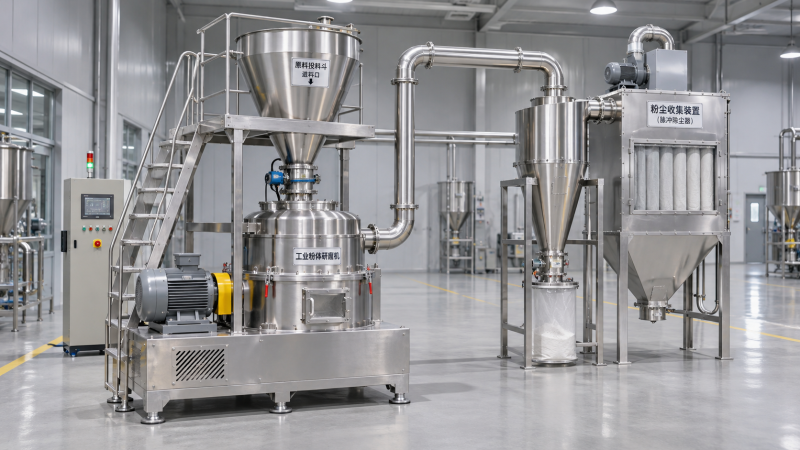
In food, pharmaceutical, chemical and advanced-materials production, milling is not simply a matter of making a material as fine as possible. A product can leave the mill with an acceptable average size and still create problems downstream because the distribution is too wide, the temperature has risen, the powder has absorbed moisture or the dust collection system cannot keep up. A machine that appears suitable in a short demonstration may behave differently after several hours of continuous production, when heat, wear and changing feed conditions begin to affect the process.
The most reliable way to approach a new line is to define the process before choosing a machine name. What particle size is required? How much material must be processed per hour or per batch? Is the material heat sensitive, abrasive, oily, fibrous or explosive? How quickly must the equipment be cleaned between products? These questions provide a better starting point for selecting industrial milling equipment than a simple comparison of motor power or catalogue capacity.
What a milling step actually changes
Milling reduces larger particles through impact, shear, compression or friction. The dominant force changes the shape of the particles, the amount of heat generated and the width of the final distribution. A hammer-style machine generally uses a high-speed rotor and hammers to break material through impact. A pin mill uses high-speed pins to create impact and shear for fine or ultra-fine grinding. A classifier, screen or adjustable gap can then influence which particles leave the chamber and which return for another pass.
That is why the label on a machine is only the first layer of the decision. The result depends on the relationship between the material, feed rate, rotor speed, screen or gap, air flow, discharge route and collection system. A fine powder made from a brittle mineral may need a very different arrangement from a heat-sensitive pharmaceutical intermediate, even when both are described as requiring fine grinding.
Start with the material, not the machine
A useful specification sheet records the material name, moisture range, bulk density, hardness, fibrous content, oil content, feed size, target size and allowable variation. It should also state whether the material is likely to oxidize, ignite or absorb moisture. If the material arrives in lumps, the upstream breaking step must be defined. If it is sticky, the team should discuss build-up on screens, pins and chamber walls before a trial is arranged.
Particle-size language should be precise. “Very fine powder” is not an acceptance criterion. A project may need a D50 value, a D90 limit, a maximum particle size or a narrow distribution for a downstream tablet, coating, blending or filling step. The sampling point and test method matter as much as the target number. A supplier and a buyer can both claim that a trial passed when they used different sampling or measurement methods.
Recognize the main equipment families
A hammer mill is often considered when fast impact and a practical reduction step are needed. It can be useful for secondary or fine crushing, but the correct result still depends on rotor speed, screen selection, feed stability and material behavior. A Fitz Mill can be considered where a high-speed shear pulverizer and different rotor arrangements are appropriate. A pin mill is commonly associated with fine or ultra-fine grinding, especially when a screenless, speed-adjustable approach is helpful. A contraplex pin mill offers another arrangement for fine grinding and should be evaluated through a material trial rather than selected by name alone.
The Guibao milling catalogue also describes features such as low-temperature operation, dust-free or sealed processing and inert-gas shielding on relevant equipment. These descriptions are useful prompts for a technical discussion. They do not replace a site-specific confirmation of temperature, dust classification, gas supply, pressure control or local safety requirements. A buyer should ask which feature belongs to which model and which conditions must be met for it to work as intended.
Control heat, dust and contamination together
Heat is often treated as a separate issue from dust, but the two can be connected. A sealed system may help contain powder and protect the product from the room atmosphere, while cooling or controlled air flow may be needed to manage temperature. The team should discuss the complete route from feed hopper to collection vessel, including filters, cyclone or other separation equipment, transfer lines and packaging.
Dust control has three practical goals: recover product, protect the work area and keep the process repeatable. A filter that is too small can increase resistance and reduce throughput. A poorly sealed transfer point can release powder and make cleaning harder. For materials that change between batches, the design should allow operators to reach the chamber, screen, pins, seals and collection points without unnecessary dismantling.
Cleaning and changeover are production parameters
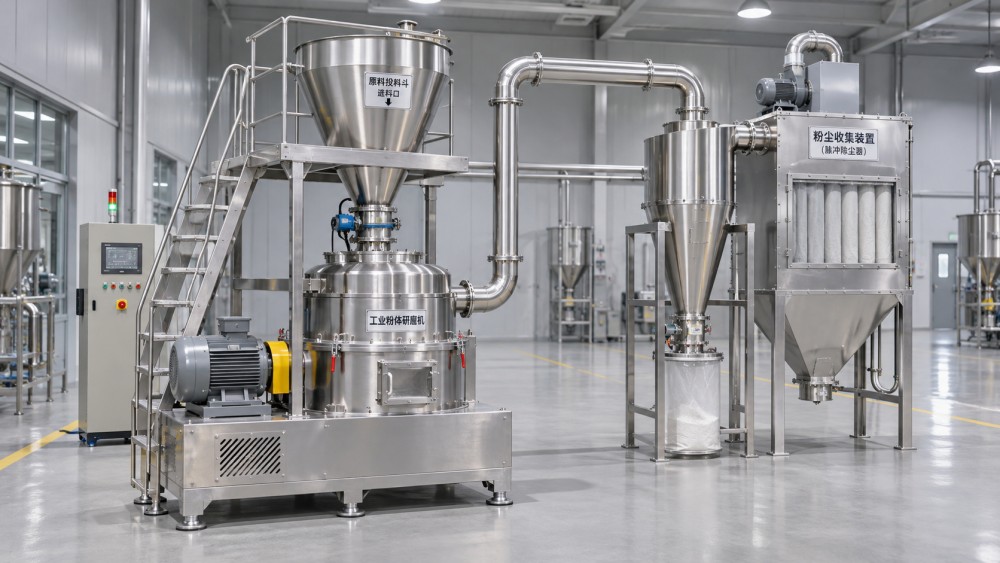
In a multi-product factory, the time needed to clean and inspect a mill can be more important than a short-term capacity figure. The buyer should ask how contact parts are removed, whether tools are required, where powder can settle and how the equipment is protected after cleaning. The cleaning procedure should address dry residues, wet cleaning if permitted, drying time, inspection and reassembly. If a product is sensitive to cross-contamination, the acceptance test should include swab or rinse checks defined by the quality team.
Materials of construction and surface finish also matter. The specification should identify which parts contact the product, how seals are selected and which components are expected to wear. A convenient spare-parts list is not a substitute for a clear maintenance plan, but it can help production and procurement teams understand the service burden before the line is commissioned.
Make the trial represent real production
A trial should use the customer material whenever possible, or a substitute with similar moisture, hardness, density and flow behavior. Record feed rate, run time, product temperature, particle distribution, power use, dust collection behavior and cleaning time. A ten-minute demonstration may show that a material can pass through a chamber; it does not show whether the line remains stable after heat builds up or a screen begins to load.
For a plant with several products, select representative cases: a standard product, the most difficult material and a product with the strictest cleanliness requirement. Ask the supplier to show how operators adjust the machine and recover from a controlled interruption. The goal is not to create a perfect laboratory result. It is to learn whether the equipment can be operated, cleaned and repeated by the people who will run the line.
Purchasing checklist
- Define the particle-size target, test method, sampling location and acceptance limit.
- Record moisture, density, hardness, stickiness, heat sensitivity and feed-size ranges.
- Confirm the interfaces between feed, milling, dust collection, conveying and packing.
- Confirm contact materials, surface finish, seals, screens, pins and expected wear parts.
- Ask for a continuous-run trial record instead of relying only on a catalogue capacity.
- Document cleaning, changeover, operator training, spare parts and service boundaries.
FAQ
Is larger industrial milling equipment always better?
No. Oversizing can make small batches inefficient and can reduce the useful adjustment range. The right size depends on actual throughput, batch size, operating schedule and planned expansion.
Can a buyer choose a mill from the target particle size alone?
No. Hardness, moisture, stickiness, thermal behavior, feed size and contamination limits can change the suitable milling method. Particle size is necessary information, but it is not sufficient information.
What should a buyer ask about a multi-product line?
Ask about access to every product-contact surface, screen and seal, the number of dead zones, the changeover sequence and the time needed to verify cleanliness. A line that is easy to clean can be more valuable than one with a higher nameplate capacity.