




Search
Related News
- 00
0000-00
How to Select Agricultural Irrigation Solutions for Water-Limited Farms - 00
0000-00
How to Select Food Plant Sanitation Equipment for High-Risk Processing Areas - 00
0000-00
Selecting Meat Packaging Technology to Extend Shelf Life and Control Leakage - 00
0000-00
Selecting Secondary Dairy Packaging Systems for Hygienic, High-Speed Distribution - 00
0000-00
How to Design Greenhouse Irrigation Zones for Uniform Watering and Lower Waste
Tags
Poultry Ventilation Systems: Matching Airflow Capacity to House Climate




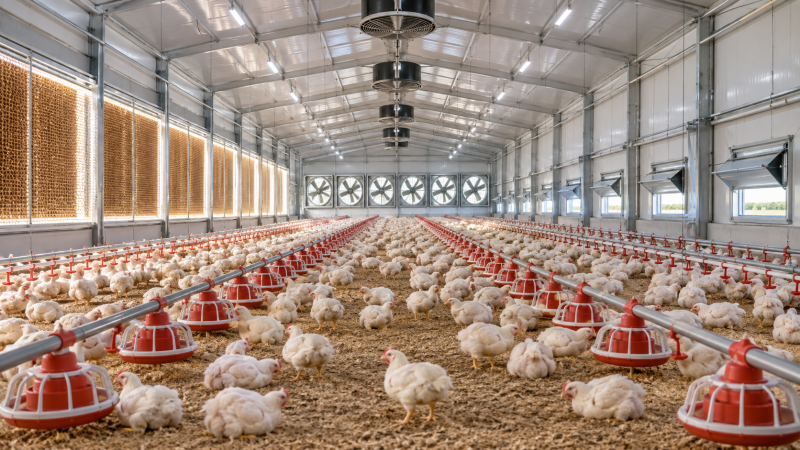
Selecting poultry ventilation systems starts with a practical question: can the house move enough air, in the right pattern, during its most demanding weather conditions? Fan capacity alone does not answer that question. A system can have impressive catalog airflow and still leave birds exposed to heat stress, damp litter, stale air, or uneven temperatures if the house is poorly sealed, inlets are undersized, controls are weak, or the ventilation mode does not fit the local climate.
The useful way to assess ventilation systems poulty facilities rely on is to treat ventilation as a climate-control package. Exhaust fans, air inlets, tunnel openings, circulation fans, evaporative cooling equipment, sensors, controllers, curtains, and building tightness all affect the final result. The right system is the one that maintains acceptable air quality and bird comfort across brooding, cool weather, mild weather, and peak heat, rather than one sized only for average conditions.
Start with the house and the climate, not the fan model
Airflow requirements change as bird age, body mass, stocking density, feed intake, outside temperature, humidity, and solar load change. A ventilation design that works in a lightly populated house during moderate weather may become inadequate near market weight on a hot, humid afternoon. Conversely, a system designed only around maximum summer airflow can create cold drafts and excessive heating demand during early brooding if it cannot operate accurately at low rates.
Before comparing equipment, define the operating envelope of the building:
- House length, width, ceiling height, roof profile, and internal obstructions.
- Bird type, expected flock weight, production stage, and maximum planned stocking density.
- Local summer temperature, humidity, wind exposure, winter conditions, and seasonal variation.
- Building leakage, insulation condition, curtain quality, door sealing, and service penetrations.
- Available electrical capacity, backup power arrangements, water quality, and water availability for cooling.
- Whether the building must support natural, mechanical, cross, tunnel, or mixed-mode ventilation.
This information determines the design problem. A naturally ventilated house in a mild climate needs a different approach from a closed, tunnel-ventilated broiler house in a region with sustained hot weather. The same nominal fan package cannot be assumed suitable for both.
Airflow capacity is more than the nameplate rating
Fan catalog ratings are commonly stated under controlled test conditions. Installed performance is lower when air must pass through shutters, guards, dirty screens, cooling pads, restrictive inlet paths, undersized openings, or poorly maintained equipment. Static pressure also matters. A fan may deliver strong volume when operating freely, yet lose substantial usable capacity as resistance rises inside a real poultry house.
For selection purposes, evaluate the delivered airflow at the expected operating static pressure, not only the maximum published airflow figure. The supplier should be able to provide performance information that shows how airflow changes as resistance increases. This is especially important in negative-pressure and tunnel systems, where the desired airspeed depends on maintaining a controlled pressure difference and a defined air path.
Airflow should also be assessed as a system total. Adding more fans does not always solve a ventilation problem. If inlet area is insufficient, extra exhaust capacity can create excessive negative pressure, distort airflow paths, pull air through leaks, and make inlet adjustment less predictable. If the tunnel end opening is restrictive, the system may fail to develop the air movement expected at bird level. If evaporative pads are dirty or too restrictive, the pressure penalty can reduce ventilation performance precisely when cooling demand is highest.
Choose the ventilation mode around the hardest climate condition
A house may use several modes through the year, but selection should be anchored in the most difficult period to manage. In many warm regions, that is maximum heat load near the end of the production cycle. In cold climates, maintaining dry litter and fresh air during minimum ventilation can be equally challenging. A design that handles only one extreme can still perform poorly during the rest of the cycle, so the controls and inlet strategy need to transition reliably between modes.
Minimum ventilation protects air quality in cold conditions
Minimum ventilation is often misunderstood as simply “running fewer fans.” Its purpose is to exchange stale air while preserving stable temperature near the birds. During cold weather, moisture from birds, drinking systems, and combustion sources can accumulate quickly. So can ammonia and carbon dioxide when airflow is reduced too aggressively.
The incoming air must have enough velocity and direction to mix with warmer room air before reaching the occupied zone. If it falls directly onto chicks or young birds, the house may show an acceptable average temperature while birds experience localized chilling. This is why inlet geometry, ceiling height, inlet control, and house tightness matter as much as fan cycling. A low-capacity ventilation stage should be controllable in short, repeatable intervals rather than relying on crude manual adjustment.
Transition ventilation is where uneven house conditions emerge
During moderate weather, the system must remove heat and moisture without creating sharp temperature differences from one end of the building to the other. Cross ventilation, sidewall ventilation, or staged mechanical systems can work well when fan locations and inlet distribution match the building geometry. Problems appear when air enters through only a few locations, bypasses part of the house, or short-circuits directly to nearby exhaust fans.
Walk the house during operation rather than judging performance only from controller readings. Check for persistent wet areas, bird clustering, dust movement, cold zones, and odors at different points. These signs often reveal an airflow-distribution problem before it becomes visible in production records.
Tunnel ventilation is an airspeed system, not just a high-fan-count system
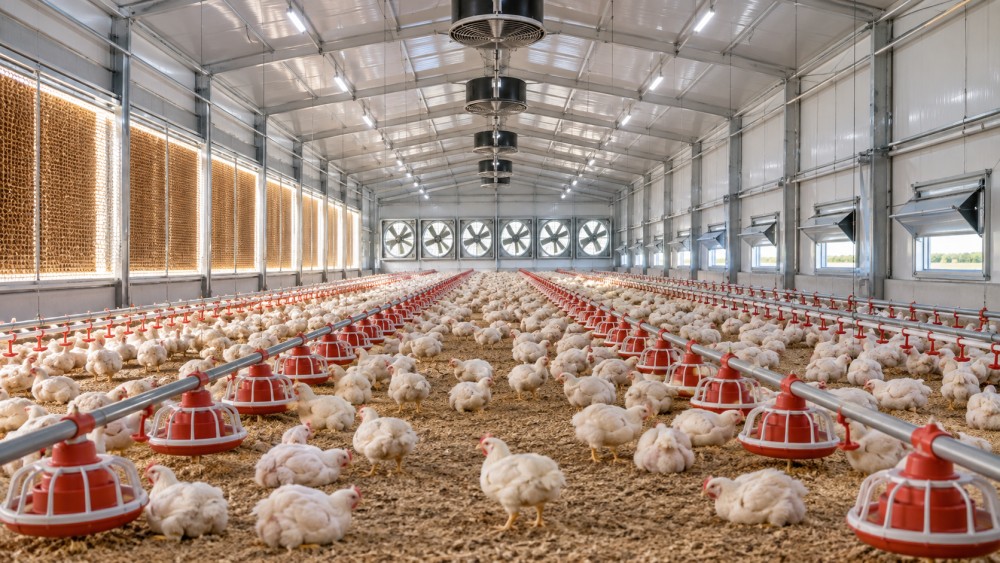
Tunnel ventilation is commonly selected for hot-weather poultry production because it moves air longitudinally through the house and creates a cooling effect at bird level. Its value depends on achieving reasonably uniform airspeed from the inlet end to the fan end. Long houses, internal equipment, uneven sidewall sealing, and poor tunnel inlet design can all reduce that uniformity.
When evaluating tunnel ventilation, review the entire air route: tunnel opening or cooling-pad face, inlet support structure, internal clearances, fan bank layout, shutters, end-wall sealing, and possible leakage through side curtains or doors. A fan bank cannot compensate indefinitely for a building that allows uncontrolled air entry. Air follows the easiest path, and uncontrolled leakage weakens the designed airflow path.
Evaporative cooling must fit humidity and water conditions
Evaporative cooling can reduce incoming air temperature when water evaporation is effective, but it also increases moisture in the air. In dry heat, this can be a highly useful complement to tunnel ventilation. In humid conditions, its cooling benefit can narrow because the air has less capacity to absorb additional water. The decision should therefore consider local peak humidity patterns, not only peak dry-bulb temperature.
Water supply is part of the ventilation assessment. Cooling pads and fogging systems depend on consistent water quality, pressure, drainage, filtration, and maintenance. Mineral deposits, algae, uneven wetting, blocked distribution lines, and damaged pad sections reduce cooling uniformity and can raise airflow resistance. A design that assumes continuous pad operation without accounting for water treatment and maintenance resources introduces avoidable risk.
Where humidity is regularly high, investing in effective tunnel airspeed, good insulation, shade management, and responsive fan staging may deliver more reliable comfort than making evaporative cooling the central solution. Cooling equipment can still be useful, but it should be controlled according to actual temperature and humidity conditions rather than activated as a fixed response to temperature alone.
Controls determine whether installed capacity is actually usable
Ventilation equipment is only as stable as the control logic behind it. A suitable controller should coordinate temperature, humidity, static pressure, minimum ventilation timing, fan staging, inlet position, cooling activation, and alarm conditions. More automation is not automatically better; the important question is whether the control system can be configured for the house’s real operating modes and maintained by the people responsible for daily operation.
Sensor placement deserves close attention. A sensor too close to an inlet, heater, fan discharge path, direct sunlight, or an area with unusual bird density can misrepresent the house climate. Multiple sensing points are often more useful than one central reading in longer buildings, particularly where temperature gradients are likely. The system should also make sensor faults visible rather than allowing a failed reading to drive ventilation decisions unnoticed.
Alarm design is a resilience issue, not an accessory. High-temperature alarms, power-loss alarms, controller-fault warnings, and backup ventilation provisions should be evaluated alongside fan capacity. In mechanically ventilated houses, a power interruption can turn into a flock emergency quickly. Backup systems must be compatible with the starting load of the installed motors and tested as an operating arrangement, not treated as a paper specification.
Do not overlook building tightness and inlet area
Two houses with the same fans can behave very differently because one is tight and the other leaks. In a leaky house, exhaust fans pull air through cracks, damaged curtains, unsealed doors, and service openings instead of through designed inlets. That makes air direction unpredictable. Cold air may drop where it should not, warm air may be exhausted before mixing, and static-pressure control becomes less meaningful.
House tightness is particularly important for minimum and transitional ventilation. It is less visible than fan selection, but it often determines whether incoming air can be directed and mixed correctly. Inspect seals, curtains, wall joints, ridge openings, fan shutters, pad frames, and cable or pipe penetrations before specifying additional equipment. Repairing uncontrolled leakage may improve ventilation behavior more effectively than increasing installed fan capacity.
Inlet area must also be matched to the active fan stage. Too little open inlet area raises resistance and can create fast, poorly directed air jets. Too much open area can reduce incoming air velocity, causing cold air to fall before it mixes. Adjustable, well-distributed inlets give the controller a better chance to maintain an appropriate air pattern as fan stages change.
A practical comparison method for suppliers
Supplier quotations are easier to compare when every proposal is forced to address the same operating conditions. Avoid comparing only fan quantity, motor power, or initial cost. Ask each supplier to map the proposed system to the house layout and explain how it performs in minimum, transitional, and maximum ventilation modes.
- Provide a fixed house drawing, bird plan, local climate profile, and available utilities to every bidder.
- Request delivered fan performance at the intended static pressure, including the effect of shutters, guards, pads, and other restrictions.
- Ask for the proposed inlet area, inlet control method, tunnel opening arrangement, and expected airflow path.
- Review fan staging and controller sequences for brooding, cool weather, moderate weather, heat stress, and power failure.
- Compare energy use through operating logic, motor efficiency, maintenance needs, and partial-load behavior, not only rated motor size.
- Assess service access: belt tensioning, bearing inspection, shutter cleaning, sensor replacement, pad maintenance, and controller support should be practical within the building.
- Confirm the backup-power arrangement against the ventilation equipment that must operate during an outage.
A proposal that cannot explain these interactions is incomplete, even if the fan specifications look strong. The most dependable option is usually the one that clearly links building condition, airflow path, control sequence, and maintenance requirements.
Common selection errors that create operating problems
Choosing on airflow volume alone. This ignores static pressure, air distribution, inlet behavior, and real restrictions. Usable airflow inside the house is what matters.
Sizing for average weather. Average conditions rarely expose the system’s limits. Ventilation should be reviewed against the combination of high bird heat output, peak outdoor heat, and expected humidity.
Adding cooling without checking airspeed. Evaporative cooling cannot replace adequate air movement. In humid weather, this error can leave the house warmer and wetter than expected.
Assuming a tight house without inspecting it. Leakage can undermine negative-pressure control and make a carefully designed inlet system ineffective.
Underestimating maintenance. Dirty shutters, belt wear, clogged pads, faulty sensors, and poorly calibrated controllers gradually reduce capacity. Maintenance access should influence equipment selection from the start.
For broader project assessment, AFBN organizes livestock automation and controlled-environment production knowledge alongside energy, water, equipment, and supply-chain considerations. That wider view is useful when ventilation decisions affect building design, utility planning, flock management, and long-term operating cost at the same time.
Make the final decision on operating control, not equipment count
The final selection should show how the poultry house will be controlled throughout the production cycle: fresh-air exchange at low ventilation rates, balanced temperature and moisture management in changing weather, high airspeed during heat events, and dependable response when equipment or power fails. Fans remain central, but their performance only becomes valuable when inlets, building tightness, cooling equipment, sensors, and controls are designed as one system.
Before placing an order, verify the house airflow path under each intended ventilation mode and identify the conditions that will place the greatest load on the flock. That process produces a more defensible choice than selecting the largest fan package or the lowest quotation.