




Search
Related News
- 00
0000-00
How to Specify Stainless Steel Processing Machinery for Hygienic Food Lines - 00
0000-00
How Food Processors Can Improve Throughput Without Compromising Hygiene Control - 00
0000-00
Microbial Fermentation Explained: How It Produces Food Ingredients at Scale - 00
0000-00
Protected Cultivation Technology: Which Climate Control Systems Fit Your Crop? - 00
0000-00
Sizing Livestock Ventilation Systems for Heat, Humidity, and Ammonia Control
How Recirculating Soilless Cultivation Improves Water Efficiency in Greenhouses




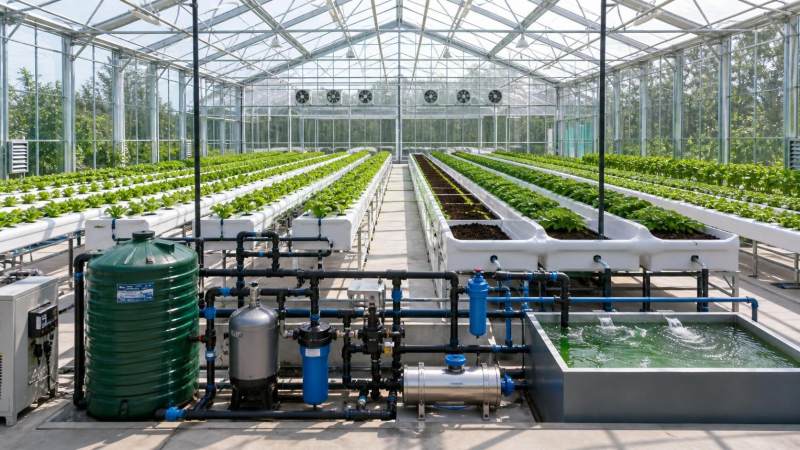
In modern greenhouse projects, water efficiency is no longer just a sustainability target—it is a core factor in cost control, production stability, and long-term competitiveness. Recirculating soilless cultivation gives project managers and engineering decision-makers a practical way to reduce water loss, optimize nutrient use, and improve system performance while supporting more precise, scalable crop production.
That matters even more in regions where water allocation is tightening, discharge rules are becoming stricter, or production plans depend on year-round consistency rather than seasonal flexibility. In those settings, open irrigation systems often look simple at the start but become expensive once runoff, fertilizer loss, drainage handling, and disease pressure are taken seriously.
Recirculating soilless cultivation changes the logic of greenhouse irrigation. Instead of treating drainage as waste, the system captures unused nutrient solution, conditions it, and sends it back into production. The basic idea is straightforward. The engineering behind stable operation is not.
Why water efficiency in greenhouses is really a system question
A greenhouse does not lose water in only one way. Some of it is used productively through crop transpiration. Some is lost through evaporation, leaks, drainage overflow, flushing, cleaning, and poor irrigation timing. In conventional drain-to-waste systems, a portion of water and dissolved fertilizer is intentionally over-applied to maintain root-zone balance, then discharged. That may protect crop quality in the short term, but it also means the project is paying for water intake, fertilizer input, and often wastewater management on the same cubic meter more than once.
For project teams, the key issue is not simply “how much water can be saved,” because that depends on crop type, climate, substrate, irrigation strategy, and sanitation design. The more useful question is whether the irrigation architecture allows operators to recover and control water that would otherwise leave the system.
This is where recirculation becomes a design decision, not a marketing feature. It affects tank sizing, pipe routing, disinfection, sensor placement, control software, emergency bypass logic, and even greenhouse hygiene procedures.
What recirculating soilless cultivation actually includes
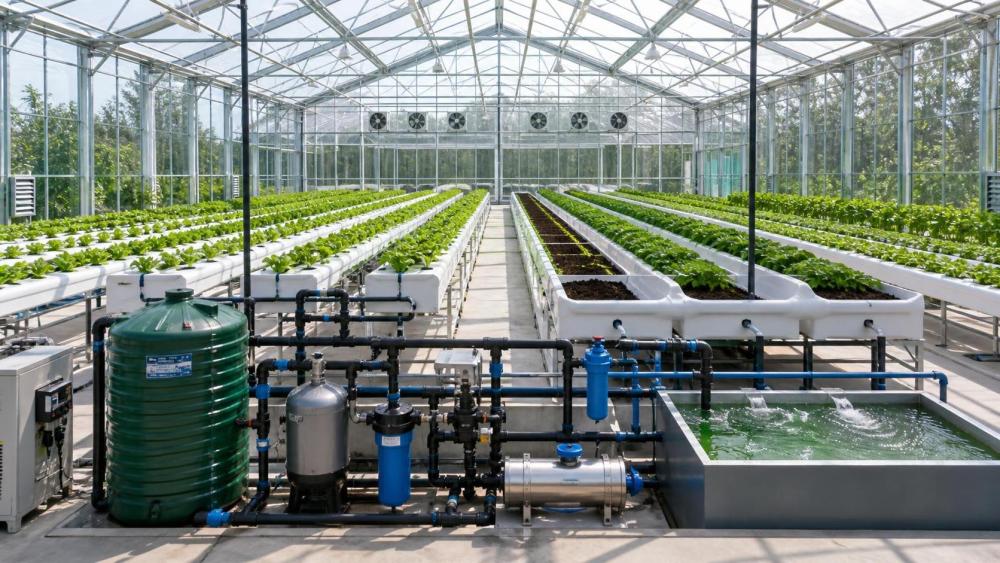
In practice, the term covers several production methods: hydroponic channels, substrate bag systems, gutter-based cultivation, trough systems, and other root-zone setups where irrigation water can be collected after drainage. The crop may be grown in rockwool, coco coir, perlite, or another inert or semi-inert medium, or with roots exposed in flowing solution. What makes the system “recirculating” is not the substrate itself but the recovery loop.
A typical loop includes a clean water source, nutrient dosing, irrigation delivery, drainage collection, return tanks, filtration or disinfection, measurement of parameters such as EC and pH, and controlled blending before reuse. Some projects add UV, ozone, heat treatment, membrane filtration, or slow-sand filtration depending on crop sensitivity, pathogen risk, and local operating conditions. There is no single universal layout. The right design usually depends on water quality, disease history, labor capability, and how much process stability the operator expects.
Where the water savings come from
The first source of savings is obvious: unused drainage is reused instead of discharged. But that is only part of the gain. Once a greenhouse is designed around recapture, operators usually start managing irrigation with tighter feedback. They pay closer attention to radiation-based irrigation triggers, drain percentage, root-zone EC drift, and tank balance. In other words, recirculation often improves water efficiency both directly and behaviorally.
The second source is nutrient retention. Fertilizer dissolved in drainage water still has value unless the solution has drifted too far from target composition or become microbiologically unsafe. Recovering that solution reduces the need for fresh mixing and lowers nutrient discharge. In markets where fertilizer cost and environmental reporting are under pressure at the same time, that matters almost as much as raw water reduction.
The third source is process visibility. Recirculating systems typically require more monitoring, which exposes issues that open systems can hide for a long time: emitter non-uniformity, blocked drippers, return-flow imbalances, tank dead zones, and sanitation failures. Better visibility does not automatically save water, but it reduces the chance of losing efficiency through unnoticed drift.
The technical conditions for stable recirculation
Water reuse in greenhouses only works well when three control layers are aligned: hydraulic balance, nutrient balance, and hygiene control.
Hydraulic balance
Collection capacity must match irrigation peaks. If gutters, drains, or return tanks are undersized, valuable solution is lost during high-frequency irrigation windows. Pump selection also matters. Oversized pumps can create unstable pressure and poor dosing accuracy; undersized pumps may not support timely recirculation, especially in larger zones. Projects that look efficient on paper sometimes underperform because return infrastructure was treated as secondary rather than as part of the core irrigation system.
Nutrient balance
Plants do not absorb all ions at the same rate. Over time, the returned solution can deviate from the original recipe. That means recirculating soilless cultivation needs measurement, correction, and sometimes partial refresh rather than endless reuse. EC and pH are the minimum control points, but they do not tell the full story of nutrient composition. Depending on crop value and risk tolerance, operators may need periodic lab analysis or more advanced monitoring protocols to prevent accumulation of unwanted ions or imbalances in key nutrients.
Hygiene control
This is the issue that most often determines whether recirculation is accepted or resisted. Reusing water also means reusing risk unless pathogens are controlled. Root diseases, biofilm formation, algae growth, and organic load can turn a water-saving system into a crop-health problem if sanitation is weak. The right treatment method depends on the water characteristics and the organisms of concern, but the project brief should always define the sanitation strategy early, not after construction. “We will add treatment later” is rarely a good plan.
What project managers should verify before approving a design
The most common mistake is assuming that any hydroponic or substrate system is automatically efficient. Water efficiency comes from design discipline and operational control, not from the label.
These checks are especially important for new greenhouse investments where irrigation, fertigation, climate control, and data systems are being specified together. AFBN often frames greenhouse technologies in that connected way because buyers and project teams do not really purchase “a water-saving component” in isolation. They are evaluating how water, nutrients, energy, labor, compliance, and crop quality interact inside one operating system.
Common trade-offs that are easy to underestimate
Recirculation improves efficiency, but it also raises the technical bar. Capex may increase because more tanks, sensors, treatment steps, and control functions are needed. Commissioning usually takes more discipline. Staff must understand that measurement errors can propagate through the loop rather than disappear with discharge.
There is also a crop-management trade-off. Some high-value crops tolerate precise recirculation very well when the system is well managed. Others may require more conservative drain strategies or partial discharge depending on local climate, water composition, or disease exposure. A design copied from another country may not perform the same way if source water or greenhouse hygiene standards differ.
This is where technical due diligence matters more than broad claims. A system that saves water on a demonstration site may not translate directly to a commercial project unless maintenance routines, operator skill, and spare parts access are also realistic.
How to evaluate performance without relying on vague claims
When suppliers or internal teams discuss water efficiency, it helps to bring the conversation back to measurable operating questions:
- How much irrigation volume is applied, collected, treated, and reused by zone?
- What drain percentage is expected under normal climate conditions, and how is it adjusted seasonally?
- What water quality parameters trigger partial discard, fresh-water blending, or sanitation intervention?
- What is the cleaning and verification routine for sensors, tanks, filters, and disinfection units?
- If recirculation must be interrupted, what is the fallback mode and how does it affect crop risk?
Those questions are more useful than headline promises because they reveal whether the project team understands the operational mechanics. They also help align engineering design with production realities, which is often where greenhouse projects succeed or fail.
Why this topic matters beyond the greenhouse itself
Water efficiency in controlled-environment farming increasingly affects upstream and downstream decisions: site feasibility, utility planning, wastewater handling, crop scheduling, sustainability reporting, and investor confidence. That is one reason industry platforms such as AFBN treat greenhouse irrigation, automation, bioscience applications, and food supply chain performance as connected topics rather than separate silos. A water decision in production can influence nutrient procurement, compliance exposure, yield consistency, and the economics of future expansion.
For engineering teams, this broader view is useful. Recirculating soilless cultivation should not be judged only by whether it reduces freshwater intake. It should be judged by whether it creates a controllable production environment with acceptable biological risk, service requirements, and lifecycle operating cost.
If a greenhouse project is still in planning, the right next step is usually not choosing a treatment brand or sensor model too early. It is confirming the water source profile, discharge constraints, crop strategy, sanitation approach, and control philosophy first. Once those are clear, the value of recirculation becomes much easier to quantify—and much harder to oversell.