




Search
Related News
- 00
0000-00
Microbial Fermentation Explained: How It Produces Food Ingredients at Scale - 00
0000-00
Protected Cultivation Technology: Which Climate Control Systems Fit Your Crop? - 00
0000-00
Sizing Livestock Ventilation Systems for Heat, Humidity, and Ammonia Control - 00
0000-00
Agri-Food Industry Trends Reshaping Supply Chain Risk and Investment Priorities - 00
0000-00
How to Evaluate Food Processing Suppliers for Capacity, Traceability, and Quality Control
Microbial Fermentation Explained: How It Produces Food Ingredients at Scale




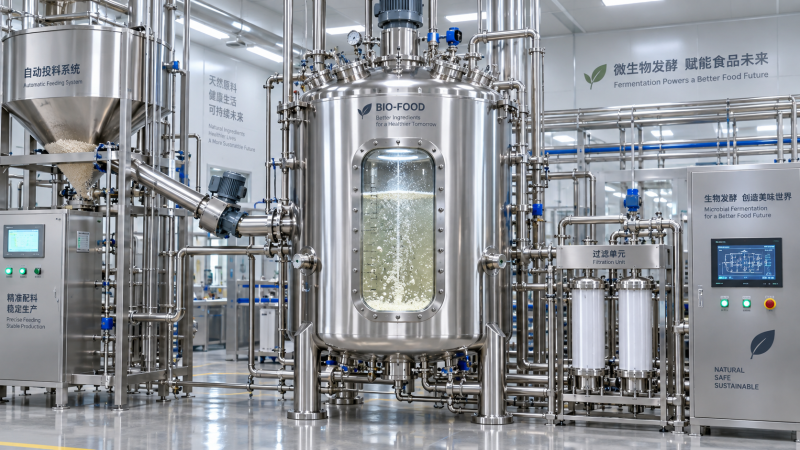
A fermentation tank in a modern ingredient plant may look more like pharmaceutical equipment than a traditional food facility: polished stainless steel, sealed piping, automated dosing, sensors, and a control room tracking conditions hour by hour. Yet the principle inside is ancient. Microorganisms consume nutrients and transform them into useful compounds. The difference is that microbial fermentation now allows this biological activity to be managed with a level of precision that can support industrial-scale food production.
For food manufacturers, ingredient buyers, and researchers, the subject is no longer limited to yogurt, beer, or bread. Microbial fermentation is used to produce enzymes, organic acids, vitamins, natural colors, flavor compounds, cultures, preservatives, probiotics, texturizing materials, and increasingly, proteins designed for modern food formulations. Understanding how the process works is essential when assessing claims around scalability, consistency, clean-label positioning, or sustainability.
What microbial fermentation actually means
Microbial fermentation is a controlled production process in which selected microorganisms—commonly bacteria, yeasts, or fungi—convert raw materials into targeted products. Depending on the organism and process design, those products may be the microorganisms themselves, substances they produce during growth, or compounds released after processing the microbial biomass.
In food systems, the starting feedstock is usually a source of carbon and nutrients. This might include glucose, sucrose, starch hydrolysates, molasses, glycerol, or side streams from agricultural and food-processing operations. The microorganism uses these materials as fuel and building blocks. Under carefully controlled conditions, it produces a desired output: perhaps lactic acid for preservation, an enzyme for baking, a flavor molecule for beverages, or a protein ingredient for a meat alternative.
It is useful to distinguish microbial fermentation from the familiar household idea of “letting food ferment.” Traditional food fermentation often relies on mixed cultures and develops flavor, texture, and preservation over time. Industrial fermentation may use a highly defined production strain, a standardized nutrient medium, and a tightly controlled bioreactor. Both use microbes, but their operating goals can be very different.
From culture vial to commercial ingredient
Commercial microbial fermentation is not a single reaction. It is a connected production system, and a weakness in one step can affect yield, cost, quality, or regulatory suitability later. The sequence generally begins long before the main tank is filled.
1. Selecting and maintaining the microorganism
The production organism is chosen for more than its ability to make a target compound. Developers examine growth rate, productivity, genetic stability, tolerance to temperature or acidity, nutrient requirements, downstream processing needs, and food-use status in intended markets. A strain that performs well in a laboratory flask may be unsuitable for a 100,000-liter fermentation run if it becomes unstable, foams excessively, or requires expensive inputs.
Most industrial operations maintain a master cell bank and working cell bank. This structured approach protects strain identity and reduces the risk that production gradually drifts away from the validated microorganism. For buyers reviewing an ingredient platform, strain management may sound like a technical detail, but it is closely linked to consistency and traceability.
2. Building the inoculum
A small quantity of the selected culture is gradually expanded through a seed train. It moves from a vial to small vessels and then to progressively larger seed fermenters before entering the main production vessel. Each stage is designed to provide an active, healthy population at the right physiological state.
This scale-up phase matters because microorganisms do not always behave identically when volume changes. Heat transfer, oxygen supply, mixing intensity, and nutrient gradients can shift as equipment becomes larger. Careful seed preparation helps reduce the risk of slow starts, inconsistent growth, or contamination in the main batch.
3. Preparing the fermentation medium
The medium provides the carbon, nitrogen, minerals, vitamins, and other nutrients required by the organism. Its formulation affects both the amount of ingredient produced and the impurity profile that must later be removed. A seemingly low-cost feedstock may create downstream challenges if it introduces variable composition, unwanted color, inhibitory compounds, or difficult-to-handle solids.
In an agri-food context, the choice of feedstock is increasingly important. Manufacturers are exploring by-products and renewable raw materials to reduce dependence on refined sugars, but these streams must be evaluated carefully. Availability, seasonal variation, food-safety controls, transport requirements, and local regulations can be as important as their headline sustainability potential.
4. Running the bioreactor
The main fermentation takes place in a closed bioreactor, often called a fermenter. The vessel provides an environment in which temperature, pH, dissolved oxygen, agitation, nutrient addition, pressure, and foam can be monitored and adjusted. The target is not merely to keep microbes alive; it is to guide them toward a production state that delivers the desired output reliably.
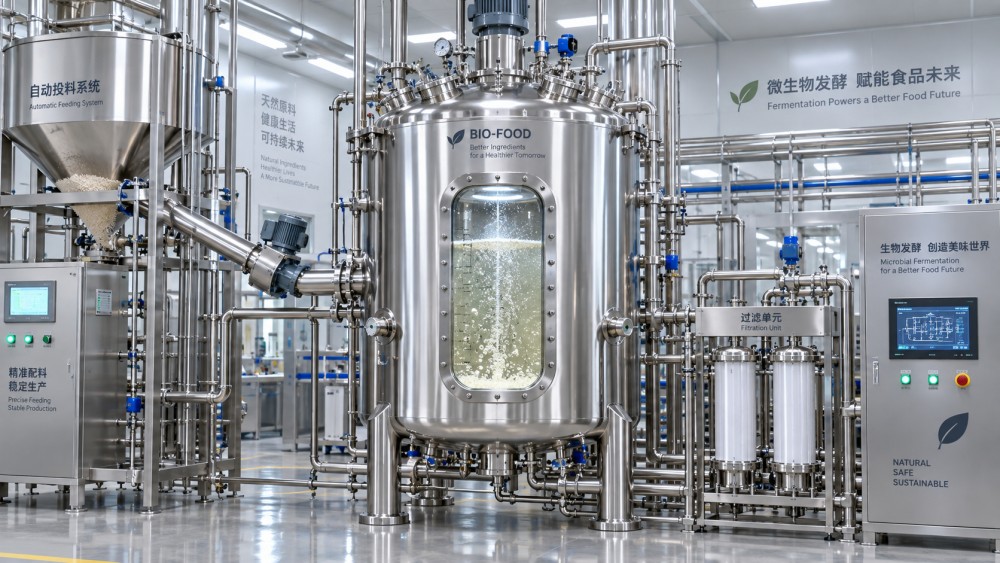
Some processes are run as batch fermentation, where all or most nutrients are added at the start. Others use fed-batch fermentation, in which nutrients are supplied gradually to avoid overfeeding or metabolic stress. Continuous fermentation is also possible, with fresh medium entering while product-containing material exits, although it requires particularly robust control and contamination management. The best choice depends on the organism, product type, production economics, and quality strategy.
Why process control makes or breaks scale-up
Microbes respond quickly to their surroundings. A slight drop in oxygen, a pH shift, or a nutrient imbalance can change how they grow and what they produce. At pilot scale, uniform mixing may be relatively easy. At industrial scale, gradients can emerge inside the vessel: one zone may receive more oxygen or nutrients than another. This is why moving from a promising laboratory result to commercial output is often one of the most demanding stages in fermentation development.
Oxygen transfer is a classic example. Many production organisms need oxygen, but oxygen does not dissolve easily in water-based media. Engineers must balance aeration, agitation, vessel geometry, and energy use. Excessive mixing can damage sensitive cells or increase operating costs, while insufficient oxygen can reduce productivity or lead to unwanted by-products.
Foam is another practical concern. Protein-rich media and microbial activity can generate large volumes of foam, creating a risk of filter blockage, product loss, or contamination. Antifoam agents, mechanical foam breakers, and automated foam detection are commonly used, but they must be chosen with downstream purification and food-contact requirements in mind.
Contamination control is equally fundamental. An unwanted bacterium, yeast, or bacteriophage can consume nutrients, alter product quality, or terminate a batch. Industrial facilities therefore rely on hygienic design, sterilization-in-place systems, validated cleaning procedures, filtered air, controlled raw material handling, and routine microbiological monitoring. Fermentation is biological production, but it succeeds only when biology and disciplined process engineering work together.
What happens after fermentation?
The end of the fermentation run is often the beginning of another major challenge. The product may be dissolved in the liquid, contained within cells, attached to biomass, or mixed with residual nutrients and naturally occurring metabolites. Downstream processing separates, concentrates, stabilizes, and formats the material for its intended application.
Common operations include centrifugation, filtration, cell disruption, membrane separation, extraction, precipitation, chromatography, evaporation, drying, and blending. A probiotic product may require gentle concentration and protective drying to preserve viability. An organic acid may need purification and crystallization. An enzyme preparation may be filtered, concentrated, standardized for activity, and supplied as a liquid or powder.
Downstream processing can represent a substantial portion of total production cost. Therefore, a commercially attractive microbial fermentation process is not simply one with a high fermentation yield. It must also deliver a product that can be recovered efficiently, meet specifications, remain stable during storage, and fit into food manufacturing operations.
Where fermented ingredients appear in the food value chain
Many food ingredients made through fermentation are invisible to consumers but central to product performance. Enzymes are a clear example. They can improve dough handling, cheese development, juice clarification, brewing efficiency, and the texture of processed foods. Because enzymes act in precise ways, they may help manufacturers reduce processing time or replace harsher chemical interventions.
Organic acids such as lactic acid, citric acid, and acetic acid can contribute acidity, flavor balance, preservation, and pH control. Fermentation-derived cultures support dairy products, plant-based fermented foods, and specialty beverages. Vitamins, amino acids, hydrocolloids, and flavor compounds also have established roles in nutrition and formulation.
A newer area is precision fermentation, where microbes are selected or developed to produce a specific functional molecule, such as a milk protein, egg protein, flavor component, or specialty fat. The commercial discussion around this category can become overly simplified. Precision fermentation does not remove the need for formulation expertise, processing capacity, regulation, sensory assessment, or cost discipline. It is a production route, not an automatic guarantee of market success.
How to assess a fermentation-derived ingredient
For information researchers and procurement teams, the most useful questions go beyond “Is it made by fermentation?” That phrase describes a method, not the full value proposition. A more grounded evaluation considers the following areas.
- Functional role: What does the ingredient do in the finished food—provide flavor, nutrition, texture, preservation, processing support, or culture activity?
- Specification consistency: Which parameters are controlled between batches, such as purity, potency, microbial counts, moisture, color, particle size, or residual substrates?
- Application fit: Does it tolerate heat, shear, low pH, salt, freezing, or the specific processing steps used by the manufacturer?
- Regulatory pathway: Is the ingredient permitted for the intended food category and market? How is the production organism classified and documented?
- Supply resilience: Are feedstocks, fermentation capacity, purification equipment, and cold-chain requirements aligned with expected demand?
- Quality and safety controls: How are contaminants, allergens, residual processing aids, toxins, antimicrobial resistance concerns, and foreign materials assessed where relevant?
These questions are particularly important for ingredients positioned as alternatives to animal-derived or petrochemical-derived materials. The environmental profile of fermentation depends on energy sources, raw material origin, yields, water use, purification intensity, and transport. Broad sustainability claims should be supported by a transparent assessment of the actual production system.
Common misunderstandings worth avoiding
One common misconception is that microbial fermentation always means “natural” in a regulatory or consumer-communication sense. The answer depends on the jurisdiction, the microorganism, the feedstock, the processing steps, and the claim being made. Marketing language should not substitute for regulatory review.
Another is that fermentation automatically means a product is minimally processed. Some fermented foods are simple and traditional; some fermentation-derived ingredients involve sophisticated recovery and purification. Neither is inherently positive or negative, but the distinction matters when discussing labeling, consumer expectations, and product positioning.
It is also risky to assume that a fermentation process proven in one geography can be transferred without adjustment. Water quality, sugar availability, energy cost, local ingredient standards, technical service capability, and market approval requirements can all shape feasibility. A strong business case connects microbial performance with the realities of manufacturing and supply chains.
Why this technology matters to the wider agri-food industry
Microbial fermentation sits at an increasingly important intersection of agriculture, food engineering, and bioscience. It can convert agricultural feedstocks into concentrated, high-value ingredients; create tools that improve food processing; and support new approaches to nutrition and preservation. At the same time, it creates demand for reliable raw-material systems, hygienic processing infrastructure, analytical testing, packaging, temperature control, and technical expertise.
For decision-makers, the most productive way to view microbial fermentation is neither as a novelty nor as a replacement for every conventional ingredient. It is a flexible industrial platform with clear strengths, technical limits, and different levels of commercial maturity. The relevant question is not simply whether fermentation is innovative. It is whether a particular fermentation-derived ingredient can meet a defined need—at the required quality, scale, cost, and regulatory confidence.
As food manufacturers seek more resilient formulations and consumers continue to look for products with credible functional and nutritional value, fermentation will remain a practical area of inquiry. A sound understanding of the organisms, process controls, recovery steps, and application requirements makes that inquiry far more useful than following the latest headline alone.
- Last One:No more articles
- Next Article:Ventilation Checks That Help Reduce Heat Stress in Broiler Cage SystemsOct 05, 2026