



Search
Related News
- 00
0000-00
Probiotics Price Guide: What Drives the Cost of Bulk Ingredients? - 00
0000-00
Georgia’s Tomato Import Value Reaches Record for January–October 2026 - 00
0000-00
Health Attributes Drive Innovation in the Cereal Industry - 00
0000-00
French Tomato Output Forecast to Fall in 2026 as Prices Remain High - 00
0000-00
Choosing Food Packaging Lines: Capacity, Product Type and Automation
How Extrusion Processing Creates Texture in Plant-Based Meat




How Extrusion Processing Creates Texture in Plant-Based Meat
How does a blend of plant proteins become a product with a meat-like bite? In plant-based processing, extrusion combines heat, moisture, pressure, and mechanical shear to restructure proteins and create texture. For technical evaluators, understanding how these variables interact is essential when assessing equipment, formulations, and process performance. The challenge is not simply to make a fibrous material, but to make one that survives downstream processing and delivers the intended bite after cooking.
What happens to protein inside the extruder?
A plant-based meat extruder takes a hydrated mixture of protein ingredients and moves it through a heated barrel using one or two rotating screws. As the material travels, it is mixed, compressed, heated and subjected to shear. Proteins unfold and interact with one another, while starches, fibers, fats and other ingredients alter the way the mixture flows and sets.
The material leaving the barrel is not yet a miniature version of muscle. Meat-like texture develops through a combination of changes in protein structure, separation or redistribution of components, and flow through the die. In high-moisture extrusion, controlled cooling under flow can help organize and stabilize a layered structure. The exact mechanism depends on the formulation and equipment; it is not explained by protein alignment alone.
That distinction matters when troubleshooting. A dense, rubbery product may contain plenty of protein but lack the intended separation between layers. Increasing protein content alone may make the material harder to process without making it more meat-like.
Low-moisture and high-moisture extrusion produce different starting materials
Low-moisture extrusion commonly produces expanded, porous texturized vegetable protein. As the hot material exits the die, pressure drops and some water flashes into steam, creating expansion. The product is generally dried and later rehydrated before being mixed into applications such as patties, mince or fillings.
For this route, texture after rehydration is more useful than the appearance of the dry piece. Evaluators should check water uptake, the speed and uniformity of hydration, and whether particles remain intact during mixing and cooking. A highly porous piece may hydrate quickly but lose definition under aggressive handling.
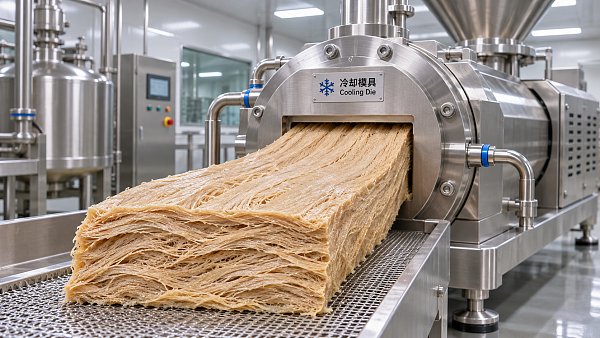
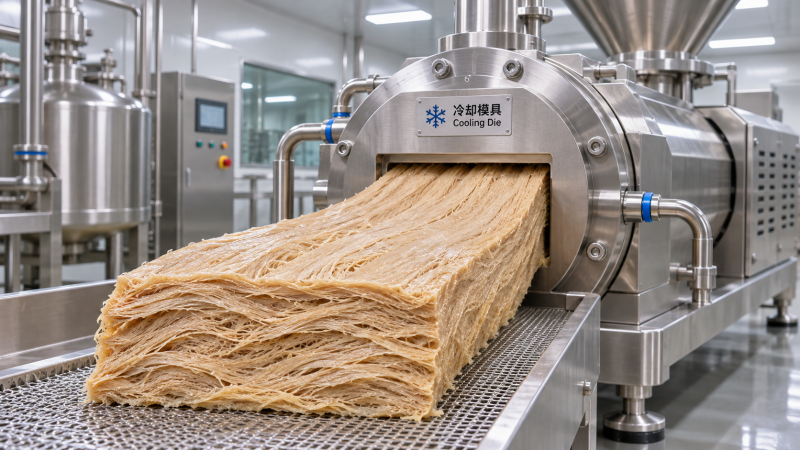
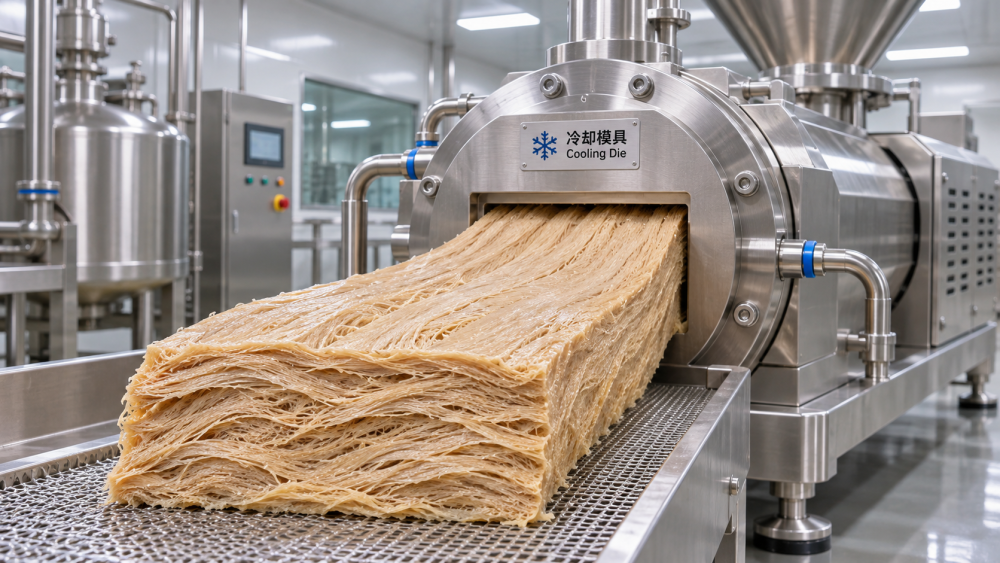
High-moisture extrusion typically uses more water and a cooling die to produce a dense, layered material with limited expansion. It is often considered for strips, chunks or whole-cut-style products. The cooling die is part of the texture-forming process: it removes heat while the material remains confined and flows through the channel.
Neither route is inherently better. Low-moisture ingredients can simplify dry storage but require a controlled rehydration step. High-moisture products may offer a more immediately fibrous structure, but their water content makes downstream hygiene, temperature control and shelf-life validation central to the project.
The process variables interact
Water changes both flow and structure
Water acts as a plasticizer and affects viscosity, heat transfer and protein interactions. Too little can make a formulation difficult to convey or create excessive mechanical load. Too much may reduce the stresses needed for structure formation or produce a soft, poorly defined texture. The workable range is formulation-specific, so a moisture setting that succeeds with one protein blend should not be treated as a universal target.
Measure moisture in the incoming ingredients as well as added water. A change in powder moisture or water absorption can shift the effective formulation even when the dosing setpoints remain unchanged. Sampling and a consistent basis for reporting moisture help distinguish an ingredient problem from a machine problem.
Barrel temperature is not the whole thermal history
Heat supports protein unfolding and changes the behavior of other ingredients, but excessive thermal treatment can damage flavor, color or functionality. Barrel setpoints are useful operating references, not necessarily the temperature experienced by every part of the product. Mechanical energy can also heat the mixture, and temperature varies along the process path.
When comparing trials, record measured product temperatures where practical, alongside barrel settings, pressure and motor load. If a supplier reports only a barrel temperature profile, ask how product temperature was measured and under what throughput and formulation conditions.
Screw configuration and feed rate determine the work done
Screw speed affects conveying, mixing and mechanical energy input, but it cannot be interpreted on its own. Screw geometry, fill level, feed rate, viscosity and die resistance all influence the actual stresses applied to the material. More speed does not automatically mean better fiber development; it can also increase heat generation or shorten the time available for particular transformations.
Twin-screw extruders offer configuration flexibility and controlled feeding for many formulations, while single-screw systems can be suitable for established applications. The useful comparison is not the number of screws in isolation. It is whether the machine can process the intended recipe at a stable rate, with acceptable texture and manageable wear.
Why the cooling die deserves as much attention as the barrel
In high-moisture processing, a promising melt can lose its potential if the die does not provide suitable flow and cooling. Channel geometry, residence time, temperature control and pressure drop influence how the product exits and whether layers remain coherent. Uneven cooling or flow distribution can produce differences across the width of the product, even when barrel conditions appear stable.
A common evaluation mistake is to compare dies solely by nominal width or advertised capacity. Ask whether the design allows temperature monitoring and adjustment, how readily it can be opened for inspection, and whether the proposed throughput has been demonstrated with a comparable formulation. A wider die can raise output, but only if material distribution and cooling remain sufficiently uniform.
Examine samples from the center and edges separately. Differences in tearing behavior, moisture or layer definition may reveal distribution issues that an averaged sample would conceal.
Ingredient specifications can change the result
Soy, pea, wheat and other protein ingredients do not behave interchangeably. Even ingredients with similar declared protein content may differ in solubility, particle size, water absorption, residual starch or fat, and response to heat. Those differences affect feeding and flow before they show up as a texture defect.
Fat, flavor systems, fibers and binders also have consequences beyond taste or labeling. Depending on their type and addition point, they can change lubrication, water distribution and structural continuity. A formulation that works on a pilot line may need adjustment when an ingredient supplier or processing grade changes.
For development trials, retain the ingredient specifications and batch identifiers with the process data. If a later batch behaves differently, that record makes it possible to investigate raw material variation rather than immediately redesigning the screw or die.
Test texture in the finished application, not only at the die
A fresh extrudate can look convincing and still fail commercially. Chopping may destroy its layers; freezing and thawing may alter water retention; a marinade may soften the structure; cooking may expose a dry or rubbery bite. Define the end-use process before choosing the acceptance test.
Instrumental texture measurements can help compare batches, but the method needs to reflect the product. Compression, cutting and tensile tests answer different questions. For an anisotropic product, test across and along the visible structure where practical. Report sample preparation, temperature, dimensions and test direction so results can be compared meaningfully.
Pair those measurements with controlled cooking and sensory assessment. Check bite, chew, juiciness, particle integrity and any undesirable pastiness or toughness. Water loss during cooking is useful, but it should not be interpreted alone: a product can retain water and still feel gummy.
From pilot trial to production decision
Scale-up is not a simple matter of copying screw speed and temperature settings to a larger extruder. Equipment geometry, heat transfer, fill level and residence-time distribution change. A production trial should therefore establish a stable operating window rather than a single successful sample.
Agree in advance on the feedstock, target formulation, run duration, sampling plan and definition of saleable output. Record startup losses and periods of instability separately from steady-state production. Nominal throughput is less informative than the rate of product meeting the agreed texture, moisture and appearance specifications after downstream handling.
Also examine the surrounding line. Powder handling, water dosing, cutting, cooling, packaging and cold storage can constrain output even when the extruder has spare capacity. For high-moisture products, establish a food safety plan covering hygienic design, cleaning, environmental controls and validated storage conditions. Extrusion heat alone should not be assumed to guarantee the safety or shelf life of the packaged product.
The Global AgriFood & Bioscience Intelligence Alliance (AFBN) approaches these decisions across ingredients, processing equipment, food safety and supply chains. That broader view is useful here: a credible extrusion assessment connects the texture seen in a trial with ingredient variability, measurable operating conditions and the requirements of the finished product.
Before selecting a process or accepting a supplier trial, request samples made with the intended formulation and test them through the actual downstream steps. If the process window, cleaning approach or product acceptance criteria are still undefined, an attractive fibrous sample is a starting point—not evidence that the production system is ready.
Want to dive deeper into these market dynamics, or need data-driven support for your next business move? Drop a line below and let the analysts at AFBN provide customized insights.
We respect your privacy. Your information is strictly confidential.
相关推荐
 How Extrusion Processing Creates Texture in Plant-Based MeatExplore plant-based processing extrusion and discover how moisture, heat and cooling shape meat-like texture, plus what to consider when evaluating equipment and scaling production.
 Specifying Stainless Steel Mixing Tanks for Alcohol ProductionSpecify stainless steel mixing tanks for alcohol production with confidence. Explore agitation, cleaning, safety and supplier criteria for a better investment.
 Dairy Equipment Price Guide: Budgeting for Machines and InstallationCompare dairy equipment prices beyond the machine quote. Learn how to budget for installation, utilities, startup, and ownership costs before you buy.
 Choosing a Yogurt Processing Line: Capacity, Product Types and EquipmentCompare dairy processing lines for yogurt by capacity, product type and equipment. Discover key factors for selecting a reliable, scalable production line.