




Search
Related News
- 00
0000-00
How to Select Agricultural Irrigation Solutions for Water-Limited Farms - 00
0000-00
How to Select Food Plant Sanitation Equipment for High-Risk Processing Areas - 00
0000-00
Selecting Meat Packaging Technology to Extend Shelf Life and Control Leakage - 00
0000-00
Selecting Secondary Dairy Packaging Systems for Hygienic, High-Speed Distribution - 00
0000-00
How to Design Greenhouse Irrigation Zones for Uniform Watering and Lower Waste
How washing and classification systems control quality in food processing




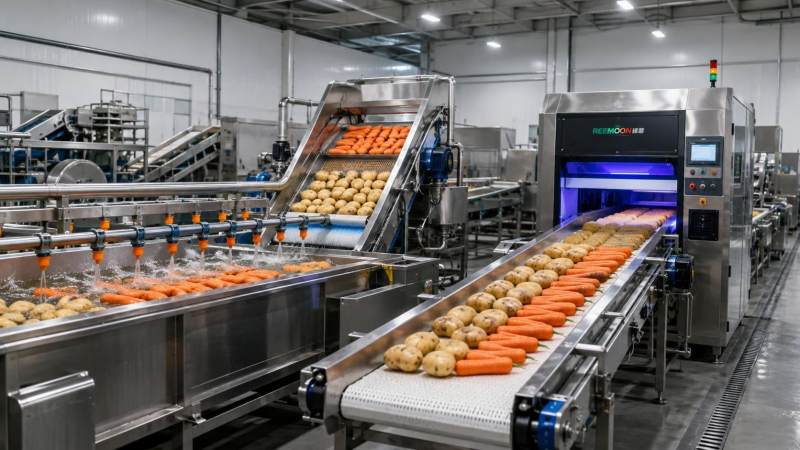
In food processing, washing and classification systems are often treated as early-stage equipment. In reality, they set the conditions for almost everything that follows: cutting accuracy, cooking consistency, packaging appearance, shelf life, foreign-material control, and the credibility of a plant’s quality records. A poorly controlled incoming product stream can turn a well-designed downstream line into a source of rework, waste, and recurring customer complaints.
For technical evaluators, the question is not simply whether a system can wash or sort. The more important question is whether it can produce a predictable, documented, and hygienically controlled product stream under real operating conditions. That means dealing with natural variation in raw materials, fluctuating soil loads, fragile product surfaces, changing throughput, water constraints, and the practical limits of sensors, operators, and sanitation routines.
Washing and classification therefore need to be assessed as a connected quality-control function rather than as two isolated machine categories. Washing removes or reduces unwanted material; classification determines which product is suitable for a defined destination. Together, they decide what enters the value-added part of the process and what must be diverted, reworked, downgraded, or rejected.
Quality begins before the product looks clean
A visual inspection of washed produce can be misleading. A product may appear clean while still carrying residual soil, plant debris, pesticide residues within the relevant control scope, microbial contamination, damaged tissue, or small foreign materials that are difficult to detect by eye. Conversely, an aggressive wash may remove visible dirt but create bruising, water uptake, or surface damage that shortens shelf life.
This is why a washing system should be evaluated against the specific contamination profile of the raw material. Root vegetables arriving from wet fields require a different approach from leafy greens grown in controlled environments. Fresh-cut fruit, shellfish, grains, potatoes, herbs, and frozen vegetables all present different combinations of soil, wax, sand, insects, stems, stones, damaged pieces, and microbiological risk.
The basic goal is straightforward: remove what should not be present without harming what must be sold. Achieving that balance requires attention to water flow, turbulence, spray pressure, immersion time, brush contact, belt speed, product loading, drainage, and the condition of recirculated water.
Washing is a controlled process, not a rinsing event
Most food washing operations combine several physical mechanisms. Flumes and immersion tanks loosen soil and allow heavier contaminants to settle. Air agitation can separate leaves or delicate items without excessive mechanical contact. Spray bars remove residual particles after a first wash stage. Brush washers are useful for firm produce such as carrots, potatoes, citrus, and certain fruits, but brush intensity must match the product’s skin strength and defect tolerance.
In a robust design, the system also controls the water itself. Filtration, sediment removal, water renewal, temperature management, disinfectant dosing where appropriate, and monitoring of chemical concentration all influence the final result. If wash water is not managed properly, it can become a vehicle for cross-contamination rather than a barrier against it.
Technical teams should look beyond the nominal water consumption figure. Lower water use may be attractive, especially in regions facing scarcity or high treatment costs, but aggressive recirculation without adequate filtration and validation can compromise hygiene. The right benchmark is not “minimum water”; it is sufficient water quality and cleaning performance at the required production load.
Classification gives product quality a measurable definition
After washing, classification systems translate a broad incoming harvest or raw-material stream into usable commercial categories. Depending on the product, classification may be based on size, weight, shape, color, ripeness, surface defects, internal defects, density, moisture, or the presence of foreign objects. The result is not merely a neater appearance. It is a more stable manufacturing input.
A French fry line needs potatoes within a predictable size and defect range. A fresh-pack tomato operation must separate fruit by color, diameter, firmness, and visual damage. A dried fruit processor may need to identify stems, pits, shriveled pieces, and color deviations. In seafood, grading can determine portion consistency and downstream freezing or packaging performance. Each application has its own definition of “acceptable,” and the classification equipment must reflect that definition.
Mechanical graders remain relevant where the quality criteria are mainly dimensional or weight-based. Roller graders, screens, belts, sizers, and weigh graders can provide dependable separation when the product geometry is reasonably consistent. However, they cannot reliably distinguish between two products of the same size when one has decay, bruising, discoloration, or an internal defect.
This is where optical sorting, machine vision, near-infrared technologies, X-ray inspection, and sensor-based classification can add value. These systems may identify color variation, shape irregularities, surface contamination, foreign materials, or density-related anomalies that mechanical separation cannot see. Their value depends heavily on product presentation, lighting stability, camera calibration, software settings, and the quality of the reject mechanism.
The handoff between washing and sorting is where many lines lose control
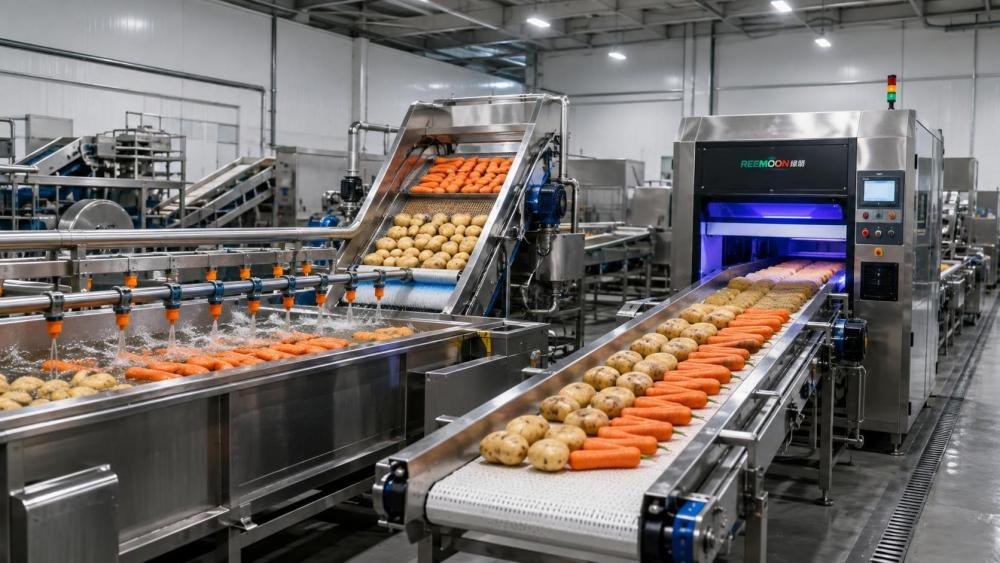
The transition from washing to classification deserves close attention. Products leaving a washer may be wet, overlapping, rotating unpredictably, or carrying residual debris. These conditions can reduce the accuracy of optical systems, cause false rejects, and make grading results inconsistent.
Effective dewatering and singulation are often the missing link. Vibratory conveyors, roller sections, air knives, drainage belts, and spacing devices can prepare the product for reliable inspection. The aim is to present each item separately, in a stable orientation where possible, with limited surface water and minimal product-to-product contact.
For delicate produce, the engineering challenge becomes more demanding. A system designed to maximize separation can cause drops, impacts, or compression points. Technical evaluators should map every transfer point from receiving through washing, drying, sorting, and packing. Damage often occurs not inside the principal machine but between machines, where line interfaces receive less design attention.
What should be measured when evaluating washing and classification systems?
Throughput is necessary, but it is not enough. A line may achieve its advertised capacity with uniform product under ideal conditions and perform very differently when raw material arrives with higher soil load, variable sizing, or seasonal quality shifts. Evaluation should therefore include performance criteria that connect the machine to the plant’s actual quality objectives.
- Cleaning effectiveness: How reliably are soil, stones, plant material, insects, and other unwanted matter removed at normal and peak loads?
- Product damage: Does the system create bruising, skin breakage, cracking, tissue damage, or excessive trimming losses?
- Classification accuracy: What proportion of defects is correctly rejected, and how much acceptable product is unnecessarily removed?
- Yield and grade recovery: Can the system separate higher-value product from lower-value material without sacrificing saleable yield?
- Water and sanitation control: Are filtration, drainage, cleaning access, chemical dosing, and water-quality monitoring adequate for the process risk?
- Changeover capability: How quickly can the line be adjusted for different varieties, sizes, grades, or customer specifications?
- Traceability: Can operational data, reject reasons, inspection records, and quality trends be linked to batches or production lots?
These metrics should be reviewed together. For example, a classifier tuned for extremely low defect escape may reject a large amount of acceptable product. That may be justified for a premium fresh-food brand, but less appropriate for an ingredient stream where a different tolerance is commercially reasonable. A good technical decision connects quality thresholds to product use, customer expectations, and economic consequences.
Food safety requires more than a hygienic machine design
Stainless-steel frames, smooth welds, sloped surfaces, enclosed motors, and tool-free access are important features, but hygienic design alone does not guarantee food safety. The system must also be cleanable within the available sanitation window, accessible for inspection, and designed to avoid stagnant water, trapped residues, and difficult-to-reach transfer areas.
For wet processing lines, evaluate where water accumulates during operation and after shutdown. Look at hollow sections, conveyor returns, spray manifolds, belt supports, brush assemblies, inspection chutes, and drainage points. Residual organic matter can support microbial growth, particularly where temperatures, moisture, and cleaning limitations create favorable conditions.
Water management plans should distinguish between process water, final-rinse water, and wastewater. Depending on product category and local regulatory requirements, facilities may need defined controls for source water quality, treatment methods, sanitizer concentration, pH, oxidation-reduction potential, turbidity, microbial verification, and water replacement frequency. The correct program is process-specific; copying settings from another plant is not a substitute for validation.
Automation improves consistency only when the data is trusted
Modern washing and classification systems increasingly generate data on flow rates, belt speeds, water conditions, reject volumes, defect categories, product counts, and operating alarms. This information can be valuable for quality assurance, preventive maintenance, supplier assessment, and production planning. It can reveal, for instance, that one field, farm, harvest period, or inbound supplier is associated with unusually high soil load or defect rates.
Yet data is useful only if the underlying inspection logic remains credible. Vision systems need regular verification with representative product samples. Sensor thresholds must be reviewed when varieties, seasons, lighting conditions, or customer specifications change. Reject devices should be checked to confirm that items identified by the system are actually removed from the correct stream.
Technical evaluators should ask whether operators can understand and act on the data. A dashboard filled with alarms does not improve quality if no one knows which alarm requires an immediate line adjustment and which one is simply informational. Clear operating limits, escalation rules, and calibration routines are as important as the digital interface.
Common mistakes in system selection
One recurring mistake is selecting equipment based on a single “worst-case” product sample. A better approach is to test the expected range: clean and dirty loads, small and large pieces, wet and dry conditions, seasonal varieties, damaged product, and representative foreign material where safe and appropriate. Equipment should be assessed on variation, because variation is normal in agri-food production.
Another mistake is treating classification as an end-of-line cosmetic step. When defective or unsuitable material is removed too late, it may already have consumed labor, energy, cutting capacity, freezing capacity, or packaging materials. Early and accurate classification can protect downstream equipment and prevent poor material from contaminating otherwise good batches.
There is also a tendency to over-automate an unstable process. If incoming specifications are unclear, wash-water control is weak, or product presentation is inconsistent, adding advanced sensors may create impressive images but unreliable decisions. The process foundation must be stable before complex inspection technology can perform at its best.
A practical evaluation path for project teams
Before comparing suppliers, define the product categories, contamination risks, acceptable defect limits, required grades, planned throughput, and sanitation regime. Then map how the system will connect to receiving, trimming, cutting, freezing, packing, cold storage, or other downstream operations. This avoids evaluating a washer or sorter as though it operates in isolation.
Factory acceptance tests and on-site trials should use documented criteria, not general impressions. Review cleaning results, product damage, yield, accuracy, water use, operator interventions, cleaning time, and maintenance access. Where optical or sensor-based sorting is involved, ask for clear definitions of defect libraries, calibration procedures, software access, data ownership, and support responsibilities.
For organizations assessing global food-processing technologies, the most useful perspective is lifecycle performance. The best washing and classification systems are not necessarily the ones with the most features. They are the systems that maintain hygiene, preserve product value, deliver repeatable grades, fit the plant’s utilities and labor model, and generate evidence that quality decisions are under control.
That is the real role of washing and classification in food processing: turning variable biological materials into a dependable, traceable production input—without losing sight of yield, food safety, and the commercial value of every usable piece of product.