




Search
Related News
- 00
0000-00
Animal Nutrition Premix: How to Choose a Formula for Livestock - 00
0000-00
USDA Cuts US Corn Output and Stocks, Raises Soybean Yield in November WASDE - 00
0000-00
Choosing Dairy Farm Systems: Milking, Feeding, and Herd Management - 00
0000-00
Rabobank: Climate Change and Heat Stress Threaten European Dairy Competitiveness - 00
0000-00
Planning Feeder and Drinker Layouts in a 1,000-Broiler House
Stainless Steel Mixing Tanks: Matching Agitation to Alcohol Blending




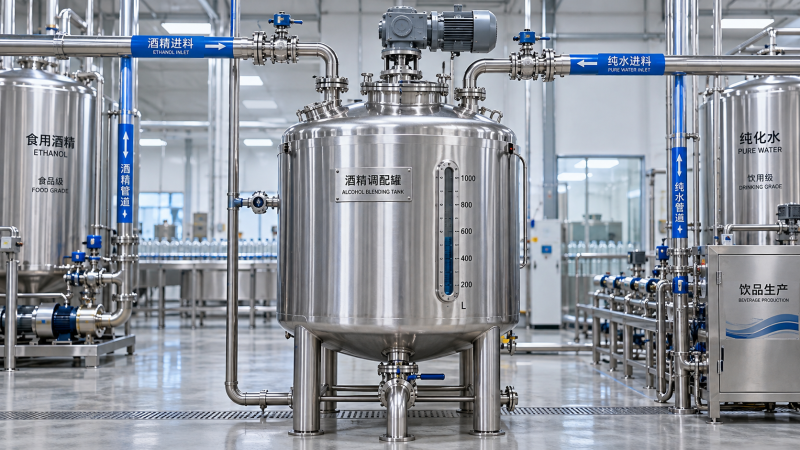
A tank can reach the target alcohol concentration at one sampling point while remaining uneven elsewhere. The problem may be inadequate circulation, a poorly positioned addition point, or an impeller that loses effectiveness at low fill levels. Selecting agitation for alcohol blending therefore starts with the mixing duty and operating envelope—not with tank capacity or motor power alone.
For a clear spirit diluted with water, the main task is usually bulk homogenization. A sweetened liqueur may also require syrup incorporation, while a cream-based formulation introduces different viscosity and emulsion requirements. These duties should not automatically share one agitator specification. Technical evaluators need to establish what must become uniform, how quickly, and without which unwanted effects.
Define the blending duty before selecting the agitator
A useful process specification describes the ingredients as they enter the vessel, rather than only the finished beverage. A low-viscosity finished product may still involve adding a viscous syrup. Likewise, an apparently straightforward liquid blend can become difficult if ingredients enter at different temperatures or through a connection outside the main circulation path. Mixing references distinguish bulk blending, solids suspension, dissolution, and dispersion because each places different demands on the equipment.[1]
For alcohol blending, separate the recipe into its actual operations:
- Alcohol and water blending: establish uniform composition and temperature throughout the working volume.
- Syrup incorporation: move the incoming syrup away from the addition point and distribute it without leaving concentrated regions.
- Powder addition: distinguish wetting and dissolution from simply circulating liquid around undissolved material.
- Flavor incorporation: determine whether the ingredient dissolves, remains dispersed, or requires an emulsion.
- Product holding: identify whether continued agitation is needed after blending, and whether a lower holding speed is acceptable.
Record minimum and maximum batch volumes, ingredient properties over the expected temperature range, addition sequence, allowable processing time, and the acceptance criteria for uniformity. Include startup and interrupted-batch conditions. A mixer that performs well with a full vessel may not provide the same circulation when the liquid barely covers the impeller.[1]
When comparing stainless steel mixing tanks for alcohol service, vessel construction and agitation should be evaluated as one system. The relevant question is whether the impeller, tank geometry, connections, and operating controls can execute the proposed blending sequence—not whether the equipment is simply described as suitable for beverages.
Match the impeller to circulation, viscosity, and shear sensitivity
For many low-viscosity, miscible-liquid blends, an axial-flow impeller is a reasonable starting point because it promotes circulation along the vessel axis. Hydrofoils and pitched-blade turbines are examples, but their performance depends on geometry, diameter, speed, placement, and baffling. An impeller name alone does not establish blend time or suitability.[1]
A rotor-stator mixer can address some wetting and dispersion duties, but it should not be assumed to replace whole-vessel circulation. Conversely, adding shear to an already miscible liquid blend may provide little benefit if poor circulation is the actual limitation. Evaluate dispersion and bulk blending separately, then decide whether one device can perform both tasks.[1]
Variable-speed control offers flexibility, but the useful operating range must be defined. Low-speed operation needs sufficient circulation and mechanical stability; high-speed operation must remain within shaft, seal, drive, and process limits. For viscous formulations, startup torque and gearbox capability deserve explicit review alongside motor power.
Read the tank geometry as part of the mixing specification
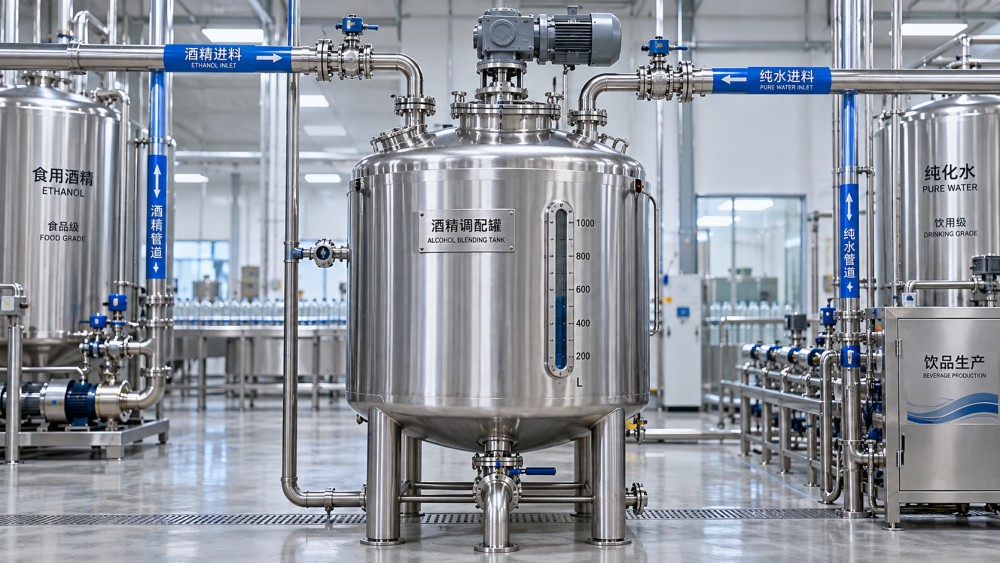
An unbaffled, centrally agitated vessel may develop substantial rotational flow rather than the desired circulation through the liquid volume. Baffles can reduce this tendency, although their dimensions and arrangement must be considered together with the impeller. Alternative configurations, including offset agitation, may be appropriate where internal obstructions are undesirable, but they require their own performance justification.[1]
Ask the supplier to show the impeller diameter, bottom clearance, liquid heights, and any baffle arrangement on the same drawing. A tall vessel may require multiple impellers or a different circulation strategy. At minimum fill, an upper impeller may become exposed or disturb the surface. These conditions can be missed when proposals show only nominal capacity and maximum liquid level.
The addition point is another functional component. Feeding syrup into a poorly swept region can leave a concentrated layer even when the surrounding liquid appears active. Feeding near a strong circulation zone may improve incorporation, but the exact arrangement should account for access, splashing, cleaning, and the properties of the incoming ingredient. Visual movement at the surface is not proof of uniformity at the bottom.
External recirculation is an alternative worth comparing when the process benefits from inline ingredient addition or instrumentation. Its evaluation should include the withdrawal and return locations, pump operating limits, line cleanability, and residual product volume. A high recirculation rate does not by itself demonstrate that every part of the vessel participates in blending.[1]
Use operating parameters carefully—and avoid simplistic scale-up
Impeller speed is easy to compare, but revolutions per minute are not a transferable measure of mixing performance. Impeller diameter changes tip speed, pumping behavior, and power demand. Tank proportions and fluid properties also affect the resulting flow.[1]
Two useful relationships illustrate why a single headline specification is insufficient:
- Tip speed: proportional to impeller diameter multiplied by rotational speed. It helps describe impeller motion but does not establish whole-tank blend time.
- Impeller power: commonly expressed as P = Np × ρ × N³ × D⁵, where Np is power number, ρ is density, N is rotational speed, and D is impeller diameter. Power number depends on the impeller and flow regime.[1]
These relationships are engineering tools, not acceptance tests. Equal power per unit volume across two tanks does not necessarily produce equal blending performance. Neither does equal tip speed. A scale-up proposal should state the criterion being preserved, the assumptions about viscosity and flow regime, and the expected effects of changing vessel geometry.
Require the supplier to distinguish motor nameplate rating from calculated impeller power. Also request the predicted performance at the minimum batch volume and the most demanding ingredient condition. A calculation based only on the final diluted product can overlook the temporary conditions created during addition.
Account for alcohol measurement, temperature, and vapor risk
Alcohol-water blending requires a measurement plan as well as a mixer. Alcoholometric relationships account for composition, density, and temperature; ingredient volumes should not be treated as simply additive when establishing final concentration. OIML R 22 provides international alcoholometric tables for ethanol-water mixtures.[2] For formulations containing sugar or other dissolved ingredients, confirm that the selected analytical method is appropriate to the matrix rather than applying a binary-mixture density relationship without qualification.
Temperature should be recorded during trials because it affects density-based interpretation and can influence process behavior. Define the reference temperature, sampling procedure, and any conditioning required before analysis. Apparent differences between samples may otherwise reflect measurement handling rather than inadequate mixing.
Flammability assessment must cover the actual materials and operating conditions, including concentrated alcohol feeds—not just the finished beverage. The NIOSH Pocket Guide identifies ethanol as a flammable liquid and provides hazard information for the pure substance; that information is a starting point, not a substitute for evaluating a specific beverage mixture.[3]
For U.S. facilities, OSHA requirements concerning flammable liquids and hazardous electrical locations provide relevant regulatory references.[4] Applicable duties elsewhere depend on local law. Ventilation, vapor release points, electrical classification, ignition control, and bonding or grounding should be reviewed by qualified personnel. A motor described as “explosion-proof” does not establish the suitability of the complete installation, including instruments, wiring, and surrounding equipment.
Evaluate cleanability and material compatibility together
Stainless steel grade should be selected against the complete exposure profile: ingredients, dilution water, cleaning chemicals, temperatures, and contact times. Grade designation alone does not establish corrosion resistance for every process or hygienic suitability. Procurement documents should identify wetted materials and the compatibility basis for seals and gaskets, not merely describe the vessel as “food grade.”
Hygienic design also depends on accessibility, drainage, joints, and surface condition. EHEDG’s hygienic design principles provide a useful framework for assessing equipment that must be cleaned reliably.[5] In U.S. food manufacturing, 21 CFR 117.40 addresses equipment construction, cleanability, and protection against contamination.[6] These references inform evaluation; they do not demonstrate that a particular tank complies.
Review the underside of impellers, shaft connections, baffle attachments, and instrument fittings as potential cleaning challenges. Ask how cleaning solution reaches these areas and how performance will be verified. A spray device’s nominal coverage should not be accepted as evidence that all product-contact surfaces are adequately cleaned.
Maintenance access affects the practical decision too. Compare seal replacement procedures, lifting requirements, spare-part identification, and any product-contact work needed during repair. A configuration with fewer internal components may simplify cleaning, while a more elaborate arrangement may offer better mixing under difficult conditions. The trade-off should be explicit.
Make acceptance testing reflect the production envelope
A useful acceptance plan defines the endpoint before the trial. “Mix until uniform” is too vague unless uniformity has a measurable meaning. Establish the sampling locations, analytical method, allowable variation, temperature conditions, and maximum permitted blending time.
Sampling should cover locations capable of revealing poor circulation, rather than relying solely on a convenient outlet. Where vessel access limits sampling, agree on a justified alternative before testing. A water-only test can demonstrate mechanical operation, but it cannot automatically validate syrup incorporation, powder wetting, or performance with a more viscous formulation.
Test representative operating extremes: the lowest working volume, the highest volume, and the ingredient condition expected to create the greatest mixing difficulty. Record addition sequence, feed rate, mixer speed, temperature, and observed surface behavior. Check discharge behavior as well, since satisfactory bulk mixing does not prove that retained material in a connection or poorly drained area meets the same composition criteria.
The strongest selection is a documented match between duty and performance. Specify the required circulation and incorporation outcomes, verify them across the intended operating range, and keep safety and cleaning assessments separate from claims about blend time. Motor size and stainless steel construction are inputs to that decision, not substitutes for it.
References
- Paul, E. L., Atiemo-Obeng, V. A., and Kresta, S. M., editors. Handbook of Industrial Mixing: Science and Practice. Wiley-Interscience, 2004.
- International Organization of Legal Metrology. OIML R 22: International Alcoholometric Tables. 1975.
- National Institute for Occupational Safety and Health. NIOSH Pocket Guide to Chemical Hazards, entry for ethyl alcohol.
- U.S. Occupational Safety and Health Administration. 29 CFR 1910.106, Flammable Liquids; and 29 CFR 1910.307, Hazardous (Classified) Locations.
- European Hygienic Engineering & Design Group. Document 8: Hygienic Design Principles. Third edition, 2018.
- U.S. Food and Drug Administration. 21 CFR 117.40, Equipment and Utensils.