




Search
Related News
- 00
0000-00
Animal Nutrition Premix: How to Choose a Formula for Livestock - 00
0000-00
USDA Cuts US Corn Output and Stocks, Raises Soybean Yield in November WASDE - 00
0000-00
Choosing Dairy Farm Systems: Milking, Feeding, and Herd Management - 00
0000-00
Rabobank: Climate Change and Heat Stress Threaten European Dairy Competitiveness - 00
0000-00
Planning Feeder and Drinker Layouts in a 1,000-Broiler House
What Does Food Packaging Technology Cost Beyond the Equipment Price?




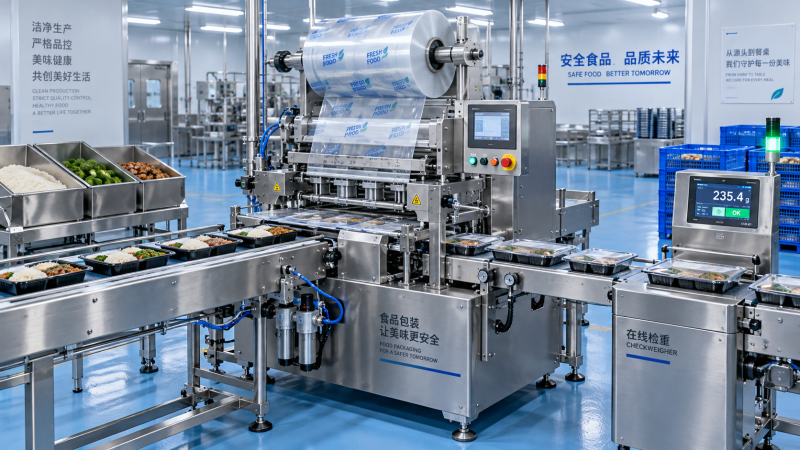
A competitive equipment quote can still lead to an expensive packaging operation. The relevant cost is not simply the machine price, but the investment required to produce a saleable, compliant pack at the required output. Installation, line integration, packaging materials, cleaning, labor, maintenance, and validation all affect that figure.
The most useful way to compare food packaging technology cost is to separate the cash needed to reach stable production from the recurring cost per accepted pack. A lower purchase price is only an advantage if it survives both comparisons under the same product mix, operating schedule, and quality requirements.
The quotation boundary determines what the price actually means
A packaging machine can be quoted as a standalone unit, a partially integrated system, or a complete line. Those offers are not financially comparable until their boundaries are aligned. A filler may exclude product feeding, while a tray sealer may exclude tooling, gas mixing, or downstream inspection. Even a “turnkey” offer needs a written scope defining where responsibility starts and ends.
Before comparing prices, specify the required output as accepted packs per hour for identified products and formats—not maximum mechanical speed. Pack dimensions, product temperature, fill characteristics, seal contamination, and inspection requirements can change achievable performance.
For imported equipment, shipping terms also matter. Freight, insurance, duties, nonrecoverable taxes, customs handling, and inland delivery should be assigned explicitly. Recoverable import taxes may be a working-capital requirement rather than a permanent project cost; their treatment depends on local rules and the company’s tax position.
Getting the machine into production can require a separate investment
Site readiness is a source of budget exposure because it sits between equipment supply and factory infrastructure. Check electrical capacity, voltage and frequency compatibility, compressed-air quality, vacuum provision, cooling, drainage, ventilation, and access for unloading. A machine that physically fits may still leave insufficient space for cleaning, maintenance, film loading, or safe movement.
Utility specifications should describe consumption under defined operating conditions. Connected electrical load is not the same as average energy use. Compressed-air demand also creates costs outside the machine through compressor operation, drying, filtration, and leakage.
Integration can be more consequential than the utility bill. If upstream filling delivers product irregularly, a fast sealer may spend time waiting. If downstream case packing cannot absorb output, the packaging machine may stop repeatedly. Buffering, conveyor controls, and product accumulation must suit the food and its handling limits.
A useful budget therefore distinguishes equipment supply, site works, and integration engineering. Otherwise, an apparently complete capital request can leave essential work unfunded.
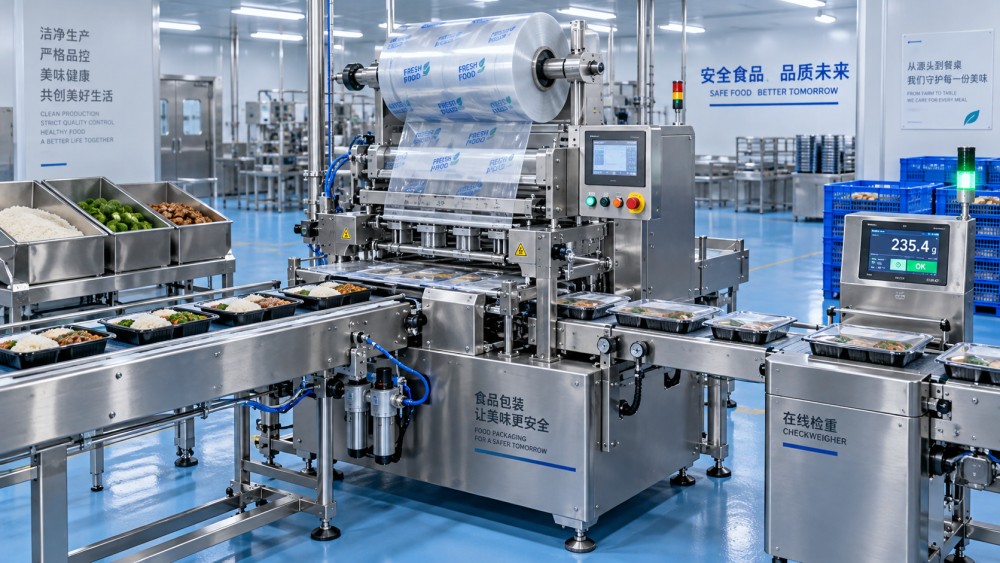
Packaging materials can outweigh the initial price difference
Film, trays, pouches, lids, labels, cartons, adhesives, and process gases create recurring costs tied to production volume. Small differences in material consumption become financially significant when applied to every pack over several years.
Material price alone is insufficient. Compare the material required per accepted pack, including trim, startup waste, reel-end losses, setup samples, and rejects. A lower-priced film may require a narrower operating window or produce more sealing failures. A higher-priced material may reduce consumption if its dimensions or structure allow a more efficient pack design—but that saving needs testing.
Machine compatibility can also restrict sourcing. Proprietary consumables, unusual reel dimensions, tightly specified tray tolerances, or limited approved suppliers can reduce negotiating flexibility. Ask which specifications are essential to performance, which alternatives have been demonstrated, and whether using another qualified material affects warranty coverage.
For modified-atmosphere packaging, include gas consumption, supply arrangements, and verification of the required atmosphere. For vacuum packaging, assess vacuum performance with the actual product and loading pattern. Neither technology should be evaluated on the assumption that the packaging machine alone guarantees shelf life.
Material qualification also consumes cash before routine production. Minimum order quantities, printed-packaging lead times, trial batches, and safety stock can increase working capital. A format change may leave obsolete packaging inventory even when the machine itself changes over successfully.
Nominal speed is not the denominator that matters
Cost per pack depends on saleable output, not the number printed on the machine specification. Planned cleaning, changeovers, breakdowns, minor stops, reduced-speed running, and rejects all reduce output available to absorb fixed costs.
The distinction becomes critical on lines with many short production runs. A machine with a higher top speed may offer little economic advantage if tooling changes, recipe adjustments, and restart checks consume the available production window. Compare changeover time from the last accepted pack of one format to stable, accepted production of the next—not merely the time needed to exchange a tool.
Labor estimates need the same discipline. Automation may remove a manual loading task while retaining material replenishment, inspection, cleaning, and fault recovery. Count staffing across the operating shift, including shared support where it is genuinely required. Do not value labor savings as cash savings unless staffing costs or paid hours can actually be reduced, or released capacity has a defined use.
Downtime should be valued according to the production constraint. If lost output can be recovered within existing capacity, the incremental cost may be overtime, rescheduling, and waste. If the line is capacity-constrained, lost contribution from unfulfilled demand may also matter. Adding lost revenue, lost margin, and recovery costs indiscriminately overstates the exposure.
Cleaning and food safety change the operating economics
A machine’s hygiene design affects both production availability and cleaning expense. Access to product-contact areas, disassembly requirements, drainage, component protection, and compatibility with cleaning chemicals influence labor hours and restart time. A faster production cycle can be offset by a longer sanitation cycle.
The appropriate cleaning regime depends on the food, contamination risks, and production environment. Dry products, chilled ready-to-eat foods, and allergen-containing products do not impose identical requirements. Equipment should be assessed against the intended sanitation method rather than a general claim that it is “food grade.”
Budget separately for commissioning checks and product-specific validation. Depending on the application, expenditure may include seal-integrity testing, leak testing, residual-oxygen measurement, coding verification, food-contact documentation review, and shelf-life studies. Machine conformity documentation does not establish that a particular food-and-package combination achieves the intended shelf life.
Inspection also has an integration cost. Checkweighing, metal detection, or X-ray inspection may require suitable spacing, stable product presentation, verified rejection, and records. The detection device price alone does not cover the complete inspection function.
Maintenance cost includes the ability to recover production
A spare-parts list is only part of the maintenance budget. Include scheduled servicing, wear components, calibration where required, specialist labor, software support, and the stock needed to avoid extended stoppages. Identify which components are available locally and which depend on the original manufacturer.
Service commitments should distinguish response from restoration. A promise to acknowledge a fault quickly does not establish when a technician, replacement controller, or sealing assembly will reach the site. Remote diagnosis can help, but it cannot replace physical intervention for every failure.
Warranty exclusions deserve particular attention. Consumables, wear parts, travel, labor, and failures associated with utilities or packaging materials may be treated differently. Confirm when the warranty begins, especially where shipping, installation, or site delays could consume part of the coverage period.
For equipment expected to operate for many years, request information on controls support, software backups, license transfer, and replacement-part availability. A low-cost machine becomes harder to justify if routine recovery depends on unsupported electronics or inaccessible programming.
A comparable cost model can reverse the apparent winner
A practical comparison uses the same evaluation period, annual accepted volume, product mix, labor rates, utility tariffs, and material assumptions. Separate one-time expenditure from recurring costs, and show working capital separately so that cash requirements are not confused with consumption.
Cost per accepted pack = total relevant ownership cost over the evaluation period ÷ accepted packs produced during that period.
The following hypothetical example illustrates the method; the figures are not market benchmarks. Both systems are assumed to deliver two million accepted packs annually for five years.
Here, combined operating cost covers packaging consumables, direct packaging labor, utilities, routine maintenance, and modeled packaging losses. The example excludes financing, tax effects, residual value, and the common food cost in saleable packs. Any difference in food wasted during packaging must be added separately.
System B costs $55,000 more to install but saves $20,000 annually under these assumptions. Its simple incremental payback is 2.75 years, and its five-year undiscounted advantage is $45,000. That result depends on achieving the assumed volume and operating savings; it is not proof that the higher-priced system is inherently better.
Test the comparison at lower utilization, a different SKU mix, higher material prices, and longer changeovers. Where timing materially affects the decision, use discounted cash flows and the organization’s approved investment assumptions. Avoid adding depreciation to the purchase price in a cash-cost model, which would double-count the capital expenditure.
Make the assumptions enforceable before placing the order
The strongest cost comparison is supported by an acceptance agreement. Define the products, packaging materials, formats, staffing, sustained test duration, quality limits, waste measurement, and utility conditions used to demonstrate performance. Factory testing establishes one set of conditions; site testing must address the installed line and its interfaces.
Training should cover operation, changeovers, sanitation, maintenance, and fault recovery—not just basic machine use. Agree on documentation language, training materials, and any follow-up support needed after startup. Link payment milestones to defined deliverables and acceptance where commercially feasible.
The decisive question is whether each offer can deliver the required accepted output at a defensible lifetime cost. A cheaper machine can be the right purchase when it fits the production pattern and has manageable support requirements. A more expensive system earns its premium only when material savings, availability, labor effects, or reduced losses are demonstrated under conditions the factory can reproduce.