




Search
Related News
- 00
0000-00
How Food Processors Can Improve Throughput Without Compromising Hygiene Control - 00
0000-00
Microbial Fermentation Explained: How It Produces Food Ingredients at Scale - 00
0000-00
Protected Cultivation Technology: Which Climate Control Systems Fit Your Crop? - 00
0000-00
Sizing Livestock Ventilation Systems for Heat, Humidity, and Ammonia Control - 00
0000-00
Agri-Food Industry Trends Reshaping Supply Chain Risk and Investment Priorities
Tags
Broiler Cage House Equipment Budgets: Capacity, Space and Ventilation




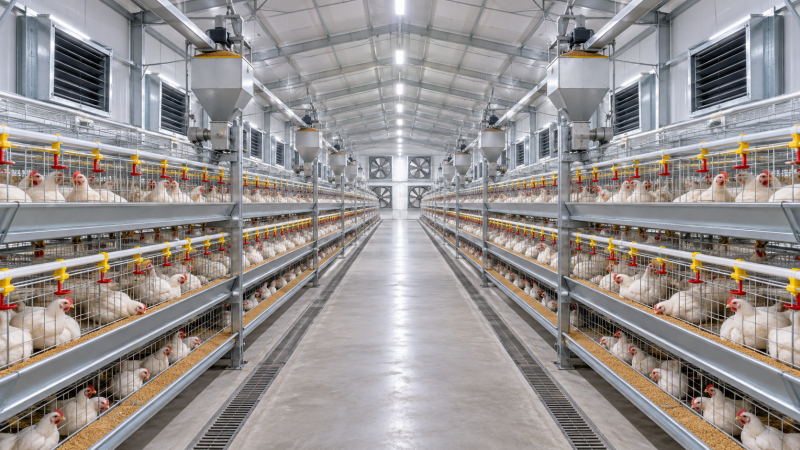
A broiler-house equipment budget becomes unreliable when capacity is treated as a single number. A proposal may state that a house holds a given flock size, yet the actual economic capacity depends on usable floor area, bird target weight, cage or pen geometry, ventilation performance, feed and water access, litter or manure handling, and the local power situation. For a finance approver, the key question is not “How many birds fit?” It is “What flock size can the house support without creating recurring losses, welfare problems, or an unplanned upgrade in the next production cycle?”
This distinction matters most when equipment is purchased as a package. A lower initial quote can conceal undersized fans, insufficient electrical protection, impractical aisle widths, weak support frames, or a house layout that leaves little room for maintenance. Those gaps tend to emerge after installation, when correcting them can involve dismantling equipment, interrupting production, or accepting a lower stocking plan than the budget assumed.
Start the budget with saleable capacity, not nominal cage positions
Nominal capacity is usually based on the number of cage positions, pens, or square metres shown on a layout. Saleable capacity should be based on the number of birds that can be placed, grown, inspected, caught, and removed under expected environmental conditions. The difference between the two figures is where much of the investment risk sits.
A useful approval model works backward from the production plan:
- Set the intended market weight and the expected number of production cycles.
- Define the house’s usable area after allowing for service passages, equipment clearances, entry areas, and access to drinker and feeder lines.
- Choose a stocking plan that can be supported at the anticipated bird weight and seasonal climate conditions.
- Check whether the ventilation, water, feed delivery, electrical system, and waste arrangement are sized for that plan.
- Use the lower of the space-based and environment-based capacities as the budget capacity.
That last step prevents a common approval error: financing cages or floor space for a theoretical maximum while funding ventilation and utilities for an average load. The house then operates close to environmental limits during hot periods, at the heaviest bird weights, or when one fan bank is unavailable.
Broiler management guidance generally treats stocking density as a management decision rather than a universal fixed figure. It should be assessed alongside bird weight, air quality, temperature, litter condition, feeder and drinker access, and the ability to inspect birds. The World Organisation for Animal Health similarly identifies stocking density, thermal environment, air quality, and access to feed and water as relevant welfare outcomes in broiler systems. Sources: WOAH, Terrestrial Animal Health Code, Chapter 7.10, “Animal Welfare and Broiler Chicken Production Systems,” 2024; Aviagen, Ross Broiler Management Handbook, 2022.
Space is a structural input to the equipment specification
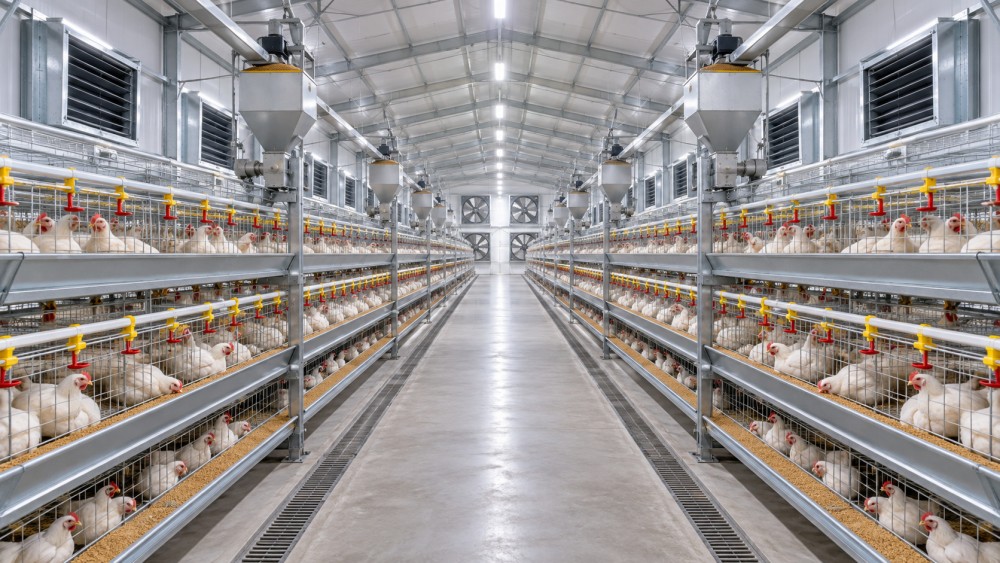
Space planning affects far more than the building footprint. It determines aisle widths, the number and location of feed and water lines, service access, airflow paths, cleaning practicality, lighting coverage, and the time required to inspect birds. In a cage-based arrangement, the specification must also account for tier height, deck depth, cage doors, egg or manure systems where applicable, and the space needed to safely remove birds.
For broilers, floor-based housing remains common in many production systems, while cage or multi-tier configurations introduce different constraints. A cage arrangement can increase the number of birds accommodated within a building envelope, but it concentrates the need for reliable environmental control and access. Finance teams should avoid assuming that a higher bird count automatically produces a lower cost per kilogram. If bird access, cleaning, airflow distribution, or serviceability are compromised, the cost of mortality, uneven performance, rejected birds, labour delays, and repairs can exceed any capital saving.
Wooden cage components require a particularly careful review in humid or washdown-prone environments. Wood can vary widely in treatment quality, moisture resistance, fastener retention, and cleanability. The procurement file should identify whether wood is structural, non-structural, or only part of a temporary frame; whether it is protected from wet manure and drinker leaks; and how damaged sections can be replaced without destabilising adjoining modules.
In local procurement discussions, the phrase broiler wooden chicken cage in nigeria may describe a practical, lower-capital housing concept, but the decision should still begin with bird space, structural loading, cleaning access, and ventilation requirements rather than the material label alone. A layout that appears inexpensive per cage can become costly if timber replacement, moisture damage, or difficult sanitation is built into routine operation.
Questions that expose weak space assumptions
- Does the drawing distinguish gross building area from bird-usable area?
- Are central aisles, end-of-row access, electrical panels, water tanks, and service zones included before capacity is calculated?
- Can workers inspect every tier or row without climbing on equipment or blocking airflow?
- Can feed lines, drinker lines, and cages be cleaned and repaired while birds are absent between cycles?
- Does the layout still work if the final market weight is higher than the original commercial forecast?
These are not cosmetic design questions. A narrow aisle may save building area but raise labour time and make sick-bird removal slower. A crowded equipment room may make a routine motor replacement more expensive because parts cannot be accessed. Space left for maintenance is a capital-cost item with an operating-cost return.
Ventilation capacity should be budgeted as a system, not a fan count
Fans are visible on an equipment quotation, but ventilation performance depends on a connected system: fan capacity, house dimensions, air inlets, controls, pressure management, electrical supply, standby power, sensors, and maintenance. A house with adequate fan nameplate capacity can still ventilate poorly if air enters through uncontrolled gaps, inlet area is wrong for the operating mode, belts slip, shutters foul, or controls do not stage equipment correctly.
Broiler ventilation has several operating purposes that can conflict if the system is simplified too far. At low external temperatures, minimum ventilation removes moisture and contaminants while limiting heat loss. At higher temperatures and larger bird weights, air speed and cooling strategy become more important. Transitional conditions require controls that can respond without abrupt temperature swings. Aviagen and Cobb management guidance both describe ventilation as a combination of air exchange, air distribution, temperature management, humidity control, and bird observation rather than simply an hourly air-volume target. Sources: Aviagen, Ross Broiler Management Handbook, 2022; Cobb-Vantress, Broiler Management Guide, 2022.
For budget approval, a supplier’s fan schedule should be reviewed alongside the layout. Ask for the stated duty point, motor rating, proposed inlet arrangement, control logic, and the assumptions used for house length, width, bird age, and climate. A free-air fan rating alone is not enough for comparing quotations because installed performance changes with pressure, shutters, guards, dust accumulation, and system resistance.
Backup power deserves separate approval rather than being treated as an optional accessory. The required generator capacity depends on which loads must continue during an outage: ventilation stages, controls, lighting, water pumping, feed delivery, cooling equipment, and safety systems. The financial review should require a prioritised load list. Funding every installed motor at once may be unnecessary in some designs, but funding too little can leave the ventilation system unable to operate in a critical condition.
Separate equipment cost from lifecycle exposure
A sound capital request divides the budget into categories that behave differently over time. Structural equipment, cages, and building works are largely fixed costs. Fans, controls, pumps, lighting, water treatment, consumables, repairs, and electricity create recurring exposure. Combining them into one undifferentiated “house equipment” line makes it difficult to compare alternatives.
Finance reviewers can use four tests:
- Capacity test: Does every major subsystem support the approved flock plan, including the heaviest birds and difficult weather periods?
- Resilience test: What happens when a fan, pump, sensor, or power source fails? Is there redundancy, an alarm, a manual procedure, and access to spares?
- Maintainability test: Can belts, motors, drinker parts, damaged cage sections, and electrical components be serviced without major disruption?
- Cash-flow test: Which costs are paid before placement, during each cycle, and when replacements are likely to be needed?
Electricity costs should be modelled using the intended operating schedule rather than motor nameplate ratings alone. A fan’s rated power indicates the maximum electrical demand under its specified conditions, but actual consumption depends on run-time, staging, speed control where used, maintenance condition, and seasonal weather. The same caution applies to water: a building may have a sufficient tank volume on paper yet lack pumping capacity, filtration, pressure regulation, or reserve arrangements during peak demand.
Water quality and equipment hygiene affect the reliability of drinker systems. Biofilm, sediment, mineral deposits, and poor flushing practices can reduce flow or make cleaning more difficult. FAO biosecurity guidance identifies cleaning, disinfection, water management, controlled access, and separation of clean and dirty operations as practical disease-risk controls for poultry production. Source: FAO, Good Practices for Biosecurity in the Small-Scale Poultry Production Chain, 2008.
Use the purchase order to close design gaps
Many budget problems begin after the quote is accepted because the scope was never converted into verifiable deliverables. A purchase order for broiler-house equipment should identify the approved drawing revision, material descriptions, coating or corrosion-protection requirements where relevant, electrical ratings, quantities, packing responsibilities, installation boundaries, and commissioning criteria. “Complete system” is too vague when different parties may supply the building shell, wiring, water source, generator, and equipment installation.
Before final payment, the acceptance process should confirm that the installed arrangement matches the approved layout; fans rotate and stage as intended; alarms and manual overrides operate; drinker lines maintain usable pressure; feed delivery runs without obstruction; and access routes remain clear. Commissioning should also include a documented power-failure simulation where safe to perform, since standby arrangements are most valuable when they operate automatically under real fault conditions.
The strongest broiler-house budget is not the one with the highest stated capacity or the lowest equipment price. It is the one whose space plan, environmental controls, utility provisions, and maintenance access all support the same realistic flock plan. When those assumptions are documented before approval, capital costs become easier to compare and operating risks are less likely to reappear as emergency expenditure after birds are already in the house.