



Search
Related News
- 00
0000-00
Probiotics Price Guide: What Drives the Cost of Bulk Ingredients? - 00
0000-00
Georgia’s Tomato Import Value Reaches Record for January–October 2026 - 00
0000-00
Health Attributes Drive Innovation in the Cereal Industry - 00
0000-00
French Tomato Output Forecast to Fall in 2026 as Prices Remain High - 00
0000-00
Choosing Food Packaging Lines: Capacity, Product Type and Automation
Powder Seasonings: Specifications to Check Before Purchase




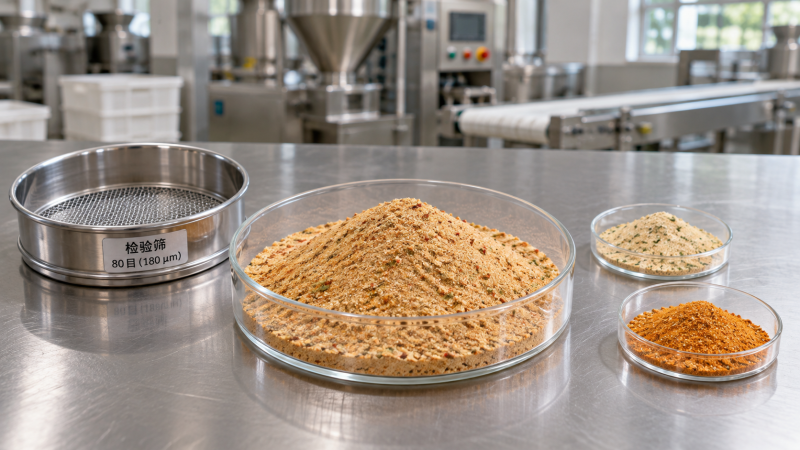
A seasoning can pass a taste test and still create purchasing problems when it reaches the production line. A blend that cakes in a hopper, varies in salt intensity, or behaves differently after heating may disrupt a product even though its ingredient name and price appear acceptable. Before placing an order, buyers need an agreed specification covering composition, physical behavior, food safety, packaging, and lot-to-lot acceptance.
The starting point is the intended use. A dry coating for snacks, a seasoning dispersed into soup, and a blend added to a sauce before heat treatment face different stresses. The same specification will not necessarily suit all three. Purchasing, product development, quality assurance, and production should agree on the conditions the powder must tolerate before comparing offers.
Define the application before comparing blends
Describe where the seasoning enters the process, the expected dosage, mixing time, processing temperature, and whether it will be exposed to oil, steam, or moisture. Include the characteristics of the finished food: a visible herb coating may need a different particle profile from a smooth beverage or sauce. A blend intended for a dry tumbler may also need to flow differently from one tipped manually into a liquid mixing tank.
When evaluating powder seasonings, buyers should distinguish between individual ground ingredients and compound blends containing several components. For a blend, the specification should identify the agreed ingredients and any carriers or processing aids that affect its use. Request enough formulation information to assess allergens, dietary claims, and labeling obligations, while recognizing that a supplier may protect proprietary proportions. Confidentiality arrangements can help resolve gaps without requiring unrestricted disclosure.
Ask for a representative sample and a written product specification at the same time. A sample demonstrates one material at one point in time; the specification establishes what can be accepted in future deliveries. Where the document uses terms such as “free-flowing,” “characteristic aroma,” or “uniform color,” agree on how those descriptions will be assessed and what happens when the buyer and supplier disagree.
Set physical specifications that match the production line
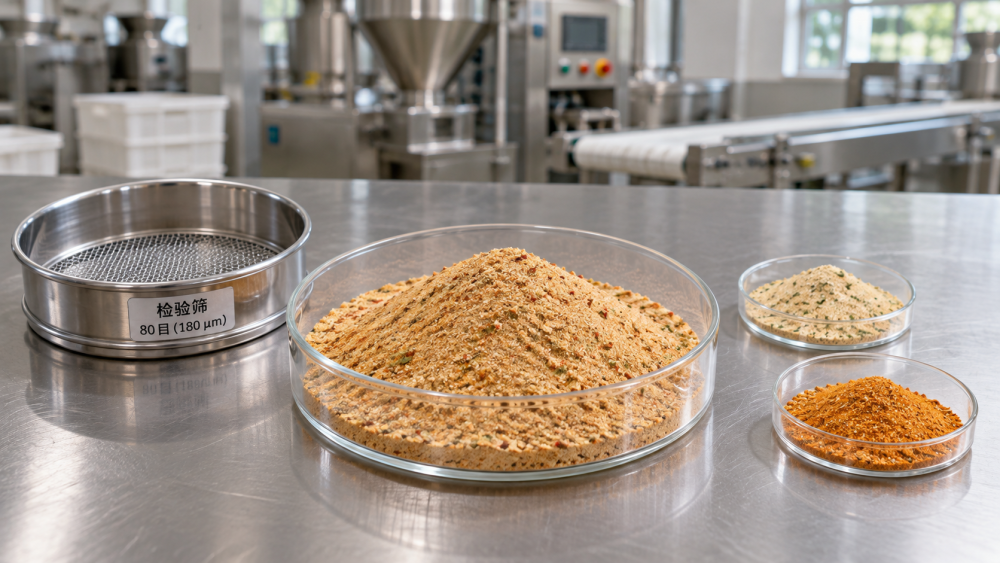
Particle size and distribution. Particle size influences appearance, mouthfeel, dust generation, mixing, and dispensing. Fine material may adhere well to a snack surface but can be dusty during handling. Coarser particles may provide a visible texture while increasing the risk of uneven distribution if components separate during transport. Specify an appropriate test method and particle-size range or distribution where these properties affect performance; a single average may conceal an unacceptable proportion of very fine or coarse material.
Flow and caking. Powder may flow freely from a fresh sample bag yet bridge in a hopper after storage or compaction. Moisture uptake, fat content, particle shape, and the proportions of different ingredients can all affect behavior. If the blend must feed through an auger or dosing system, test it in equipment representative of the actual line. Define whether small, easily broken lumps are acceptable or whether the material must pass a specified sieve before use.
Moisture and water activity. These are different measurements: moisture content describes the amount of water in a material, while water activity relates to its availability. Depending on the formulation and risk assessment, one or both may be useful controls. Agree on the test method, limits, sampling approach, and reporting basis rather than borrowing a generic value from another seasoning. A suitable limit depends on the ingredients, processing, packaging, and intended shelf life.
Appearance and solubility. Clarify whether visible color variation, specks, sediment, or undissolved particles are acceptable. Some spice components are dispersible rather than truly soluble, so a promise of “instant mixing” should be replaced with a practical test: mixing speed, liquid temperature, dosage, standing time, and the observations used for acceptance. A powder that performs well in hot water may behave differently in a cold, acidic, or oily recipe.
Make flavor consistency measurable
Sensory consistency is often the hardest requirement to express. A blend can remain within a broad ingredient specification while the perceived heat, saltiness, aroma, or color shifts enough to change the finished food. Agree on a reference sample, its storage conditions and validity, the preparation method, and who is authorized to approve changes. For blends used in a finished recipe, assess both the powder itself and the prepared product: heat, oil, and competing flavors can alter perception.
A useful sensory protocol specifies the dosage, base material, serving temperature, and attributes to compare. Buyers can record whether a lot is acceptable against the reference and note the nature of any difference. If a supplier uses laboratory measurements to support consistency, confirm which attributes those measurements represent and how results relate to sensory acceptance. An instrument result alone may not capture the overall flavor profile.
Batch-to-batch control also depends on change notification. The purchase agreement should address changes to ingredient sources, formulation, processing location, manufacturing method, or packaging that could affect the agreed characteristics. Decide which changes require advance notice, renewed documentation, or a new trial. This is especially useful when a seasoning is used in a mature recipe with little room for reformulation.
Request evidence proportionate to food-safety risk
Specifications should identify relevant hazards and controls for the ingredients and intended use. Dried herbs, spices, and compound blends can have different risk profiles depending on origin, processing, storage, and whether the finished food receives a validated treatment. Ask the supplier to explain the controls applied to the product, including any microbial reduction step where relevant, and whether the material can be recontaminated after treatment.
A certificate of analysis can support lot acceptance, but its value depends on what was tested and how the result relates to the delivered lot. Confirm the lot identification, parameters, methods, limits, and whether results are from the actual lot or another defined basis. Testing alone cannot establish that every part of a lot is free from a hazard; sampling design and preventive controls matter as well.
For technical context, the Codex Alimentarius Code of Hygienic Practice for Low-Moisture Foods (CXC 75-2015), including its annex for spices and dried aromatic herbs, addresses hygiene controls relevant to these materials. The Codex General Principles of Food Hygiene (CXC 1-1969) provides broader guidance on food hygiene and hazard controls. Buyers should check the current editions and applicable local requirements; Codex guidance is not a substitute for the laws in the market where the food is made or sold.
Allergen information needs the same precision. Request the allergens present as ingredients, relevant cross-contact risks, and the supplier’s control and labeling approach. Requirements differ by jurisdiction, so compare the declaration against the destination market and the finished product’s label. Claims such as organic, gluten-free, or suitable for a particular diet should be supported by documentation appropriate to the claim and market, not inferred from the product name.
Use a trial that reflects normal and difficult conditions
A bench sample is useful for screening, but it cannot establish how a seasoning will behave through a full production cycle. After initial approval, arrange a trial using representative packaging, dosing equipment, mixing conditions, and the actual food base. Where practical, compare more than one production lot before approving a material for routine use. Record the source and lot of every sample so that observations can be traced back to the material tested.
At the line, check whether the powder feeds at the target rate, creates dust, segregates in the hopper, or leaves residue on equipment. For a coating application, assess distribution at the beginning and end of the run as well as appearance on the finished product. For a wet application, inspect dispersion after mixing and again after a defined holding period. Include relevant heat treatment or storage in the trial when the seasoning’s flavor or appearance may change during those steps.
Agree on acceptance criteria before testing. “Suitable for use” is too broad to resolve a dispute after delivery. The criteria might include a defined sensory comparison, a workable feed-rate range, an agreed sieve result, and the absence of unacceptable hard lumps. Set tolerances around the needs of the process rather than imposing limits that add cost without improving the finished product.
Check packaging, shelf life, and delivery terms
Packaging protects more than the powder’s appearance. Ask what barrier and closure are used, whether bags have an inner liner, and how the product should be protected from humidity, heat, odors, and physical damage. The appropriate format depends on consumption rate and handling: a larger bag may reduce packaging and handling per unit, but an opened bag held near a humid production line may be exposed for longer.
Request the stated shelf life, recommended storage conditions, and the basis for any shelf-life claim. Agree on the minimum remaining life required at delivery and how it will be calculated. A long stated shelf life is less useful if transport and warehouse time leave insufficient usable life for the buyer’s production schedule. Define how partially used packs should be resealed and identified to preserve traceability.
Commercial terms should cover lot identification on each pack, documentation supplied with each shipment, lead time, minimum order quantity, and procedures for shortages or damaged packaging. If continuity depends on an alternate production site or ingredient source, determine whether that alternative has been evaluated against the same specification. A substitute should not be treated as interchangeable solely because it has the same product description.
Compare the cost of usable seasoning, not just the quoted price
Price per kilogram is only the starting point. Compare offers at the dosage needed to achieve the agreed finished-product profile, then consider freight, duties where applicable, packaging disposal, and the expected quantity that can be used before expiry. A lower-priced blend may require a higher addition rate or extra handling; a more concentrated blend may need tighter dosing control. Neither outcome should be assumed without a trial.
Before issuing a purchase order, attach or reference the approved specification and retain the sample approval, trial record, and agreed change-control terms. Establish who can place a delivery on hold, how a disputed lot will be sampled, and whether rejection, replacement, or a documented concession is possible. The strongest purchasing decision is one that connects the material’s written limits to the way it will actually be stored, dispensed, processed, and evaluated.
Want to dive deeper into these market dynamics, or need data-driven support for your next business move? Drop a line below and let the analysts at AFBN provide customized insights.
We respect your privacy. Your information is strictly confidential.
相关推荐
 Probiotics Price Guide: What Drives the Cost of Bulk Ingredients?Compare probiotics price quotes with confidence. Discover the factors driving bulk ingredient costs and calculate the true cost per usable dose.
 Health Attributes Drive Innovation in the Cereal IndustryHealth attributes are driving cereal industry innovation. Explore what this trend could mean for product claims, ingredient sourcing and buyers.
 New York Governor Vetoes Food Safety Bill, Halting Proposed Ban on Three AdditivesNew York food safety bill veto: Explore the proposed additive ban, GRAS disclosure rules and what food businesses should review next.
 China’s New Food Labeling Standard to Ban ‘Zero Addition’ ClaimsChina’s new food labeling standard will ban certain “zero addition” claims from March 16, 2027. Discover what businesses and consumers need to know.