




Search
Related News
- 00
0000-00
Selecting Plant Proteins for Meat Analogs: Texture, Flavor, and Processing Fit - 00
0000-00
How to Specify Stainless Steel Processing Machinery for Hygienic Food Lines - 00
0000-00
How Food Processors Can Improve Throughput Without Compromising Hygiene Control - 00
0000-00
Microbial Fermentation Explained: How It Produces Food Ingredients at Scale - 00
0000-00
Protected Cultivation Technology: Which Climate Control Systems Fit Your Crop?
Evaluating Breeder Farm Management System Costs Beyond Initial Equipment Price




Capital Approval Should Start With the Operating Model
A breeder-farm proposal can look affordable when the quotation is limited to cages, feeding lines, drinkers, controllers, ventilation hardware, and installation. That figure is important, but it is not the cost that finance ultimately approves. The more useful question is whether the planned system can produce reliable flock-management conditions at a predictable lifetime cost.
Breeder operations are especially sensitive to uneven feeding, poor body-weight control, inconsistent egg collection, water-line failures, and ventilation instability. A small weakness in one subsystem can create recurring labour, maintenance, fertility, hatchability, biosecurity, or animal-welfare costs. Some of these effects may emerge only after commissioning, when the equipment package has already been capitalised and the farm is committed to its layout.
For a financial approver, the initial equipment price should be treated as one line in a broader ownership model. The objective is not to select the lowest-cost package or the most automated package by default. It is to compare alternatives on the basis of required output, operating risk, asset life, serviceability, installation exposure, and the cost of correcting a poor design after birds are placed.
Why Breeder-Farm Costs Behave Differently From Simple Equipment Purchases
A poultry house is an operating environment rather than a collection of independent machines. Feed distribution affects flock uniformity; water pressure and line height affect access; stocking density influences movement and inspection; manure handling affects air quality and maintenance workload; ventilation performance depends on building tightness, fan selection, inlet design, and control logic. The commercial effect comes from how these elements work together.
This makes a breeder project difficult to evaluate through unit prices alone. A low-priced feeder may have a reasonable materials specification but require more frequent adjustment. A less expensive controller may operate fans and lights adequately but offer limited alarm history, sensor validation, or data export. A low initial bid for cage equipment may exclude transition pieces, drainage changes, electrical distribution, lifting equipment, staff training, spare parts, or commissioning support.
Finance teams should ask for a scope map before comparing quotations. The map should show which party supplies, installs, tests, connects, trains, certifies, and maintains each major item. If an item is outside the supplier’s scope, it should still appear in the financial model as a client-side cost, contingency, or clearly assigned interface.
Build a Total Cost of Ownership View
Total cost of ownership does not require a speculative forecast. It requires the buyer to identify the cost categories that will continue after purchase order approval. A practical model can separate one-time expenditure from recurring operational exposure.
The model should also distinguish between costs that are predictable and costs that are highly variable. Electricity, consumables, planned servicing, and basic spare parts can often be estimated from operating assumptions. Losses caused by equipment downtime, poor environmental control, or delayed repair are harder to quantify, but they should not be ignored merely because they are uncertain. They can be evaluated through scenario analysis: normal operation, a likely disruption, and a severe but plausible failure.
Estimate the Cost of Operating Reliability
Reliability is often discussed as a technical preference, yet it has a direct financial value. A system that remains usable during fluctuating voltage, dusty conditions, high humidity, corrosive manure gases, or intermittent water quality may reduce the frequency of interventions. The relevant assessment is not whether a component can run in a demonstration setting, but whether it can be inspected and maintained under the farm’s actual conditions.
For example, finance reviewers can request details on motor protection, galvanisation or corrosion protection, sensor locations, cable routing, chain or auger access, emergency opening arrangements, and the availability of manual overrides. A quotation that describes a component only by name—such as “fan,” “controller,” or “feeding system”—does not provide enough information for a durable asset decision.
The requested evidence should match the risk. For electrical control panels, buyers can ask for wiring diagrams, component lists, enclosure ratings where applicable, test records, and clear responsibility for local electrical compliance. For structural equipment, drawings should identify load assumptions and fixing points. For water systems, ask how line flushing, filtration, pressure regulation, medication compatibility, and winter protection will be handled. The right answer may differ by climate, water source, building type, and operating practices.
International guidance supports treating biosecurity and animal management as operational design issues rather than paperwork. The World Organisation for Animal Health (WOAH) Terrestrial Animal Health Code includes biosecurity principles for poultry production, including controlled access, cleaning and disinfection, and management of disease risks. The Food and Agriculture Organization of the United Nations (FAO) has also published practical guidance on poultry biosecurity for production systems. These references do not prescribe one equipment layout, but they reinforce the need to evaluate cleaning access, separation of dirty and clean routes, dead-bird handling, and traffic patterns during design.
Automation Can Shift Costs Rather Than Remove Them
Automation can reduce repetitive work, improve response times, and create more consistent records when it is properly specified and used. It can also shift cost into controls, sensors, maintenance skills, software support, spare parts, and backup arrangements. A financial approval should test whether the farm has the operating discipline to capture the expected value.
Consider an environmental controller. Its purchase price is only part of the investment. The farm may also need correctly located sensors, calibration procedures, alarm escalation rules, generator integration, staff able to interpret alarms, and a documented response process. If alarms are routinely muted or there is no person responsible outside working hours, the controller’s theoretical capability has limited financial protection value.
The same applies to egg collection and feed distribution. Faster movement of eggs or feed does not automatically improve results if transfer points create breakage, contamination, bridging, or difficult cleaning zones. A buyer should ask suppliers to identify normal operating capacity, design assumptions, expected inspection points, and actions required when a line stops. The objective is to expose the human tasks that remain after automation.
Compare Alternatives by Cost Drivers, Not by Feature Count
When two proposals have different capital prices, a feature-by-feature comparison often produces misleading conclusions. A more useful approach is to compare the drivers that create lifetime cost. These may include corrosion exposure, number of moving parts, accessibility of service points, dependence on proprietary controls, availability of standard consumables, ease of sanitation, and the number of interfaces between contractors.
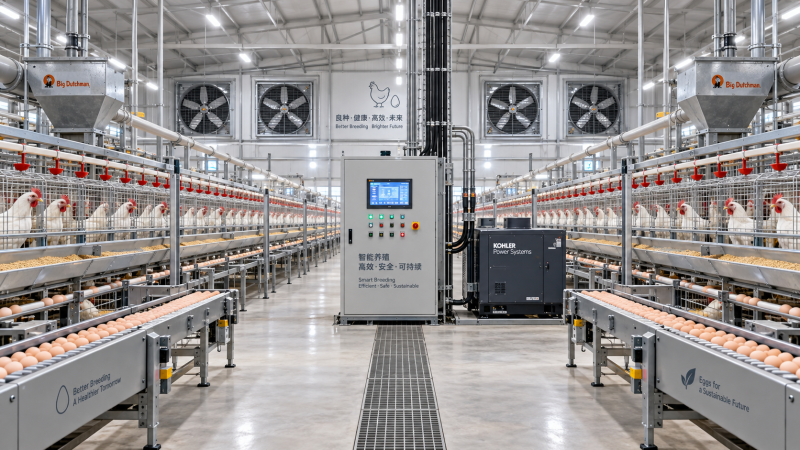
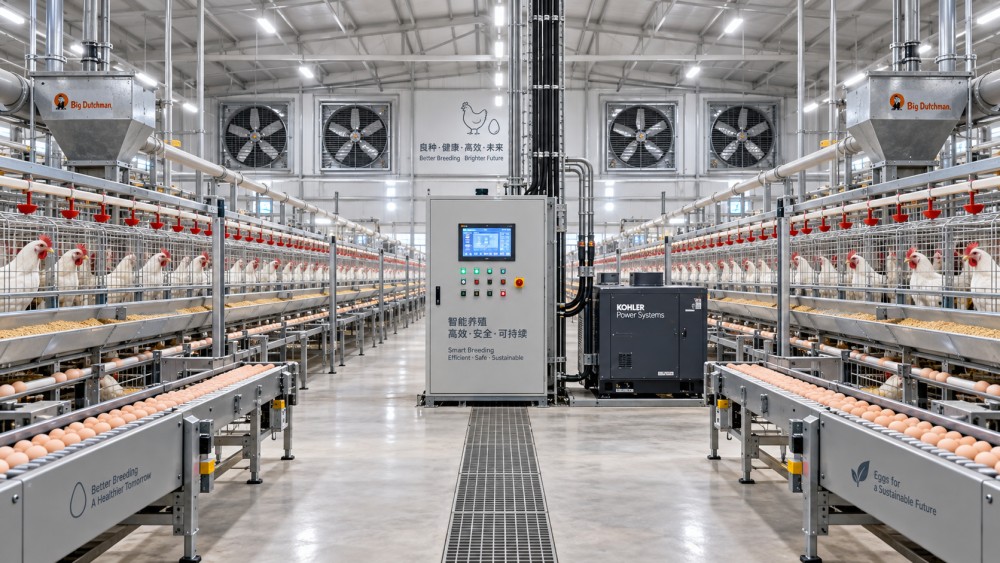
A breeder farm management system should be evaluated as a coordinated operating platform: housing equipment, feeding and watering arrangements, environmental controls, egg handling, monitoring, and the working routines around them. For a related example of how cages and harvesting equipment may be combined within a large poultry installation, buyers can review this breeder farm management system project reference. It should be read as an equipment-layout reference rather than evidence that one configuration fits every breeder operation; breeder requirements, house design, flock programme, and local regulations must still be assessed separately.
Decision makers should be cautious when the lowest bid relies on assumptions that have not been documented. Typical examples include “existing power is sufficient,” “the building will be ready,” “local labour can install,” or “replacement parts are readily available.” Each may be true, but each needs confirmation before the budget is locked. The cost difference between bids sometimes reflects different assumptions rather than a genuine difference in supplier efficiency.
Use Procurement Documents to Prevent Post-Award Cost Drift
The strongest cost control often happens before the order is placed. Procurement documents should define more than quantities and dimensions. They should state the required operating conditions, inspection rights, documentation package, acceptance process, exclusion list, delivery responsibilities, warranty boundaries, and change-control procedure.
For complex installations, acceptance should be divided into stages. Factory inspection may verify supplied components and configuration before shipment. Site acceptance can verify installation quality, electrical safety, mechanical movement, water tightness, control response, alarm functionality, and training completion. Operational acceptance should be tied to agreed performance checks that are realistic for the stage of commissioning. It is unreasonable to demand biological outcomes that depend on flock management, but it is reasonable to test whether equipment performs as specified.
Asset-management principles can help structure this process. ISO 55000 describes asset management as coordinated activity to realise value from assets, while ISO 55001 sets requirements for an asset management system. These standards are not poultry equipment specifications, but their lifecycle perspective is relevant: an asset should be judged by value, risk, performance, and planned support over time, not purchase price alone.
Questions a Financial Approver Should Resolve Before Release
- What operating assumptions support the budget, and who has validated them?
- Which costs are included in the supplier quotation, and which are allocated to the farm, builder, electrician, or third-party contractor?
- What failure modes would stop feeding, watering, ventilation, lighting, or egg movement, and what backup is planned?
- Which parts require routine replacement, what is their lead time, and what inventory will be held on site?
- Can personnel safely inspect, clean, adjust, and repair the equipment without creating avoidable downtime?
- What records prove that installation, commissioning, training, and acceptance have been completed?
- How does the design support the farm’s biosecurity procedures and local regulatory obligations?
A disciplined approval does not eliminate uncertainty. It makes uncertainty visible, assigns ownership, and prevents an attractive equipment price from concealing avoidable operating commitments. The best financial case is usually the one that clearly explains its installation interfaces, maintenance needs, failure response, and expected service life under the conditions the farm will actually face.
Sources
World Organisation for Animal Health (WOAH), Terrestrial Animal Health Code, chapter on biosecurity procedures in poultry production.
Food and Agriculture Organization of the United Nations (FAO), poultry biosecurity guidance and production manuals.
International Organization for Standardization, ISO 55000:2024 Asset management — Vocabulary, overview and principles; ISO 55001:2024 Asset management — Asset management system — Requirements.