




Search
Related News
- 00
0000-00
How to Specify Stainless Steel Processing Machinery for Hygienic Food Lines - 00
0000-00
How Food Processors Can Improve Throughput Without Compromising Hygiene Control - 00
0000-00
Microbial Fermentation Explained: How It Produces Food Ingredients at Scale - 00
0000-00
Protected Cultivation Technology: Which Climate Control Systems Fit Your Crop? - 00
0000-00
Sizing Livestock Ventilation Systems for Heat, Humidity, and Ammonia Control
Tags
Evaluating Feeding and Drinking Layouts in Broiler Cage Design




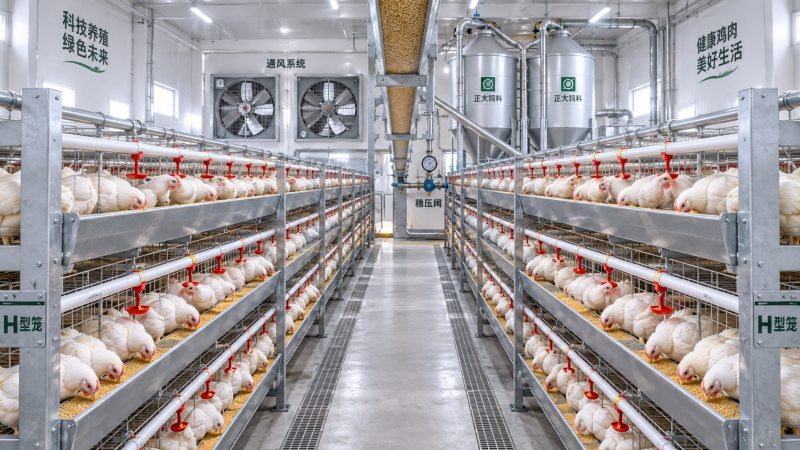
Feeding and drinking layouts can determine whether a broiler housing project operates as a controlled production system or becomes a daily source of uneven growth, wet litter, labour-intensive corrections, and difficult troubleshooting. In multi-tier cage installations, these systems are not secondary accessories. Their position, capacity, drainage, access, and relationship with ventilation influence bird welfare, flock uniformity, manure handling, and the practical workload of the farm team.
For project managers, the challenge is rarely choosing between “automatic” and “manual” equipment. The more consequential question is whether the feeding and drinking arrangement remains reliable under the farm’s actual conditions: the planned stocking density, bird weight profile, water quality, building length, power reliability, climate, maintenance capability, and cleaning procedures. A layout that looks efficient in a supplier drawing may perform poorly if it creates unreachable drinkers, feed segregation, pressure variation, persistent leaks, or conflict with airflow routes.
A sound evaluation starts with the bird’s access to feed and water, then works outward to utility connections, structural interfaces, drainage, inspection access, and contingency planning. This sequence helps prevent a common procurement error: approving cage rows and tier counts before confirming that feeding and drinking systems can be serviced and monitored safely after installation.
Start with access, not equipment labels
Birds do not experience a rearing system as a collection of individual machines. They experience the available feeder edge, the height and reach of drinkers, the stability of water supply, the distribution of feed along each line, and the competition created when access is restricted. Where access varies by position, differences in crop fill, liveweight, litter moisture, and bird activity can appear within the same house.
In an H-frame or battery arrangement, the physical distance from feed and water to each cage position deserves close review. The design team should verify access at the beginning of placement, during rapid growth, and near market weight. A feeder configuration that is reachable by smaller chicks may sit too low or too high later in the cycle. Similarly, a nipple line that works in an empty cage may be difficult to reach once bird body size, cage floor slope, and movement patterns are considered.
Rather than relying only on a general capacity statement, procurement documents should ask the supplier to show:
- the usable feeder space or feeding access per cage compartment;
- the number and location of drinker points available to birds in each compartment;
- how feed is distributed from the main hopper to the far end of every line;
- how drinker height is adjusted during the flock cycle;
- the expected operating pressure range and the method used to verify it;
- how a worker can observe feed flow, leaks, blockages, and bird access without entering unsafe positions.
The World Organisation for Animal Health states that broiler production systems should provide feed and water in sufficient quantity and quality, while feeding and watering equipment should be designed, constructed, and placed to minimise contamination and competition. It also calls for daily inspection of birds and equipment. These principles are useful as design-review criteria even where local regulation uses different wording. Source: WOAH, Terrestrial Animal Health Code, Chapter 7.10, “Animal Welfare and Broiler Chicken Production Systems.”
Feeding layout: distribution consistency matters as much as storage capacity
Automatic feed delivery can reduce routine handling, but it introduces a distribution problem. Feed must leave the storage and conveying system at a rate that does not create substantial differences between the first and last cage sections. In long houses, a project team should examine whether the feed line fills progressively, whether feed returns or recirculates where applicable, and how the system behaves after a temporary stop or power interruption.
Feed bridging, uneven fill levels, worn drive components, and inappropriate feed particle characteristics may all change what birds receive at different points in the house. These are operating risks rather than merely maintenance issues. If feed reaches one section later than another, bird behaviour can become concentrated around the feeder, and the resulting competition may be mistaken for a flock-health problem.
Feeder trough geometry also needs to match the intended bird size and cage configuration. Guards or covers can reduce feed loss, but they should not obstruct head movement or make feed depth difficult to inspect. Deep troughs may conceal fines or stale material; very shallow feed presentation may leave birds with inconsistent access when distribution is not even. The design review should include an inspection method for the whole line, not only the drive end.
Projects that plan multiple houses should pay particular attention to repeatability. A feed circuit that depends on frequent manual adjustment may be manageable in one building but difficult to control across several buildings, shifts, or farm locations. Standardising motors, sensors, line components, and spare parts can simplify commissioning and reduce the chance that operators make different corrections from house to house.
Drinking layout: manage pressure, leakage, and water quality together
Water is often the fastest route by which a layout problem becomes visible. In cage systems, a leaking nipple or incorrect pressure setting can create wet areas beneath the cage line, raise ammonia-management demands, affect manure consistency, and increase cleaning work. Yet reducing pressure indiscriminately is not a solution if it limits water delivery at peak demand. The correct setting depends on the drinker type, line elevation, regulator position, bird age, water temperature, and house geometry.
For this reason, pressure regulation should be assessed as a network, not as a single component. A project manager should determine where water enters the house, whether pressure can be checked at representative points along the line, how flush water is discharged, and whether line ends are accessible. Pressure conditions can differ between the inlet and the far end of a long run, especially when elevation changes, filters become loaded, or regulators are incorrectly set.
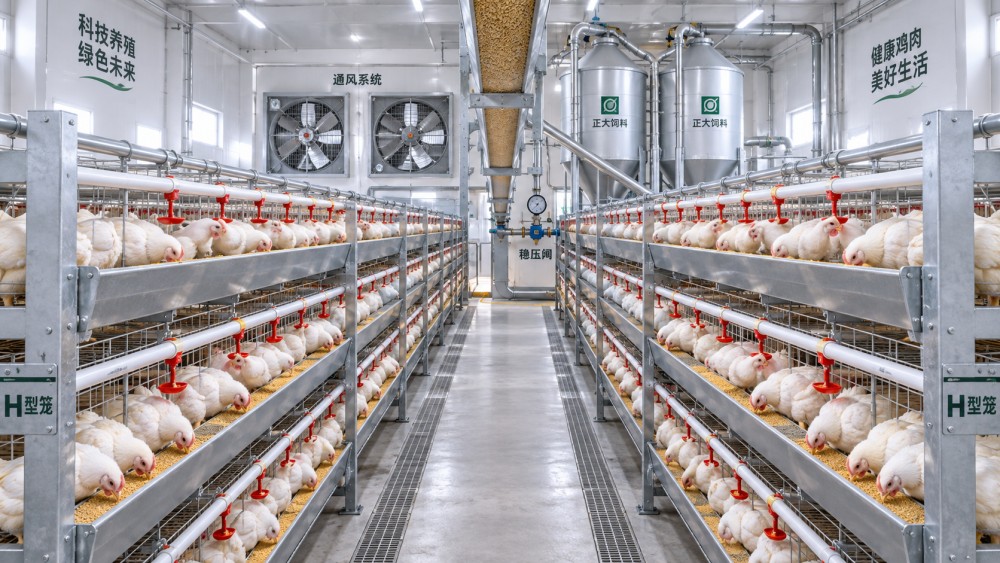
Water treatment equipment should also be evaluated in relation to the line design. Filters, dosing systems, pressure regulators, and meters need sufficient bypass and isolation arrangements for servicing. If cleaning or sanitation requires a chemical treatment, the compatibility of nipples, seals, regulators, and pipe materials should be confirmed with the equipment manufacturer. A dosing arrangement that cannot be rinsed thoroughly may leave residues or make troubleshooting harder in subsequent cycles.
The Aviagen Broiler Management Handbook advises monitoring water consumption and checking drinking systems routinely, including height, pressure, and functionality. It also describes water intake as a useful management indicator when interpreted alongside feed intake, temperature, and bird condition. A meter is therefore more valuable when its readings can be recorded by house or zone and investigated promptly, rather than treated as a billing device alone. Source: Aviagen, Broiler Management Handbook, 2022.
Evaluate the feeding and drinking systems as part of the housing envelope
Feed and water layouts cannot be reviewed in isolation from ventilation. Water leaks and inadequate manure drying create moisture loads that the ventilation system must remove. At the same time, air speed, temperature gradients, and dust movement can influence bird distribution within a cage row. If birds avoid a warmer or colder section, apparent feeder or drinker underuse may be caused by the house environment rather than by the equipment itself.
This is where a broader broiler cage design review becomes useful: cage tiers, feed lines, water lines, manure belts, air inlets, fans, lighting, and maintenance aisles need to be checked as connected systems. For example, a water line placed where it obstructs manure-belt inspection may delay leak detection. A feeder drive placed in a narrow service area may be technically accessible on drawings but unsafe to repair during operation.
Ventilation planning should account for the moisture and heat generated by the flock as well as the practical consequences of water-system faults. The U.S. National Chicken Council’s welfare guidance identifies ventilation, litter condition, water availability, and equipment operation as routine areas of flock management. The exact legal and welfare requirements vary by jurisdiction, but the operational lesson is consistent: systems must be inspectable and kept in working order throughout the growing period. Source: National Chicken Council, National Chicken Council Animal Welfare Guidelines and Audit Checklist for Broilers, 2024.
Questions that expose layout conflicts before installation
Translate the layout into measurable acceptance criteria
Many equipment specifications describe materials and nominal dimensions but say little about commissioning. For a project team, acceptance should include functional checks conducted after assembly and before the first flock is placed. The goal is not simply to prove that motors turn and water reaches the house. It is to establish that the installed system performs consistently across the full length and height of the cage arrangement.
A practical commissioning plan may include dry-running feed circuits, checking feed arrival at representative locations, confirming that each nipple or drinking point operates as intended, inspecting line pressure at multiple points, and testing flushing and drainage. Teams should also simulate likely operating events, such as a feed interruption, a water-line isolation, a controller alarm, or a power-transfer sequence. The results should be recorded with the installed configuration, not copied from a factory test report.
Documentation matters because operating settings change. The handover package should identify line routes, valve locations, electrical isolation points, recommended lubricants where relevant, compatible cleaning agents, spare-part references, and adjustment ranges. It should also separate supplier recommendations from farm-specific settings established during commissioning. Without this distinction, later operators may treat a provisional setting as a fixed design requirement.
Cost comparisons should include operational recovery time
Capital cost remains an important selection criterion, but two layouts with similar purchase prices can produce very different recovery costs after a fault. Consider how long it takes to isolate a leaking water section, locate a blocked feeder, clean a contaminated trough, restore a failed drive, or confirm that every cage tier has resumed normal service. These tasks depend on accessibility, segmentation, visibility, and the availability of standard replacement parts.
A lower-complexity layout may be preferable where technical support is limited and operators need rapid manual control. A more automated arrangement may be justified when the project has reliable power, trained maintenance personnel, documented preventive-maintenance routines, and the scale to benefit from centralised monitoring. Neither option is inherently superior; the fit depends on the site’s ability to maintain the design at its intended operating condition.
The strongest selection decisions treat feeding and drinking as service systems embedded in the building, rather than items checked only after cage capacity has been decided. Review bird access at each growth stage, test distribution and pressure across the full house, protect inspection routes, and define recovery procedures before handover. Those checks make it easier to distinguish an impressive equipment layout from one that can be operated reliably through repeated production cycles.