



Search
Related News
- 00
0000-00
Probiotics Price Guide: What Drives the Cost of Bulk Ingredients? - 00
0000-00
Georgia’s Tomato Import Value Reaches Record for January–October 2026 - 00
0000-00
Health Attributes Drive Innovation in the Cereal Industry - 00
0000-00
French Tomato Output Forecast to Fall in 2026 as Prices Remain High - 00
0000-00
Choosing Food Packaging Lines: Capacity, Product Type and Automation
Evaluating Broiler Cage Layouts for Feeder and Drinker Access




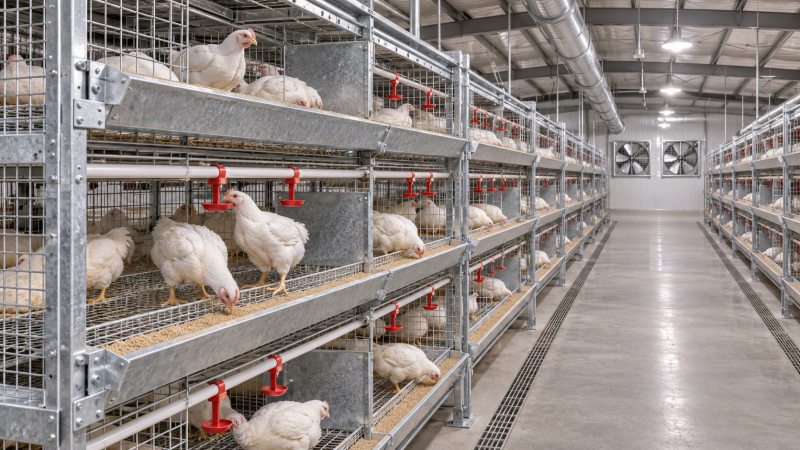
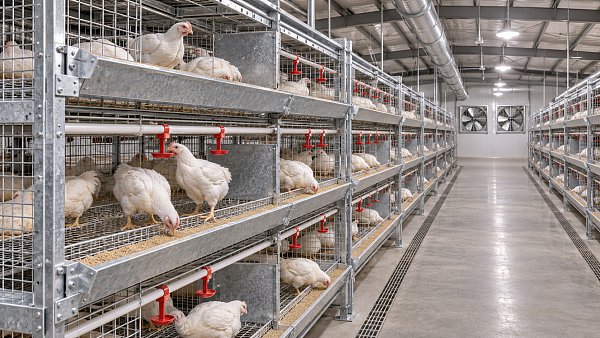
A broiler cage can provide the specified floor area and still leave birds competing for feed or water. Troughs may be interrupted by partitions, drinkers may sit beyond the reach of small chicks, or equipment that works in an empty cage may become difficult to access as birds grow. For buyers, the useful question is not simply how many birds a cage can hold, but how reliably those birds can reach feed and water throughout the flock cycle.
That judgment depends on cage dimensions, equipment placement, bird size and the conditions inside the house. A sound procurement comparison should connect the proposed stocking plan with usable feeder and drinker access, ventilation, inspection routes and maintenance requirements. Specifications that present these items separately can conceal conflicts that only become obvious after installation.
Start with the operating plan, not the cage capacity claim
Ask suppliers to prepare layouts against the same operating assumptions: bird type, expected placement numbers, target live weight, flock duration and the house dimensions available for equipment. State whether the system will accommodate chicks from placement or whether birds will be transferred into it later. Access needs change substantially as birds grow, so a layout assessed only for the final production stage may not be suitable for the first days of the cycle.
Capacity figures should identify what they include. Gross cage footprint, usable floor area and the area obstructed by equipment are not interchangeable. Dividers, structural members and feeder supports can reduce the space birds can actually occupy or move through. Request a drawing that shows internal dimensions and obstructions rather than relying on an overall bank length.
Stocking decisions must also reflect applicable local welfare requirements and the buyer’s own production standards. The World Organisation for Animal Health’s Terrestrial Animal Health Code, chapter 7.10, “Animal Welfare and Broiler Chicken Production Systems,” discusses space allowance, access to feed and water, ventilation and inspection. It is a useful international reference, but buyers still need to establish which rules apply at the installation site.
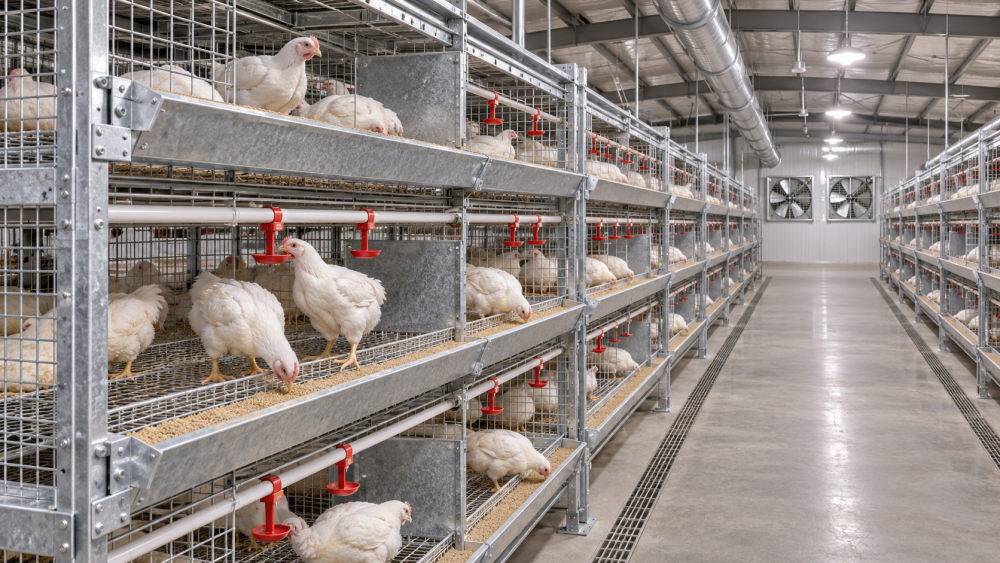
Assess usable feeder access along the entire cage
A feeder line running the length of a cage bank does not guarantee continuous feeding space. End plates, cage posts, corners and transitions between sections can prevent birds from reaching parts of a trough. Request the effective accessible length for each cage compartment, together with a drawing showing where that measurement starts and ends. If a supplier quotes feeder space per bird, check whether the calculation uses gross trough length or length actually available to birds.
Feeder height and reach matter as much as length. Young chicks must be able to find and access feed without climbing awkwardly, while larger birds need enough clearance to feed without excessive crowding or spillage. An adjustable system can help accommodate different ages, but the buyer should verify its adjustment range, locking method and access for staff. A mechanism that is difficult to adjust across multiple tiers may not be used consistently.
Compare feed distribution at the beginning and end of each line. The equipment schedule should identify how feed is delivered, where drive units and transitions sit, and how the operator can check for bridging, blockages or uneven distribution. Ask what happens after a power interruption and how feed remaining in the line is cleared during cleaning or maintenance. The relevant issue is not a promised output figure alone, but whether feed can reach every compartment under the intended operating conditions.
Wastage deserves a separate review. A trough lip that restricts birds’ reach may reduce access; one that allows excessive feed to be flicked out may increase losses and leave material beneath the cages. The balance depends on bird age, feed form and feeder geometry. A sample section or dimensioned cross-section is more useful than a catalogue photograph when evaluating that trade-off.
Check drinker reach, distribution and water supply
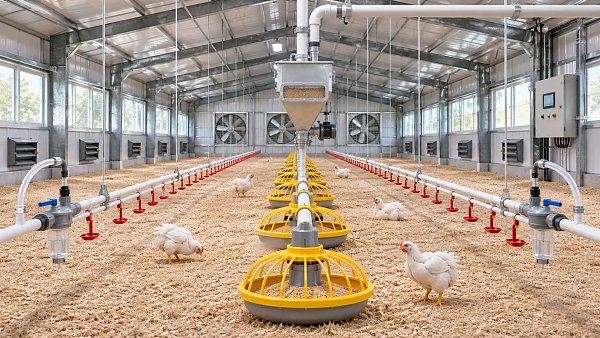
For nipple drinkers, ask suppliers to show the number and position of drinking points in every compartment, including end compartments and areas next to partitions. A total count for the house can hide uneven distribution. Birds should be able to approach a drinker without a structural member or another piece of equipment obstructing them; the buyer should also examine whether crowding around a small number of points is likely at the planned bird numbers.
Height and pressure settings require particular attention during brooding and as birds grow. A drinker that is reachable by a mature bird may be too high for a chick, while an unsuitable water flow can make access difficult or create leakage. Specify who will establish the settings, how they will be adjusted, and what checks operators should perform along the line. The applicable breeding company’s current management guide can provide bird-specific recommendations; the equipment supplier should explain how its proposed system supports them.
Water quality and supply infrastructure belong in the procurement discussion. Filtration, pressure regulation, flushing arrangements and the availability of replacement drinker components can affect operation. A buyer comparing quotations should identify whether those items are included, excluded or assumed to be provided by another contractor. Without a clear interface, the cage supplier and plumbing installer may each expect the other to supply a necessary component.
Wet areas beneath drinking lines can have several causes, including leaks, unsuitable settings or cleaning practices. They should not automatically be attributed to the drinker model. Ask how the design permits staff to locate a leaking point, isolate a section and replace a component without disrupting an unnecessarily large part of the house.
Compare cage arrangements against ventilation and inspection needs
Adding tiers or narrowing service aisles may increase the number of cages that fit in a building, but it also changes how easily workers can observe birds and reach equipment. A dense arrangement can complicate airflow distribution, cleaning and emergency access. The ventilation design should therefore be reviewed with the cage layout rather than treated as a separate purchase made after cage capacity has been fixed.
Request drawings that show air inlets, fans, cage banks, tiers, manure-handling equipment and access aisles together. The ventilation contractor should use the proposed stocking plan and house conditions in its design, while the cage supplier should identify any obstructions or clearances its equipment requires. A nominal fan capacity, without consideration of airflow paths and operating resistance, is not enough to establish that all parts of the house will receive suitable conditions.
Inspection access has a direct bearing on feeder and drinker performance. Staff need to see whether feed is present, detect leaks and observe birds on upper and lower tiers. Check sightlines from normal working positions, the equipment needed to reach high components, and whether doors or panels can open fully in the available aisle. Include the space needed to remove a damaged section, not just the space needed to walk past it.
In discussions of Taiyu(HK) poultry farm equipment, cage space requirements provide a useful starting point for connecting bird allocation with the surrounding house plan. The same review should extend to the practical details of feeder reach, drinking-point positions and access for inspection; floor area alone does not resolve those questions.
Make competing quotations comparable
A low equipment price may reflect a genuinely simpler layout, but it can also omit parts or services that another quotation includes. Use a common schedule and ask each bidder to identify deviations. The following comparisons help reveal differences before commercial negotiations are complete:
- Cage geometry: internal usable dimensions, compartment boundaries, tier arrangement and identified obstructions.
- Feeding: accessible trough length by compartment, adjustment arrangements, feed delivery components and cleaning access.
- Drinking: drinking-point locations, height adjustment, pressure control, filtration, flushing provisions and connection points.
- House interfaces: required aisle clearances, ventilation coordination, electrical loads, water connections and structural support requirements.
- Supply scope: installation, commissioning, operator instruction, spare parts, delivery terms and responsibilities for unloading.
Ask for material specifications and corrosion-protection details for components exposed to water, manure and cleaning agents. The comparison should cover fasteners, drinker lines and feeder supports as well as the main cage structure. Buyers should establish which cleaning chemicals and methods are compatible with the supplied materials, and obtain written guidance where compatibility is uncertain.
Replacement parts can be a meaningful ownership cost even when the original equipment price is attractive. Identify components likely to require routine replacement, their ordering references and expected supply arrangements. For imported systems, clarify who holds stock, what documentation accompanies parts and how substitutions are approved. Avoid treating a supplier’s estimated service life as a guarantee unless the operating assumptions and warranty terms are explicit.
Verify the layout before acceptance
Before manufacture or shipment, review the final approved drawing against the purchase specification. Check compartment counts, equipment positions and interfaces with the actual building. Changes to cage length, door placement or tier height can affect feeder access and servicing even if the total number of birds remains unchanged.
At installation, inspect a representative sample across the house, including end sections and upper tiers. Confirm that feeders and drinkers are installed at the specified positions, adjustments can be made without interference, and lines can be cleaned and isolated as documented. Run the feed and water systems under commissioning conditions agreed in the contract; record any leaks, blockages or uneven delivery for correction. Commissioning does not replace observation under normal flock conditions, so the handover should also define how early operational problems are reported and resolved.
The strongest purchasing decision is the layout whose access provisions can be explained, measured and maintained for the intended flock and building. If a bidder cannot show how birds reach feed and water in each compartment, a favourable capacity figure is not enough to establish that the system is suitable.
Want to dive deeper into these market dynamics, or need data-driven support for your next business move? Drop a line below and let the analysts at AFBN provide customized insights.
We respect your privacy. Your information is strictly confidential.
相关推荐
 Evaluating Broiler Cage Layouts for Feeder and Drinker AccessExplore Taiyu(HK) poultry farm equipment and learn how to compare broiler cage layouts for reliable feeder and drinker access throughout the flock cycle.
 Choosing Dairy Farm Systems: Milking, Feeding, and Herd ManagementCompare dairy farm systems for milking, feeding, and herd management. Discover how to assess costs, integration, labor, and reliability before you invest.
 Commercial Poultry Equipment Suppliers: An Evaluation FrameworkCompare commercial poultry equipment suppliers with a practical framework for evaluating system fit, complete costs, delivery and support. Make a confident buying decision.
 Semi-Automatic H-Type Layer Cages: Assessing Daily Labor NeedsH type layer cage system labor needs vary by equipment and layout. Learn how to estimate daily staffing, compare costs and plan with confidence.